
A summertime walk through woods and meadows is almost always good — birds are singing, flowers are blooming, and there’s always nice fresh air. But sometimes all the little pleasures form a base on which rest some observations of particular interest. Here are a few good ones from a recent trip to Gustavus.
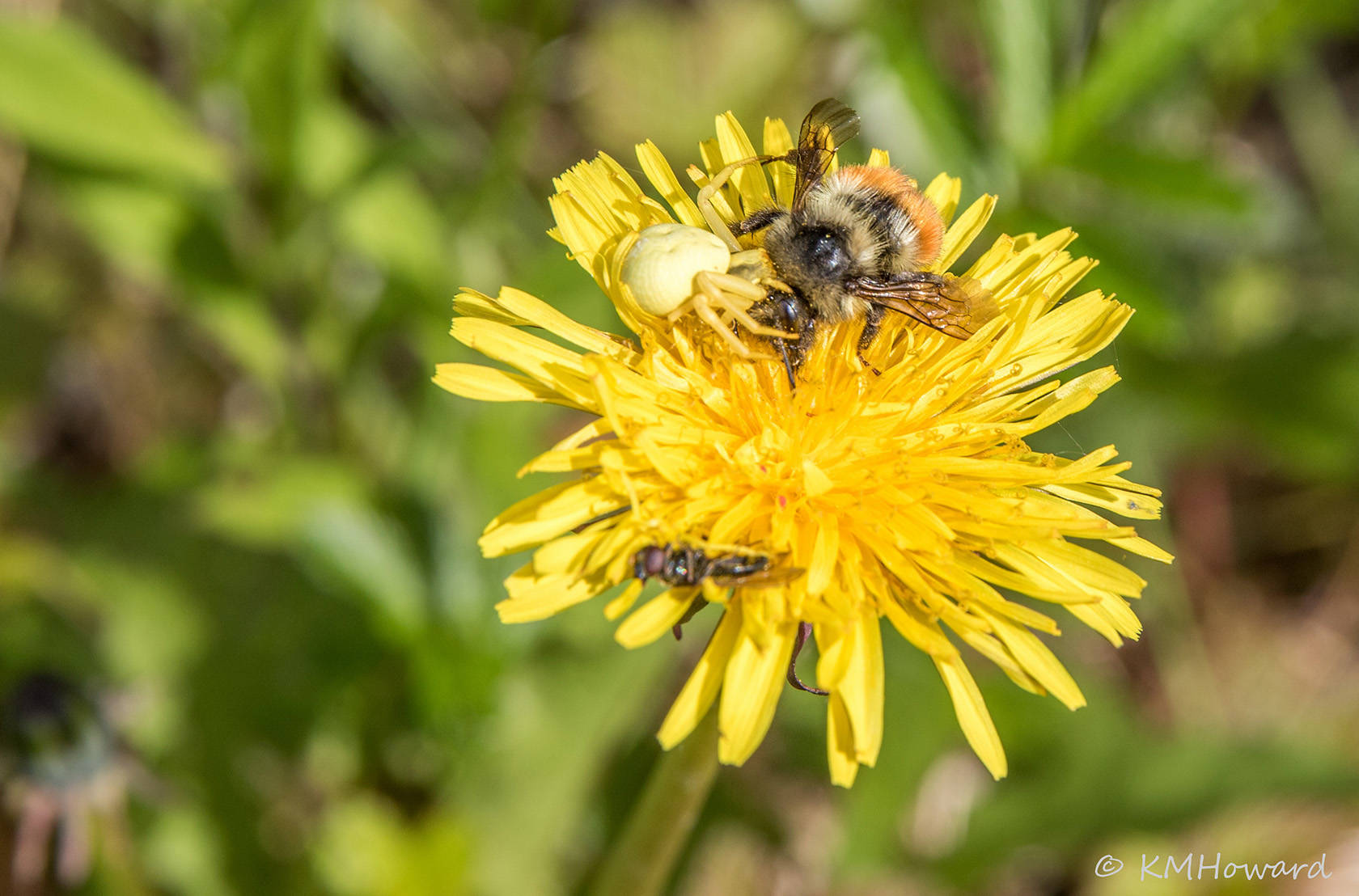
• Dandelions had mostly gone to seed, so fields that had been golden with flowers were now white with plumes on mature seeds ready to disperse on the wind. But here and there we found a laggard flower, still yellow and conspicuous on the background of white. On one of these late bloomers there was a bumblebee, a strangely immobile bee. Looking more closely, we saw a yellow crab spider with the bee in its clutches. Crab spiders are venomous (to insects), immobilizing their prey and then sucking out the juices. Dinner was in progress and the bee would fly no more. Crab spiders are generally ambush-predators; some of them lurk on flowers in hopes that a tasty insect will alight. The color of the spider often matches the color of the flower on which it awaits a victim.
• The ponds at the gravel pits are a great place to see shorebirds, swallows, and kingfishers. There were sticklebacks swimming around and, in June, there were gravid females full of eggs. One pond held many thousands of toad tadpoles, swarming in the shallows where the water temperature was salubrious. They came in a variety of sizes — some at least six times bigger than the smallest. A female toad can lay thousands of eggs; the hordes of tadpoles that we saw undoubtedly had many mothers, which probably laid their eggs at somewhat different times, accounting for the size variation. None of them had begun to transform into toadlets; no little legs were visible. A dense pack of tadpoles clustered around a silvery object, each one trying to grab a mouthful. Looking closely, we discovered that the silvery object was a dead stickleback. Toad tadpoles commonly feed on algae and detritus, but they are also known to scavenge carrion and even the dead bodies of their comrades. Toad (and frog) populations have declined dramatically almost everywhere, and it was heartening to see this large aggregation of juveniles.
• Gustavus is noted for (among other things) its wide sandy beaches. On our way out to one of them, we heard some odd sounds, rather like the hooting of a small owl. As we listened carefully, however, it became apparent that several snipes were performing their aerial territorial display. It’s called “winnowing,” and it’s made by the rapid passage of air over the spread-out tail feathers, usually as the bird dives toward the ground from high in the air. Usually the male does this but sometimes females do too. I hadn’t heard this display for a long time and it was a gladsome sound.
• Out on the sandy beaches we found windrows of long, flexible tubes that were the former housing of certain marine worms. The worms were long gone, possibly starved at the end of winter when food is scarce. Then the tides presumably stripped the empty tubes from their attachment points and piled them up on the beach. This observation stimulated a lot of conjecture but no concrete answers.
• On the vegetated sand dunes there were lots of the strange little ferns called moonworts (aka grape ferns). They don’t look at all like ferns to the layman’s eyes, because the fronds are generally not very lacy or branched. We found many that appeared to be the common moonwort, but there were also a few much more robust individuals that were certainly a different species. On one of the postglacial-uplift meadows we found another kind, one that is now classified in a different genus; the fronds on this one (so-called rattlesnake fern) are somewhat more “fern-y.” All three of these are widespread species in North America and even beyond, but they are so odd that it is always fun to find them.
• The pilings of the public dock usually offer something even to a casual observer. Enormous white anemones, far larger than any we usually see in the rocky intertidal zone, wave their tentacles if the tide is in. Sea stars cling to the vertical surfaces too, but the largest ones have trouble hanging on when the tide goes out and leaves them above the waterline. Colorful sponges and tunicates add to the array. Sometimes there’s a giant whelk laying a coil of egg cases. Small fish sometimes gather under the docks and are visible between the pilings. And while one inspects the fauna on the dock, barn swallows are swooping overhead, gathering flies and mosquitoes for their chicks.
• We searched for lady’s slipper orchids (of which more, later). One clump of flowering stems still included a stalk with last year’s seed capsule, well dried. Someone opened the capsule to see if any seeds were left and found, instead, a tiny spider guarding her minute ball of orange eggs. We were sorry to have destroyed her safe-house!
• Sweetgrass grows in many Gustavian meadows and some of us stopped to braid some stems. Braided sweetgrass is used, especially by Native Americans, to construct baskets and decorative items, and we had to try just a simple braid. As we concentrated on our task, we heard thundering hoofbeats, getting rapidly closer. Turning around, we saw a fast-trotting female moose, followed by a young calf. They were so intent on getting away from whatever startled them that they ignored us and passed by, barely 30 feet away, and off they went, full tilt.
• Mary F. Willson is a retired professor of ecology.
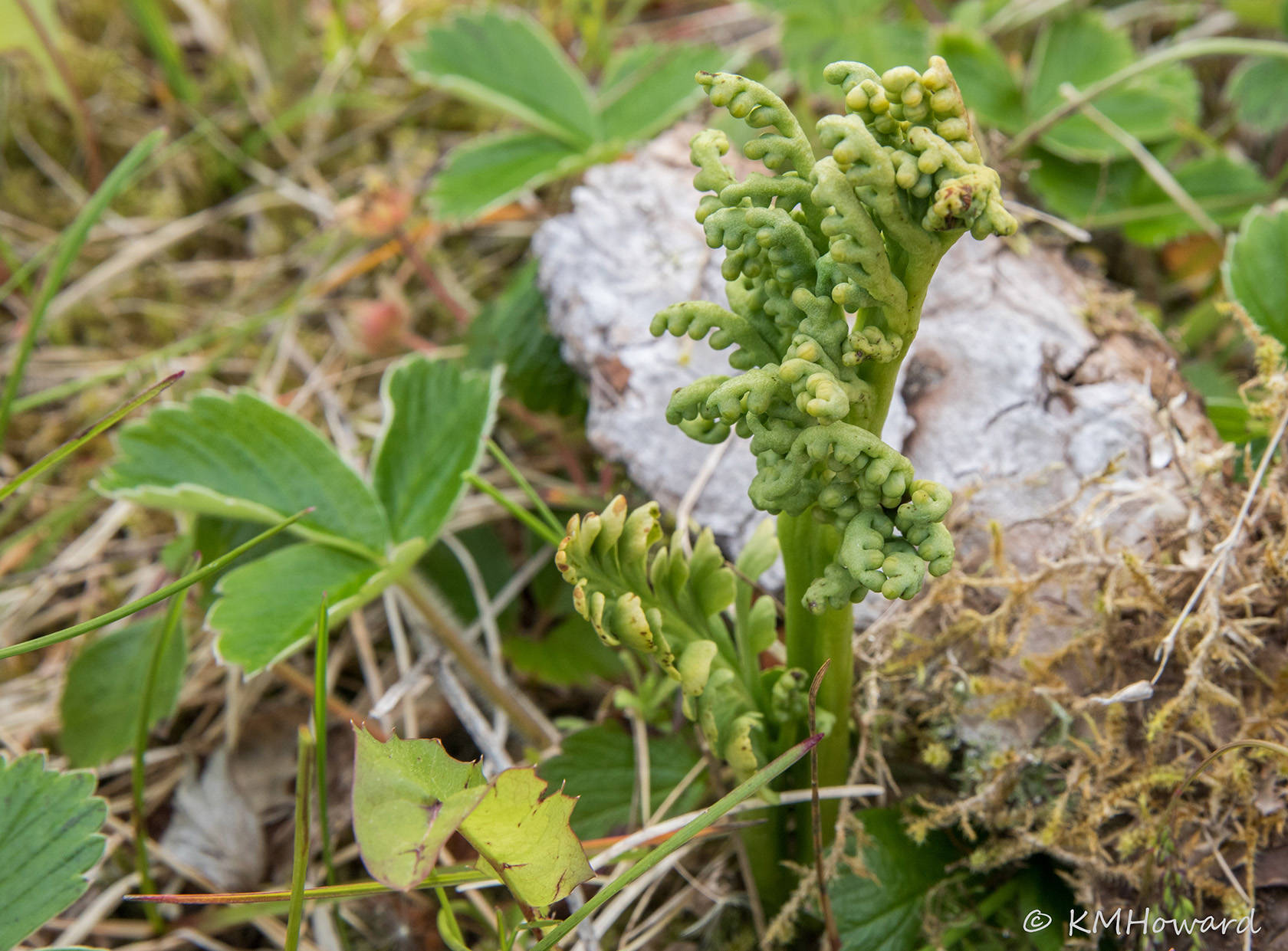
Moonworts are odd ferns, and this one was different from the one that is common on the vegetated beaches. (Kerry Howard | For the Juneau Empire)
