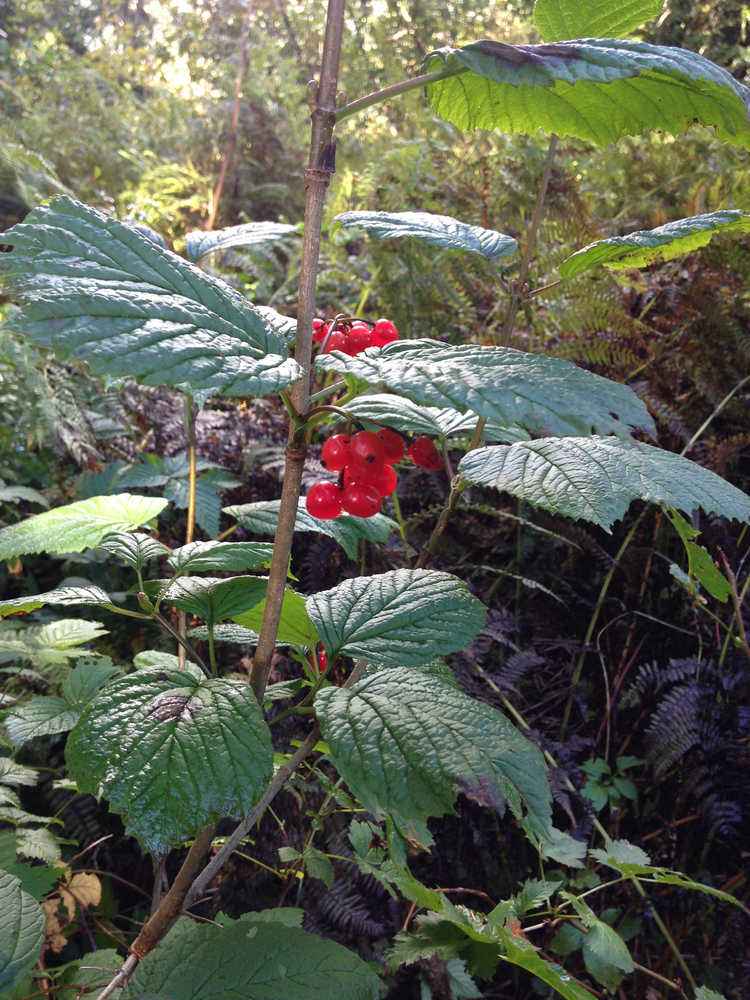
Highbush cranberries, which aren't technically cranberries, have a distinctive cluster that makes them easy to pick.

Highbush cranberries, which aren't technically cranberries, have a distinctive cluster that makes them easy to pick.

Gathering Alaska: Juice and jelly from highbush cranberries

To me, fall is a time of decay. Growing up in Wisconsin, it meant a time when the leaves changed into a layered palette of yellow, orange, and red. Eventually, the leaves piled up on the ground and the smell of decay, mixed with crisp, cold days, meant the true end of summer.

Alaska is different. I see the fall colors in the muskeg, the yellow leaves of the cottonwood, and the burgundy of blueberry leaves, but the brilliance is different than that of my childhood.

Southeast has wet leaves and rain, which create their own unique autumn scent, but it is the musty odor of highbush cranberries that now triggers my feelings that the end of summer has come. Yes, the cottony remains of fireweed might have waved their flag at me, but the juice in a popped cranberry is the exclamation point.

Highbush cranberries are Viburnum edule and are not in the cranberry family at all. There are three types of Viburnum in the United States: an introduced European shrub, the type that grows in abundance here in Alaska, and V. trilobum, which has the truest cranberry flavor. However, many would agree that our V. edule is spectacular because its flavor isn’t like that of anything else.

The plant is considered a shrub, but I often think of it as a long twig that stretches over my head. The berries cluster and by pulling down on the branch, they make for easy picking. You’ll want a bucket or something solid to prevent the juice from oozing out. No matter how careful you are, you’ll find yourself with juice.

The berry has a large seed, not harmful or toxic like the elderberry seed, but distracting to keep in there. I know someone who added highbush cranberries to salmon eggs. She said the flavor was good, but with every mouthful she had to spit out the seeds.

The seed is bitter and the flavor leaches as it is cooked. I further the juicing process by carefully emptying my collecting bag into a few layers of cheesecloth I’ve secured to a pot. Gravity does most of the work, but when it slowly drips, I’ll fold the cheesecloth together and squeeze.

I let the juice sit for a few days and then ladle out the clearer juice, leaving the murky bottom juice alone. If I have time, I process the juice by canning it so that I can use it later. Other times, I freeze it into ice cubes so that I can add it later on as an accent, rather than as a principal flavor. I’ll take one out and throw it in a soup, particularly a stew, to add some accent notes.

This year, I want to use wild crabapples to make highbush cranberry apple butter and experiment with the taste some more. Although the smell triggers my sense that fall is here and winter that much closer, I still look forward to it.

• Corinne Conlon is a freelance writer based out of Juneau. She can be reached at dirtgirlgardening@gmail.com.

More in Neighbors

Weekly events guide: Juneau community calendar for Feb. 9 – 15
Juneau Community Calendar

Weekly events guide: Feb. 9 – 15

Jeff Lund/contributed
The author would rather fish for steelhead, but he’ll watch the Super Bowl.
I Went to the Woods: Super Bowl spectacle

At some point on Sunday, dopey characters, hopelessly addicted to Doritos, will… Continue reading

Peggy McKee Barnhill (Courtesy photo)
Gimme a Smile: How much snow can one backyard hold?

Snow, snow, everywhere, and no place to put it!

The Spruce Root team gathers for a retreat in Sitka. Spruce Root, is an Indigenous institution that provides all Southeast Alaskans with access to business development resources. (Photo by Lione Clare)
Woven Peoples and Places: Wealth lives in our communities

Sustainable Southeast Partnership reflects on a values-aligned approach to financial wellness.

Actors in These Birds, a play inspired by death, flowers and Farkle, hold ‘flowers’ during a performance at the UAS Egan Library on Saturday, Jan. 31. (photo courtesy Claire Richardson)
Living and Growing: Why stories of living and dying in Juneau matter

What if we gave our town a safe space to talk about living and dying with family and friends?

calendar
Weekly events guide: Juneau community calendar for Feb. 2 – Feb. 8

Visit Juneau Arts and Humanities Council at JAHC.org for more details on this week’s happenings.

calendar
Weekly events guide: Juneau community calendar for Jan. 26 – Feb. 1

Visit Juneau Arts and Humanities Council at JAHC.org for more details on this week’s happenings.

Courtesy photo
Adam Bauer of the Local Spiritual Assembly of Bahá’ís of Juneau.
Living and Growing: Surfing into the future

Many religious traditions draw strength from the past.

calendar (web only)
Weekly events guide: Juneau community calendar for Jan. 19-25

Visit Juneau Arts and Humanities Council at JAHC.org for more details on this week’s happenings.

(web only)
Weekly events guide: Juneau community calendar for Jan. 12-18

Visit Juneau Arts and Humanities Council at JAHC.org for more details on this week’s happenings.

Four members of the Riley Creek wolf pack, including the matriarch, “Riley,” dig a moose carcass frozen from creek ice in May 2016. National Park Service trail camera photo
Alaska Science Forum: The Riley Creek pack’s sole survivor

Born in May, 2009, Riley first saw sunlight after crawling from a hole dug in the roots of an old spruce above the Teklanika River.

Sun shines through the canopy in the Tongass National Forest. (Photo by Brian Logan/U.S. Forest Service)
Opinion: Let’s start the New Year with an Alaskan-style wellness movement

Instead of simplified happiness and self-esteem, our Alaskan movement will seize the joy of duty.