
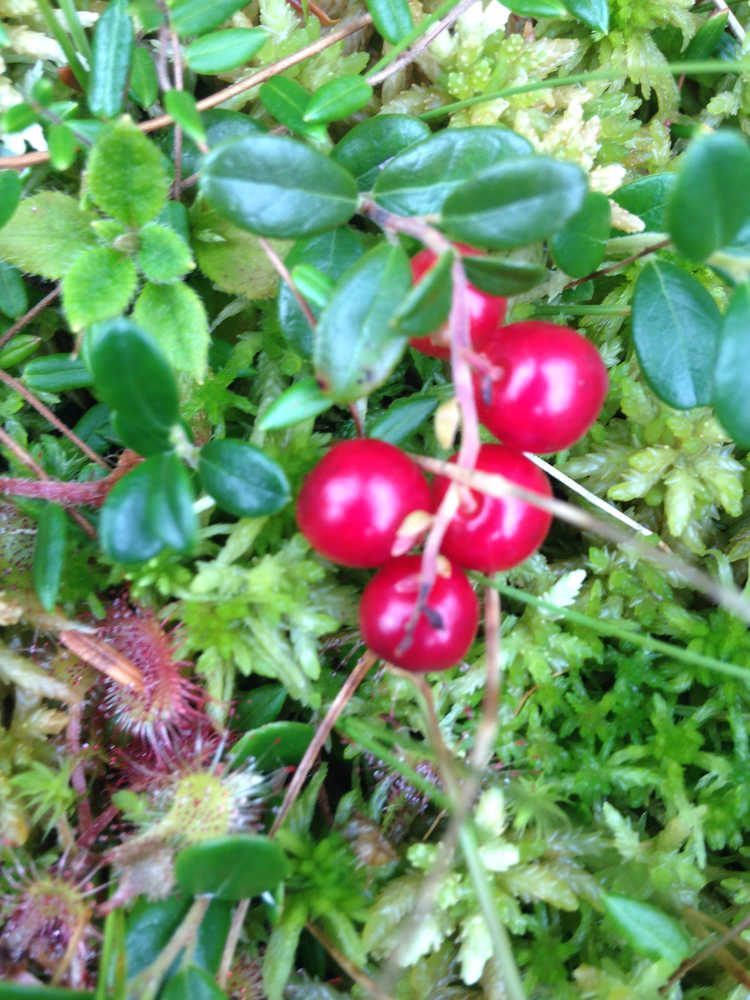
Up in Fairbanks, out towards the Chena Hot Springs, my friend and I pulled over and went for a walk. Her passion is birding and her gaze was skyward. In contrast, I was looking down at what plants we were walking by, amazed by the huge amounts of lingonberries. Suddenly, it occurred to both of us that we were in perfect moose habitat and that looking mid-range every once in a while was a good idea.
We didn’t run into a moose or a bear, but I still think of that hike. I’ve never been in such a prolific lingonberry spot since then. I’ve found patches of them, like a nice area on Admiralty near Oliver’s Inlet where I almost picked enough. But, usually, I find a patch with just enough to get a taste and to wish for more.
Unlike cranberries, which are connected by a narrow vine with small leaves that are often faded and camouflaged, lingonberries are noticeable. The plant grows upright with eight to ten oval leaves that grow symmetrically up the stem. The leaves and berries create a stark contrast against the boggy areas where I’ve found them, usually near stumps. Just as holly berries stand out against the leaves, lingonberries provide the Christmas red to the evergreen leaves.
The berries grow in clusters, making them easy to harvest. They’re typically smaller and more oval than the low bush cranberries that grow in Southeast. Both of these berries are tart, though the lingonberries are less so than the cranberries. I’ve used them interchangeably, often mixing them together in recipes when I didn’t have enough of either of them to fulfill the measurement need.
If you find one lingonberry stem, you’ll often find more as they grow in clusters, spreading out from underground stems. Although they can grow as tall as 16 inches, I think of them as a four to six inch plant. As I said, I’ve been most successful locating them in boggy areas alongside trails here in Southeast. However, lingon is an old Norse name for heather, so also look for them in the alpine and in dense forest areas.
I’ve used lingonberries in orange cranberry muffins. I also make a lowbush cranberry sauce that I like to put on sweet potatoes instead of butter. However, my favorite way to use them is in a fall galette recipe that I modified from Sunset Magazine. A galette is like a pie, with a single crust that folds over along the sides, capturing the fruit and juices. With a small layer of aged cheddar or smoked gouda and layers of pears and lingonberries, the galette is baked with or without a caramelized topping.
A few weeks back I wrote an article about the different types of vaccinium. I need to modify my accounting because lingonberry, or the other common names it goes by, is actually vaccinium vitis-idaea. So, Southeast Alaska has not seven, but eight types of vaccinium. I hope that you find a patch that will give you more than just a taste but remember to look up occasionally to see what’s around you.
• Corinne Conlon is a freelance writer based out of Juneau. She can be reached at dirtgirlgardening@gmail.com.
