
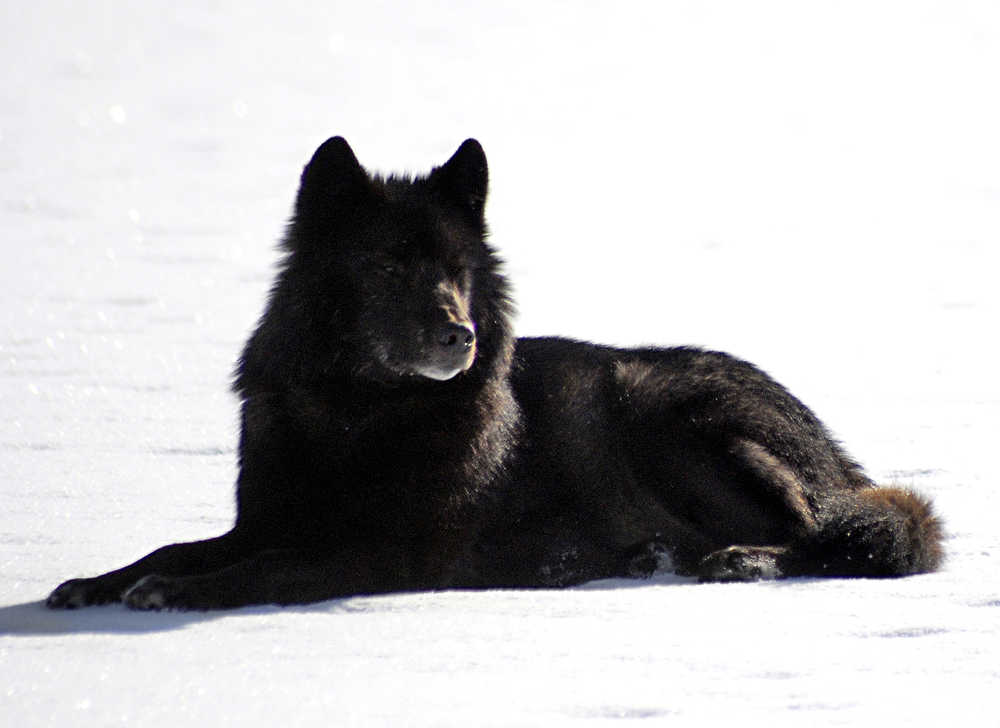
The Alexander Archipelago wolf is not endangered, the U.S. Fish and Wildlife Service announced Tuesday.
In a 94-page analysis, staff of the Anchorage office of U.S. Fish and Wildlife found that while the number of Alexander Archipelago wolves is dropping on Prince of Wales Island, wolf populations are stable elsewhere in Southeast Alaska and rising in British Columbia.
“Our review of the best available scientific and commercial information indicates that the Alexander Archipelago wolf is not in danger of extinction (endangered) nor likely to become endangered within the foreseeable future (threatened), throughout all or a significant portion of its range,” the analysis stated.
Despite the name of the subspecies, the Alexander Archipelago wolves have a range that extends from Yakutat to the southern tip of Vancouver Island. The Fish and Wildlife Service estimates between 850 and 2,700 Alexander wolves in that expanse, with more than 62 percent living in British Columbia.
That wide range of estimates indicates the lack of knowledge about the wolves. Alaska Game Management Unit 2 (Prince of Wales Island and surrounding area) has the only concrete numbers of population. In that unit, the population fell from 356 wolves to 89 between 1994 and 2014.
Tuesday’s announcement is a significant one for environmentalists and the timber industry in Southeast Alaska. Had the wolf been found worthy of listing, the listing process would have impacted timber sales throughout the Tongass National Forest.
In 2011, the Center for Biological Diversity and Greenpeace petitioned the Fish and Wildlife Service to list the Alexander Archipelago wolf — a subspecies of the gray wolf — as endangered. The petition cited the decline in GMU 2 and stated that logging, particularly on Prince of Wales Island, was degrading the wolves’ habitat.
In 2014, the Fish and Wildlife Service found that a listing might be warranted. It began a more detailed analysis that concluded Dec. 15 with the document that was released to the public Tuesday.
Larry Edwards, a Sitka spokesman for Greenpeace, called Tuesday’s announcement disappointing.
“We think that the decision is not correct,” he said.
In the view of the petitioners, the wolves in GMU 2 represent a distinct population that should be considered separately from the rest of the population of Alexander Archipelago wolves.
The Forest Service found differently, saying that while wolf populations in that area are “small and insular,” they are not genetically distinct.
Tuesday’s analysis did confirm that “timber harvest is affecting the GMU 2 wolf population,” but wolves elsewhere are not definitively being harmed by timber harvests.
Past requests to list the Alexander wolves as endangered have ended in litigation.
Edwards said Greenpeace and Center for Biological Diversity staff are still combing through the FWS analysis, but “legal action is certainly possible.”
Sen. Lisa Murkowski, R-Alaska, praised the decision not to list the wolves in a statement released early Tuesday.
“Alaska has the largest population of gray wolves in America. There is agreement that the gray wolf population in Southeast Alaska is healthy and stable in most places and growing in others,” she said. “At a time when timber harvesting on Prince of Wales Island is barely a tenth of its levels of two decades ago, the attempt by some environmental groups to list the wolf seemed to be an effort solely to end the last of the remaining timber industry in Southeast Alaska. Fortunately, it did not work.”
