
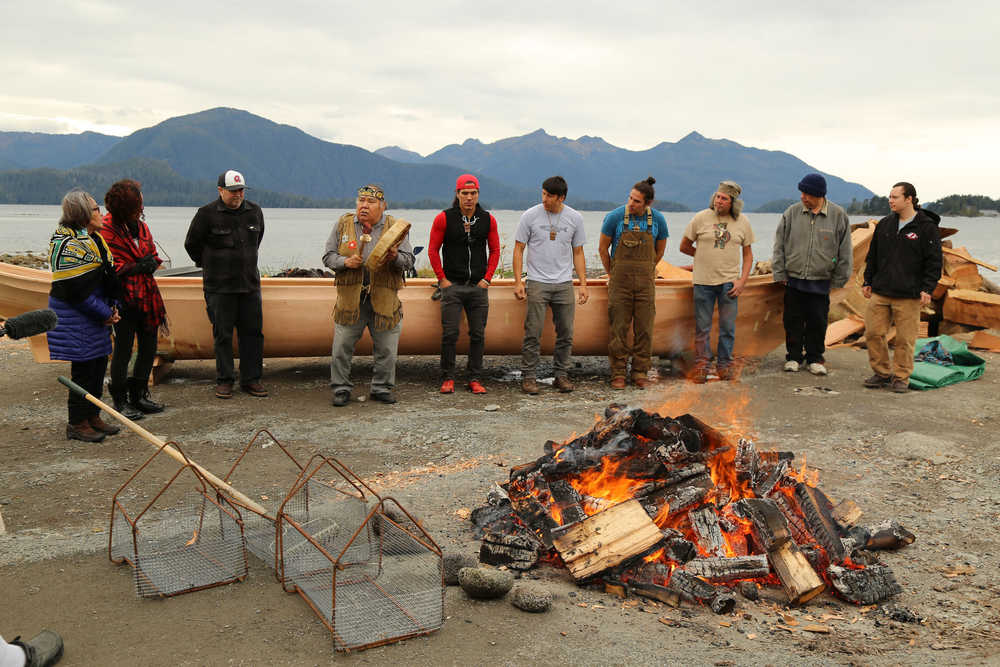
In February of this year, the red cedar log Steve Brown and his apprentices were working with was full of cracks. By the end of early October it had blossomed into a successful dugout canoe.
Sealaska Heritage President Rosita Worl said the tree strikes her as a symbol of Tlingit culture.
“It’s not just canoe carving. It symbolizes our culture, all the things that are important to us as a people. Transportation, movement of our people within the region, the gathering of food,” Worl said. “At one point in time, our culture, we stood tall, firm and strong— and then we had some difficulties that came with the changes that came to our society, and that log had many problems…. Other people might have given up, but under the instruction from Steve Brown they continued.”
The project was a partnership between SHI and the Sitka National Historical Park. Carver Steve Brown, an adopted member of the Kiks.adi, led the project; Haida artist T.J. Young, Tlingit/Unangan artists Nick and Jerrod Galanin, and Tlingit artist Tommy Joseph of Sitka worked on the boat as apprentices.
“I like to think that those guys, they represent our culture,” Worl said. “They dedicated themselves for several extra months.”
Steaming
Oct. 3, the day of the steaming, the canoe started out 36 inches wide (a little wider just below the gunnel, or upper edge of the boat.) By the end of the day, the canoe measured 52 inches across, Brown said. He estimates eleven people will fit inside.
During the expansion, kids sang songs in Tlingit, community members and other carvers helped carry the loads of rock and cut firewood, and elder David Katzeek, leader of the Shangukeidí (Thunderbird) clan, and Worl led a blessing.
“It really felt like a community event,” she said. “It was an awesome feeling sitting there.”
There will be another ceremony, Brown said when the canoe is turned over to the Sitka Tribe of Alaska, where it will find its home.
The rocks used for the expansion were from Kruzof Island, where Mount Edgecumbe is located. Brown called them “the Cadillac of rocks” since they don’t break under heat.
They carried rocks back and forth with baskets made of rebar, lowering the hot rocks into the foot of seawater inside the boat, switching cooled rocks for hot ones.
“The beauty of doing it that way… is the weight of the water, the temperature of the water, the weight of the rocks — all work together to make this process happen,” Brown said.
The traditional methods, he said, seem to make the expansion happen naturally.
It’s a difference that will be visualized in a way no one present believes has happened before — via 3D modeling.
3D modeling of the canoe
A technician from Juneau came out to scan the canoe prior to steaming and will also scan it after.
“After it’s all doctored up, a person will be able to watch the whole shape of the canoe morph,” Brown said. “To my knowledge, it’s not been done before. It’ll be a fantastic teaching tool.”
It was Nick Galanin’s idea to do the 3D scan. He also recorded a video of the steaming via an overhead drone, which is available on the Capital City Weekly’s Facebook page, as well as on Galanin’s.
“I think it’s just a great potential resource,” he said.
The scan could be used for many things, he said, but the real value is for education.
“That scan before and after will provide a really valuable reference of those transformations that take place,” Galanin said.
“There’s talk of making fiberglass versions of this from the scan,” he said. “That would be great, too.”
He added — as did others who mentioned the possibility — that it shouldn’t detract from carving the canoes the traditional way. He himself would love to be involved in another dugout, and the other carvers are planning that, too.
Galanin has also been filming throughout the process, and plans to put together a short film about it, probably after its initial launch.
“It’s been quite a journey,” said Galanin. “It’s been a completely new learning process for me, at least.”
Next steps
Now, they need to install thwarts and benches, the capability for a sail, and take care of other details. Last, they’ll paint; they’ve been asked to put both a raven and eagle design on the canoe, Brown said.
The canoe ended up taking several months longer than they thought it would, but what with all the carvers already-established artists working on other projects and pitching in when they could, it all worked out fine, Brown said.
“Everybody pitched in their utmost, really, when they were here,” he said. “They not only did a great job but made it fun to work together. You can’t ask for better than that.”
It was her first time attending a canoe-steaming ceremony, Worl said, and she doesn’t plan for it to be her last.
SHI decided to pursue a canoe project after a 2015 gathering of more than 30 Southeast Alaskan artists agreed that canoe carving was likely the area’s most endangered traditional, indigenous art form.
It’s something that, with this canoe and the two spruce canoes Wayne Price and apprentices Zack James, James Hart, and Steven Price this year carved in Hoonah, has “absolutely” changed, she said.
“We’ve got… young guys now — apprentices — who are going to be able to go out and carve canoes,” Worl said. “That’s great progress. We want to make sure it’s available in all of our communities.”
Read more about the start of the project here
Read more of this week’s Capital City Weekly:
Seaweed farming begins in Southeast
Moose butchering: Local foods project turns to game
LCCC prison art turns walls into mirrors
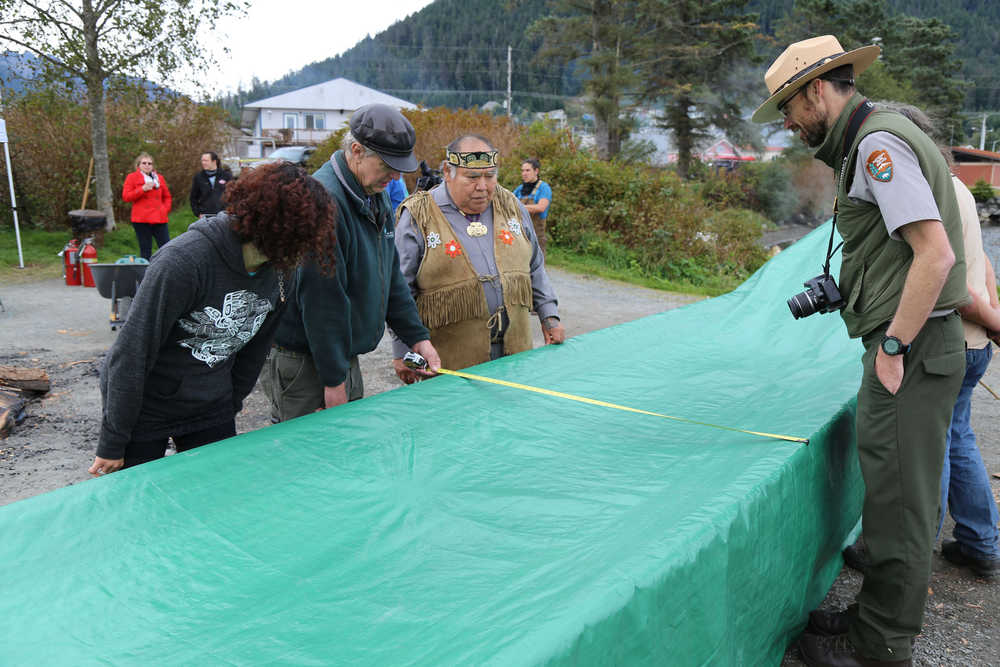
Those whose faces are visible are, clockwise from left, lead carver Steve Brown, with tape measure as he measures the expanded width of the canoe, Shangukeidí (Thunderbird) clan leader David Katzeek, and Sitka National Historical Park acting chief of interpretation Ryan Carpenter.
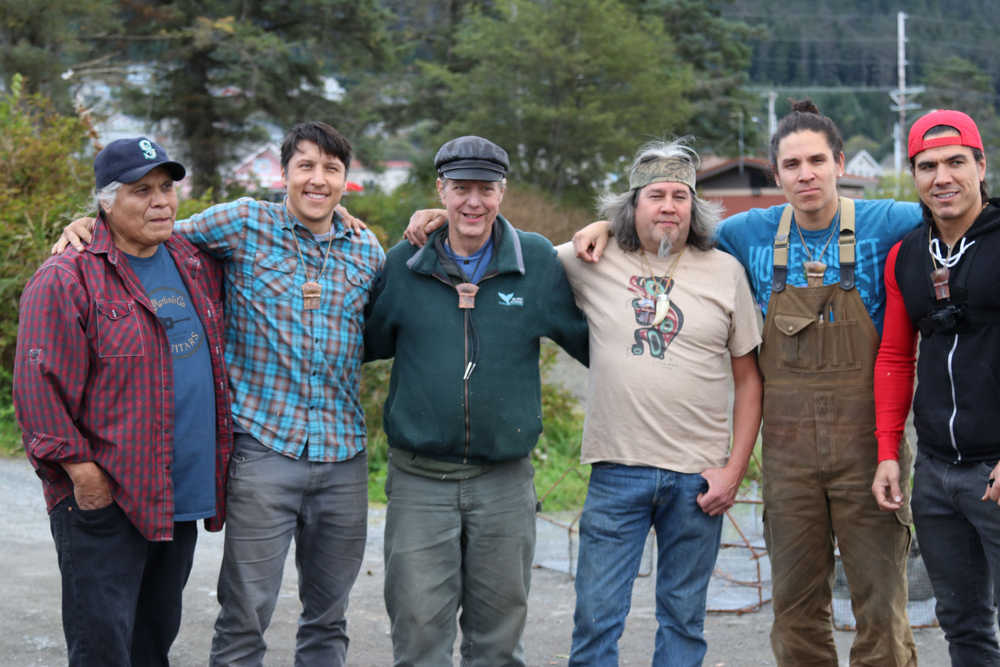
Copper, silver and gold carver Dave Galanin, left, gave the five carvers, right, the tináa necklaces they are wearing; they wore them throughout the steaming of the canoes. To Galanin’s right are son Jerrod Galanin, lead carver Steve Brown, Tommy Joseph, son Nick Galanin, and T.J. Young.
