
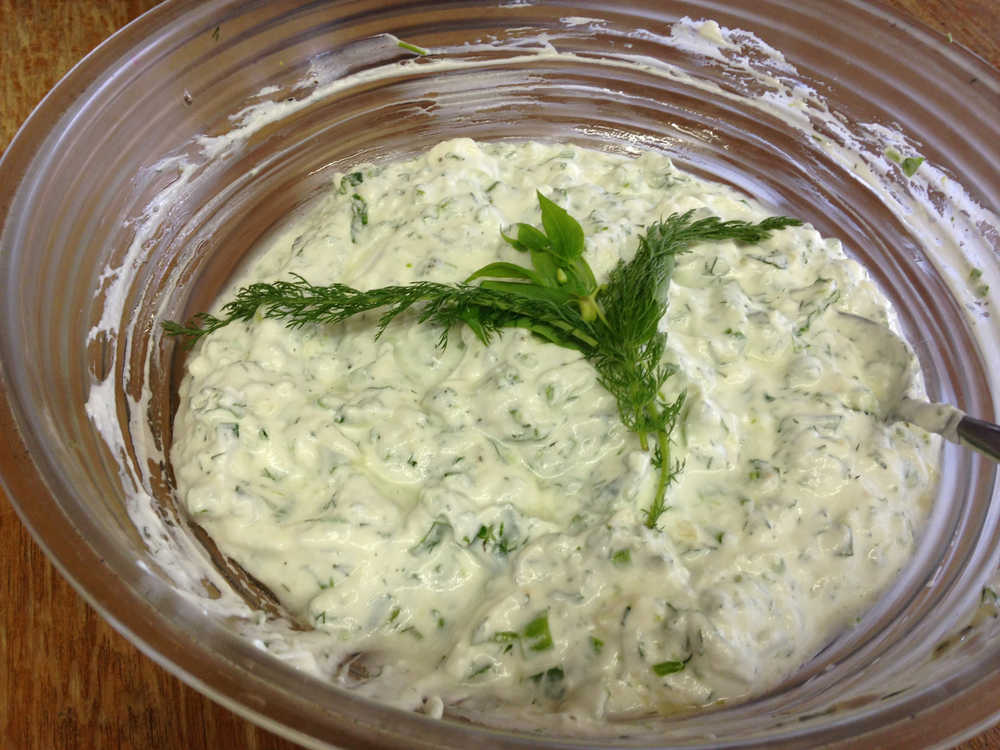
Tzatziki - a Greek dish traditionally made with yogurt and cucumbers - made in part with greens foraged on a Wild Kitchen Walk hosted by the Juneau District Extension Office. Photo by Corinne Conlon

Tzatziki - a Greek dish traditionally made with yogurt and cucumbers - made in part with greens foraged on a Wild Kitchen Walk hosted by the Juneau District Extension Office. Photo by Corinne Conlon

Foraging for goose tongue

On Shaman Island, during a day it seemed everyone in Juneau was outside embracing the sun, I had a friend identify goose tongue. It’s one of those foraged plants that you hear about and see posted on Facebook, but it’s also something that you are strongly warned against. In the same breath people use to tell you about their harvest, they’ll warn you about the serious repercussions if you mistakenly eat the wrong plant.

My friend shrugged off any concerns I had, saying that goose tongue is abundant and she rarely ever sees arrowgrass. That’s the plant you’re told can be mistaken for goose tongue. As I wasn’t quite mollified by her answer, she went on to show me some characteristics that define this plant.

Goose tongue has a wide base and a ridged middle with two other smaller parallel ridges whose purpose must be to draw water down the leaf towards the root. If you fold the leaf in, it makes a v-shape — its most distinguishing difference — although the ribs might crease mid-way. You might not end up with a perfect angle, but you’ll definitely see a valley.

Goose tongue looks like a grass, but it is thicker. It doesn’t quite have the thickness of aloe vera, but it’s definitely a fleshy leaf. It tends to spread out, the bottom leaves flattening down towards the ground. Arrowgrass, on the other hand, grows upward like a lavender plant. Janice Schofield wrote in Plants of the Pacific Northwest that “Arrowgrass leaves are flat on one side and round on the other, with grasslike sheaths at the base.”

You don’t want to mix up the plants. Although some areas, such as parts of Ireland, harvest certain arrowgrass varieties, the type we have here in Southeast collects cyanide in its leaves.

Make sure you know what you are picking, but don’t let it stop you. Goose tongue has a sweet flavor, a bit like a pea pod, but without the stringiness or the bitter aftertaste of beach greens. Look for them right at the high tide line or on a tidal flat such as the one out at Boy Scout Beach.

Munch on them raw or pick what you can. As with most foraged plants, don’t pick more than a third of the leaves to allow the plant to recover from the harvest.

I have yet to pick more than a cup at any one time, so my options for making something with them have been limited. I know some people sauté it with a bit of butter and eat it as a side green. I tend to use it in stir fries or throw it into soups at the last minute, the same way I use spinach.

Most of the time, I like it best as I sit somewhere looking out at the water and munching as I did when I was first introduced. On Mother’s Day we sat in the sun, kids running amok and voices exclaiming delight at the treasures they were finding on this very low tide, and we found another way to appreciate Alaska’s bounty.

• Corinne Conlon is a freelance writer based out of Juneau. She can be reached at dirtgirlgardening@gmail.com.

More in Neighbors

Weekly events guide: Juneau community calendar for Feb. 9 – 15
Juneau Community Calendar

Weekly events guide: Feb. 9 – 15

Jeff Lund/contributed
The author would rather fish for steelhead, but he’ll watch the Super Bowl.
I Went to the Woods: Super Bowl spectacle

At some point on Sunday, dopey characters, hopelessly addicted to Doritos, will… Continue reading

Peggy McKee Barnhill (Courtesy photo)
Gimme a Smile: How much snow can one backyard hold?

Snow, snow, everywhere, and no place to put it!

The Spruce Root team gathers for a retreat in Sitka. Spruce Root, is an Indigenous institution that provides all Southeast Alaskans with access to business development resources. (Photo by Lione Clare)
Woven Peoples and Places: Wealth lives in our communities

Sustainable Southeast Partnership reflects on a values-aligned approach to financial wellness.

Actors in These Birds, a play inspired by death, flowers and Farkle, hold ‘flowers’ during a performance at the UAS Egan Library on Saturday, Jan. 31. (photo courtesy Claire Richardson)
Living and Growing: Why stories of living and dying in Juneau matter

What if we gave our town a safe space to talk about living and dying with family and friends?

calendar
Weekly events guide: Juneau community calendar for Feb. 2 – Feb. 8

Visit Juneau Arts and Humanities Council at JAHC.org for more details on this week’s happenings.

calendar
Weekly events guide: Juneau community calendar for Jan. 26 – Feb. 1

Visit Juneau Arts and Humanities Council at JAHC.org for more details on this week’s happenings.

Courtesy photo
Adam Bauer of the Local Spiritual Assembly of Bahá’ís of Juneau.
Living and Growing: Surfing into the future

Many religious traditions draw strength from the past.

calendar (web only)
Weekly events guide: Juneau community calendar for Jan. 19-25

Visit Juneau Arts and Humanities Council at JAHC.org for more details on this week’s happenings.

(web only)
Weekly events guide: Juneau community calendar for Jan. 12-18

Visit Juneau Arts and Humanities Council at JAHC.org for more details on this week’s happenings.

Four members of the Riley Creek wolf pack, including the matriarch, “Riley,” dig a moose carcass frozen from creek ice in May 2016. National Park Service trail camera photo
Alaska Science Forum: The Riley Creek pack’s sole survivor

Born in May, 2009, Riley first saw sunlight after crawling from a hole dug in the roots of an old spruce above the Teklanika River.

Sun shines through the canopy in the Tongass National Forest. (Photo by Brian Logan/U.S. Forest Service)
Opinion: Let’s start the New Year with an Alaskan-style wellness movement

Instead of simplified happiness and self-esteem, our Alaskan movement will seize the joy of duty.