
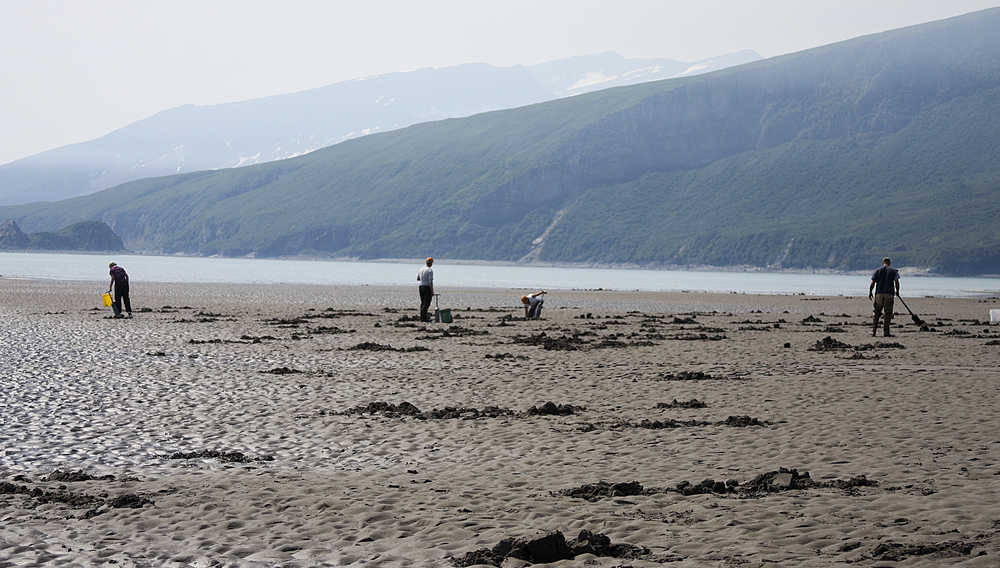
The Alaska Department of Fish and Game plans to study the razor clams on the west side of Cook Inlet this summer.
Razor clams are a popular target for both sport and commercial harvesters in the inlet. The west side’s beaches have traditionally been a commercial harvest area, while the east side has been for sport harvest since 1959. But with the east side beaches closed to razor clam harvesting because of low population numbers, the west side beaches have seen an uptick in activity in recent years.
An operational plan from Fish and Game details plans to study razor clams on the western beaches from April 5-12.
“Razor clam abundance and age composition in western Cook Inlet has never been estimated, so current harvest rate, life history parameters (recruitment, growth, age at maturity, natural mortality, etc.) and sustainable harvest rates are unknown,” the operational plan states.
The researchers would study approximately 11.2 kilometers of beaches between Redoubt Point and the Crescent River, which drains into Cook Inlet from the mainland southwest of Kalgin Island. Because this would be the first time razor clam abundance is estimated for western Cook Inlet, the researchers would have to rely on models that have shown success on the east side, according to the operational plan.
The area targeted for the study in particular has seen a steep jump in participation since 2013. From 1996-2011, annual harvests averaged around 15,000 clams. By 2014, the total harvest was more than 75,000, possibly driven by the closures on the east side beaches and increased access provided by charter boat services to the western beaches, according to the operational plan.
There is no limit on the number of clams that can be taken by personal-use and sport fishermen in western Cook Inlet, according to the operational plan. The Board of Fisheries considered a proposal in March 2015 to set a limit of 60 clams per day with up to 120 clams in possession for the west side beaches, but ultimately ruled to take no action, leaving management up to Fish and Game.
The researchers will also look at size and age to help determine a sampling design for abundance surveys in the future, according to the plan.
Surveyors from Fish and Game are concerned about the low recruitment and decreasing size and age of the razor clams on the east side beaches. Harvests have been on the decline since 2011. The low number of clams spotted, their young age and small size led the department to close the beaches in 2014 and 2015, with plans to do so again in 2016.
Clam populations are still at historically low levels on the east side beaches, though some are showing more recruitment. The reason for the decline is still unclear, said Carol Kerkvliet, a sportfisheries biologist with Fish and Game in Homer, in a previous Clarion interview. Biologists are seeing high mortality with low spawning success and poor settling success for juvenile clams.
“Then also the poor survival of the larger size clams suggests some sort of environmental impact, and it could be a combination of many things,” Kerkvliet said.
• Elizabeth Earl is a reporter for the Peninsula Clarion. She can be reached at elizabeth.earl@peninsulaclarion.com.
