
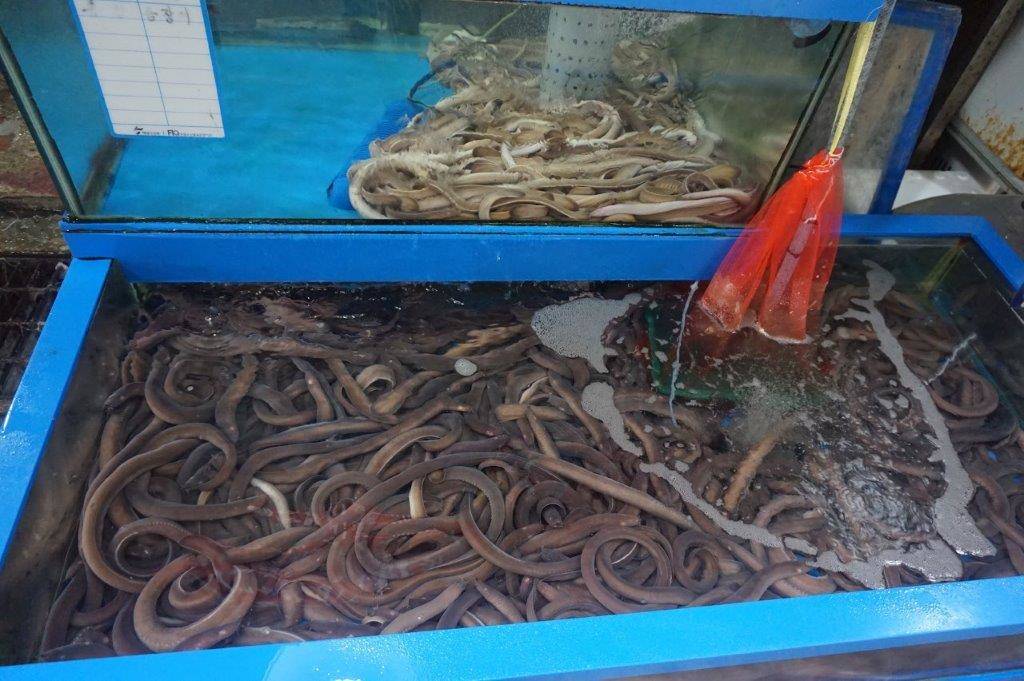
Hagfish is the real name for what is commonly called slime eels and it could become a viable fishery with ready markets standing by.
Little is known about hagfish in Alaska, although they are commonly caught elsewhere in the U.S. and abroad. In Oregon, for example, a fleet of 15 to 20 boats catches up to two million pounds each year in customized five-gallon buckets or large barrels and pay fishermen up to $1.25 a pound.
Now, two Alaska biologists are testing the waters for a fishery with longliner in Southeast who were given a special permit to catch 60,000 pounds of hagfish for their studies.
“It’s commonly seen as a pest,” said Andrew Olson, a biologist with the Alaska Department of Fish and Game. “In longline fisheries for sablefish, they often leave slime blobs on the hooks and strip bait, and they get into shrimp pots as well.”
Olsen is in the second year of a hagfish study with fellow researcher Aaron Baldwin. Their goal is to “keep the science ahead of any fishery to make sure it is sustainable” by learning more about the unique species.
“We are looking at basic biology such as length, weight and egg counts in females. We can’t yet age the fish and they don’t thrive well in captivity. We are really starting from scratch,” said Olson.
Reproduction and spawning have never been witnessed or documented, and biologists don’t know where or when hagfish do so.
“We’ve seen eggs, and juveniles, but nothing in between,” said Baldwin. “No one has ever seen a baby hagfish.”
A single foot and a half inch, nine-ounce hagfish can fill a bucket with slime in seconds from 100 glands alongside its body.
“It’s extruded and looks like a white latex liquid that comes out when it’s dry and it expands when it hits seawater. The slime molecules will entrap water molecules and it is an amazing substance,” he said.
The slime has several functions — it suffocates predators, helps hunt prey by forcing them out of burrows and it lubricates entry into fish through the anus.
“It has digestive enzymes so when you open up a sablefish, for example, it is literally bones, hagfish slime and a few hagfish inside the fish. They start with the internal organs and eat every bit of flesh that’s in there,” Baldwin explained.
Most slime, as with slugs, is just mucus, he said and doesn’t have the capability of absorbing water molecules and expanding.
“Hagfish produce a very unique substance. It is definitely one of a kind,” Baldwin added.
Studies by the U.S. Navy and other researchers has shown that the chemical makeup of hagfish slime is stronger than spider silk.
“Because of its qualities there are lots of efforts to make synthetic duplicates or bioengineer bacteria to produce the slime for industrial purposes,” Baldwin said. “The U.S. Navy is using synthetic hagfish slime to produce a substance that is lighter and stronger than Kevlar. The slime also shows potential as an anti-foulant for ship hulls. And medical research has shown that hagfish slime heals burns quickly and may be used as microfibers for cell repair.”
A well-established market for hagfish is Korea where the meat is a barbecue and stir fry favorite and the skin is sold as “eel skin leather” products.
“It’s been a fun project to work on,” Baldwin said. “We get to work with fishermen on developing a fishery and it’s a species we haven’t paid much attention to so everything we are learning is really new to us.”
If Alaska fishermen encounter hagfish in waters outside of Southeast, Olson and Baldwin would like to know about it.
Learn more about hagfish at Alaska Fish and Wildlife News where you also can see videos of commercial hagfish fishing aboard the Viking Sunrise and a biologist handling hagfish slime.
Alaska tops for salmon catches
Salmon catches throughout the North Pacific remain near all-time highs, and Alaska’s take tops them all.
For 25 years the North Pacific Anadromous Fish Commission (NPAFC) has summarized abundances and catches of salmon as reported by its member countries — Canada, Japan, Korea, Russia, and the U.S.
The Commission tracks chums, cohos, pinks, sockeyes, Chinook and steelhead trout in the North Pacific, Bering Sea and the Sea of Okhotsk, and also provides the venue for coordinating research and enforcement activities.
For 2017, just over 460 million salmon weighing more than two billion pounds were caught in those waters, less than recent odd-year averages. Salmon catches tend to increase in odd-numbered years when the most abundant species – pink salmon – tend to run higher.
Last year the U.S. fleets topped Russia by catching more than any other nation – 53 percent of the total salmon catch, topping one billion pounds, with Alaska taking all but 22 million pounds of that.
Russia took 38 percent of the North Pacific salmon last year (nearly 77 million pounds), with all other countries in single digit percentages.
As usual, pink salmon made up the bulk of the commercial catch at 49 percent by weight, followed by chums at 29 percent and sockeyes at 19 percent. Cohos made up three percent of the total North Pacific catch, with Chinook salmon at one percent.
The NPAFC report said catch trends for pinks and especially chums in Asia have been declining for 10 years with 2017 the lowest harvest since 2002.
In North America, the abundance of salmon species varies from north to south. In Alaska, pink and sockeye salmon are the primary species, followed by chums. In Canada, sockeye, pink, and chums have historically comprised the largest catch, while in Washington, Oregon, and California chums, Chinook and coho salmon are the most abundant species.
The Commission also tracks releases of hatchery salmon. Member countries released just over five billion fish in 2017, similar to numbers over the past three decades.
U.S. hatcheries released the most at 37 percent of the total (nearly 1.9 billion fish), followed by Japan at 35 percent and Russia at 21 percent. Canada released seven percent of the hatchery fish in the North Pacific and Korea less than one percent.
Chum salmon made up 64 percent of all hatchery releases, followed by pinks at 25 percent, sockeyes at five percent, Chinook salmon at four percent and cohos at less than one percent.
Got questions?
Organizers of the upcoming Bristol Bay Fish Expo are asking Alaskans to submit questions for the governor candidates’ debate on June 9 in Naknek.
“This debate is so important for us in rural Alaska to educate our next governor about what issues we face everyday,” said Katie Copps-Wilson.
Governor Walker, Mike Dunleavy, Scott Hawkins and Mike Chenault quickly agreed to participate in the two-hour event. Chenault has since dropped out of the race and Mark Begich and Mead Treadwell are both in, causing some last-minute shuffling.
“Anyone who has filed will get an invitation,” Copps-Wilson said. “We want to make sure that we address what’s on the minds of people in the community and the state of Alaska.”
The question topics will include outmigration, substance abuse, domestic violence, mental health issues, energy needs and economics.
“The candidates will be debating in Bristol Bay, the heart of the world’s largest sockeye salmon run, and at the forefront of that is the Pebble Mine. There will definitely be a conversation about where the candidates stand on the mine,” Copps-Wilson said.
The two-hour debate will be moderated by Rhonda McBride of KTVA and broadcast live on radio stations KDLG and KAKN. Alaskans are invited to submit written questions online at info@bristolbayfishexpo.com or at the Expo prior to the debate.
The second annual Expo is a fundraiser for Little Angels Childcare Academy and has attracted over 50 exhibitors so far to Naknek, home to 10 fish processing companies and over 1,000 fishing boats.
The two-day event has a packed line up of presentations and events, including the biggest money-maker on Friday night – live and silent auctions with professional auctioneer Dan Newman of Alaska Premier Auctions and Appraisals in Anchorage.
“We have some really cool items donated, such as breakfast with Governor Walker and a flight around the Pebble Mine site,” Copps-Wilson said. Other items include eight hours of welding, five hours of professional logo or website design and “a boatload of gear from Grundens.”
Auction donations are still being accepted and can be made at www.bristolbayfishexpo.com
The Expo takes place June 8 and 9 at the Naknek school. All events are free but visitor registration is encouraged.
Last year’s Expo raised nearly $15,000 for Little Angels Childcare Academy and with more participants coming from far and wide, the organizers believe that this year’s tally will likely be even higher.
• Laine Welch is a Kodiak-based journalist who writes a weekly column, Fish Factor, that appears in newspapers and websites around Alaska and nationally.
