
With dogs’ breath fogging the 30-below zero air at their knees, 71 Iditarod mushers steamed their way down the frozen Chena River in Fairbanks on March 6. Upstream, just a few miles behind them, 500 ducks were surviving in a one-mile stretch of open water.
You might think the mallards that did not migrate from the subarctic in fall would be skinny and weak, but a University of Alaska Fairbanks graduate student found the Fairbanks ducks have the highest midwinter body mass of just about any mallards in North America. The ducks improved in body condition since their brethren flew away.
Tim Spivey just defended his master’s thesis on the hundreds of mallards that spend winters in Anchorage and Fairbanks, unlike most of a half-million Alaska mallards that flew south months ago.
The mallard is the raven of the duck world, able to eat just about anything. Mallards have overwintered in Anchorage since at least 1975. There are now about 1,300 mallards there now. The Fairbanks population of mallards has increased to about 500 overwintering ducks since people began feeding them in organized fashion.
Spivey found the body condition of Anchorage mallards declined from autumn to late winter. Fairbanks ducks, however, reached their highest body mass during November, December and January, the coldest months of the year.
Ducks live in the two cities all winter because of two key factors: There is open water in both places and people feed them.
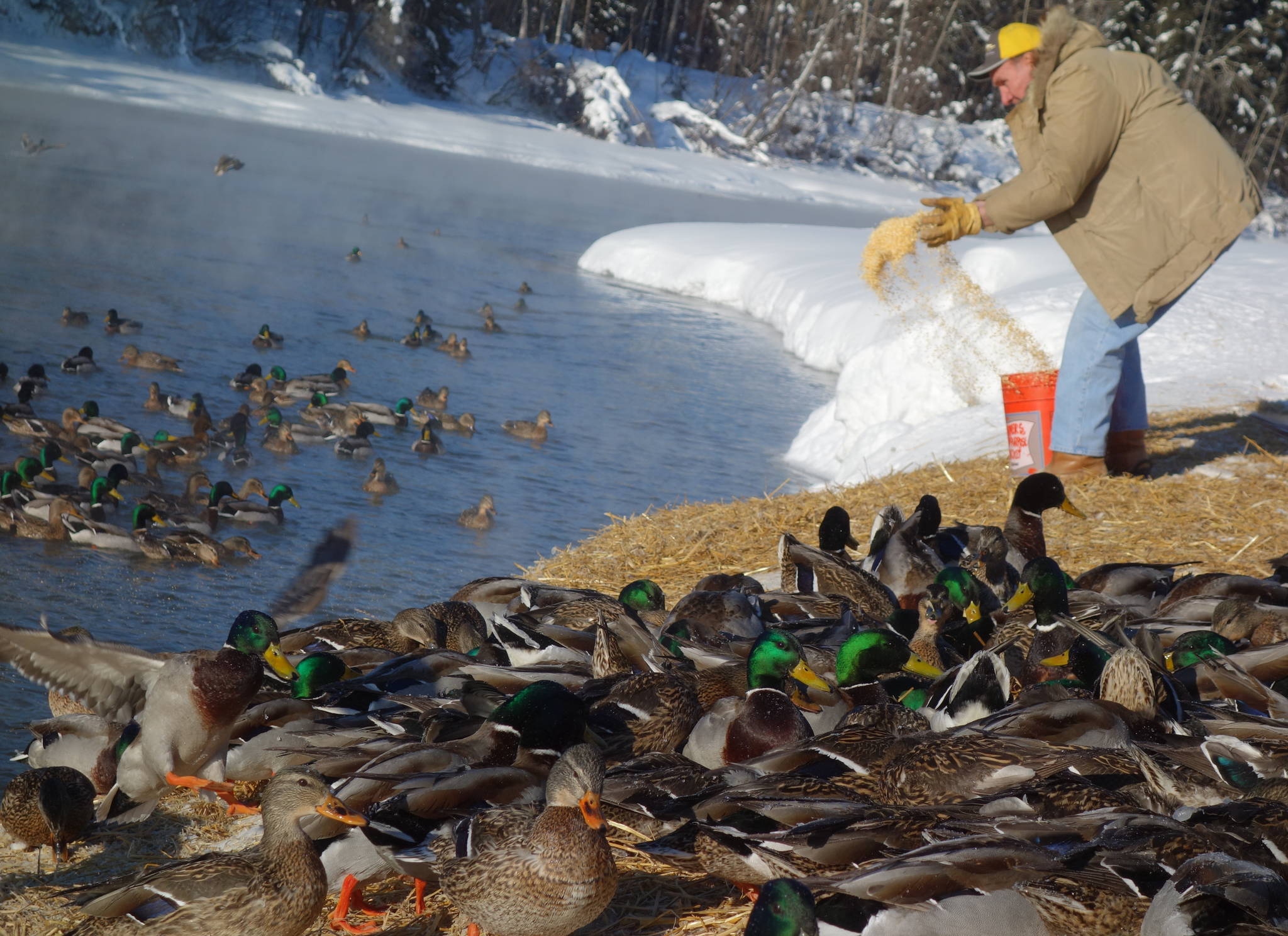
In Fairbanks, workers at the city’s main coal-fired power plant discharge equipment-cooling water into the Chena River, warming it enough that a mile-long section downstream does not freeze. Volunteers haul as many as eight five-gallon buckets of corn and wheat to the riverbank each winter day to feed the ducks.
Marv Hassebroek, 81, has fed the ducks a mixture of cracked corn, Delta wheat and feed pellets for about 12 years. At that time, he and the late Bill Stroecker saw mallards that “looked like they were starving to death.
“Bill used to say ‘I shot more ducks than anybody in Fairbanks, now I’m going to make up for it,’” Hassebroek said.
To test how much of that six-month daily gift made up the Fairbanks mallards’ winter diet, Spivey captured ducks and took blood samples and banded their legs before releasing them.
Using isotope analysis on the blood samples, Spivey found human handouts make up 85 percent of an urban mallard’s diet by late winter. A natural diet for mallards includes seeds and berries, small fish and invertebrates in the water.
Of the people feeding the ducks, Spivey said some feel the ducks will die without their help.
Hassebroek acknowledged that as he hauled a few five-gallon buckets of grain to the Chena, where a few dozen ducks amid hundreds quacked at his arrival.
“If we didn’t feed them, they’d be dead in a week, maybe a couple weeks,” he said.
“That’s not the case,” Spivey said a few days earlier during his thesis defense. “They’ll migrate to chase resource availability.”
In his research, Spivey also checked out ducks to see whether active infections were happening in the urban-wintering mallards. He found the Fairbanks mallards maintained the influenza A virus during winter when most dabbling ducks have left, which biologists think is significant.
“Wintering mallards could conceivably play a role in the perpetuation of extremely economically costly poultry pathogens in Alaska,” said Andy Ramey, an expert on avian flu with the U.S. Geological Survey Science Center in Anchorage via email. These viruses “have the potential to cause disease not only among domestic poultry, but also in pet or backyard birds and numerous species of wild birds, including raptors.”
There are pluses and minuses for mallards remaining in Alaska over the winter, Spivey said. Downsides are the increased chance of maintaining the viral reservoir and a dependence on a human-granted food supply. Upsides include avoiding the many dangers of migration and shorter commutes to summer nesting areas in places like Minto Flats, Susitna Flats and the Innoko River.
• Since the late 1970s, the University of Alaska Fairbanks’ Geophysical Institute has provided this column free in cooperation with the UAF research community. Ned Rozell is a science writer for the Geophysical Institute.
