
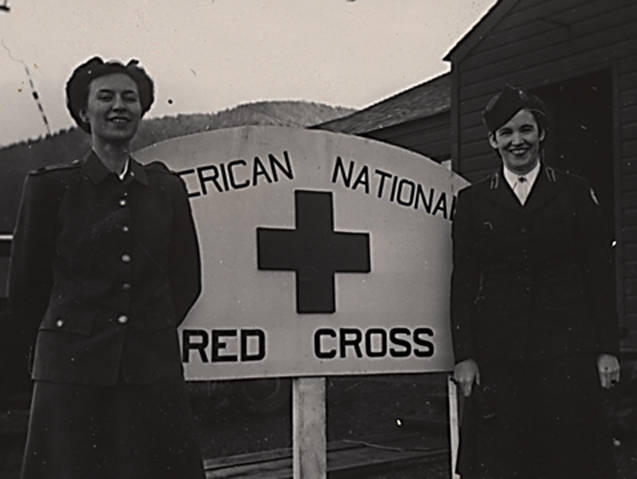
During World War II, the Sitka Chapter of the American Red Cross (ARC) worked to support the military personnel stationed at the Sitka Naval Operating Base and the U.S. Army forts in Sitka Sound, including Fort Ray and Fort Rousseau. While many may associate the ARC primarily with disaster relief, during World War II ARC members undertook a wide variety of activities in support of war efforts. The Sitka Chapter raised thousands of dollars for the ARC through its fundraising efforts, led first aid and home hygiene courses, made garments for servicemen and European children impacted by the War, and worked with the United Service Organization (USO) to provide recreational outings to servicemen and women in order to boost morale. Anyone familiar with Sitka knows that the community has long embraced a spirit of cooperativeness in times of trouble, so it comes as no surprise that the Home Service stands out as a highlight of Sitka ARC Chapter.
The genesis of the ARC in Sitka remains a bit unclear. The first ARC chapter in Alaska formed in Juneau in 1917. A year later, well-known photographer, E.W. Merrill, took a photograph of a group of Red Cross workers in Sitka. Many of those pictured are notable Sitkans, including those from the Kashevaroff, DeArmond, Trierschield, and Kostrometinoff families. On June 24, 1918, the Oshkosh Northwestern in Wisconsin reported that Sitka led a week-long fundraising campaign for the ARC, complete with movie nights, a dance, and a carnival. Their efforts raised approximately $2,000 – or about $32,000 today. The campaign corresponded with a major flu epidemic (1918-1919) in Alaska, but if Sitka members remained active over the following two decades, the evidence has not been found and no charter was issued.
As tensions rose in the Pacific prior to the Unites States’ entry into World War II, the Red Cross mobilized to support the Sitka Naval Operating Base. The Navy identified Sitka as a strategically-important site, and in 1939, Congress approved the construction of the Sitka Naval Air Station. On Christmas Eve, 1940, Sitka received its formal charter from the American Red Cross. The following spring, the Sitka chapter found itself providing service to, not only the Naval Operating Base, but also the 1500 Army troops that arrived to protect it. Ultimately, Sitka’s ARC jurisdiction would grow to cover many surrounding communities, such as Angoon, Hoonah, Pelican, Tenakee Springs, Port Alexander, Chichagof, and Yakutat.
The American Red Cross Sitka chapter chairman, Theodore Kettleson, promoted the development of several services during the War, especially the Home Service. The Home Service facilitated communication between men and women in service and their families back home. When emergency situations arose on the home front, the Service would compile reports that military authorities would use when deciding whether or not to grant furlough. Often, Home Service members would deliver the bad news of a loved one who passed away, would console those injured and in the hospital, and would make financial assistance available for servicemen to travel home in emergency situations. They also provided personal items of comfort and much needed supplies to servicemen and women. The Red Cross claimed that Home Service members could “best be described as a neighbor…a neighbor who remains an individual with all the warmth and understanding of a personal friend.”
A collection of letters in the Sitka History Museum’s collection shows that the ARC Home Service in Sitka handled a broad range of cases. The Service relayed important information to a private stationed at Lowry Field in Denver, Colorado when his father, a civilian contractor with Siems-Drake, died in a construction accident on Japonski Island in August of 1941. Two days before Thanksgiving in 1943, the office received a letter from a woman who believed her son to be stationed in Alaska. She wrote, “As my oldest son’s address in the U.S. Army is unknown to us, we cannot contact him about the loss of his brother and cousin. As we are in deep sorrow I will appreciate and will help me out to see my son.” The Service also advocated for the furlough of a Corporal stationed at the Roswell Army Air Field when his grandmother became ill, and even provided money to help with travel expenses.
By its very nature, the Home Service supported servicemen and women during very personal moments in their lives, but some situations were undoubtedly more awkward than others. On March 14, 1944, Sitka’s Home Service Chairman, Rev. Dana H. Johnson, wrote to the ARC Assistant Field Director in Seattle regarding a serviceman. “Will you bring to bear all the pressure you can that he make an allotment to his wife? She is badly in need of financial help.”
The response that came one week later read, “We are sorry to say there is nothing we can do to change his attitude towards an allotment to his wife. He claims he has never lived with her as man and wife and has never admitted paternity of the child born last summer.”
The Home Service received all sorts of odd requests. The ARC reported that one serviceman sent money asking that Home Service use it to purchase an engagement ring for his thrifty sweetheart, knowing that she would put the money into the bank if he sent it to her directly. In August of 1945, the Daily Sitka Sentinel reported that a hospitalized solider contacted the ARC to learn how he could get permission to dynamite a beaver dam after it blocked drainage on his property, quickly turning it into a lake. Undaunted, the ARC compiled information on legally removing beavers from your property and methods for reclaiming flooded land, which allowed the serviceman to oversee the project from his hospital room.
The work of the Home Service did not end with the war. Service members maintained up-to-date information about the GI Bill of Rights, helping to provide returning servicemen and women with guidance on health benefits and pensions. They would help veterans with the complete applications for government benefits and even provided financial assistance to widows until the time when they began to receive benefits. In 1954, while receiving an award for fifteen years of service to the American Red Cross, Sitka Chapter Chairman Theodore Kettleson claimed that he found the Home Service division the most interesting aspect of his work, and it’s not hard to understand why. From delivering hand-knitted socks at Christmas to comforting servicemen in a time of loss, members of the Sitka Home Service certainly proved themselves worthy neighbors and personal friends to the men and women who served at Sitka’s World War II naval and army installations, and to Sitkan families with loved ones stationed far away from home.
• Kristy Kay Griffin is the Curator of Collections & Exhibits at the Sitka History Museum.

Red Cross sewing volunteers work in Sitka. Sitka History Museum E.W. Merrill collection,
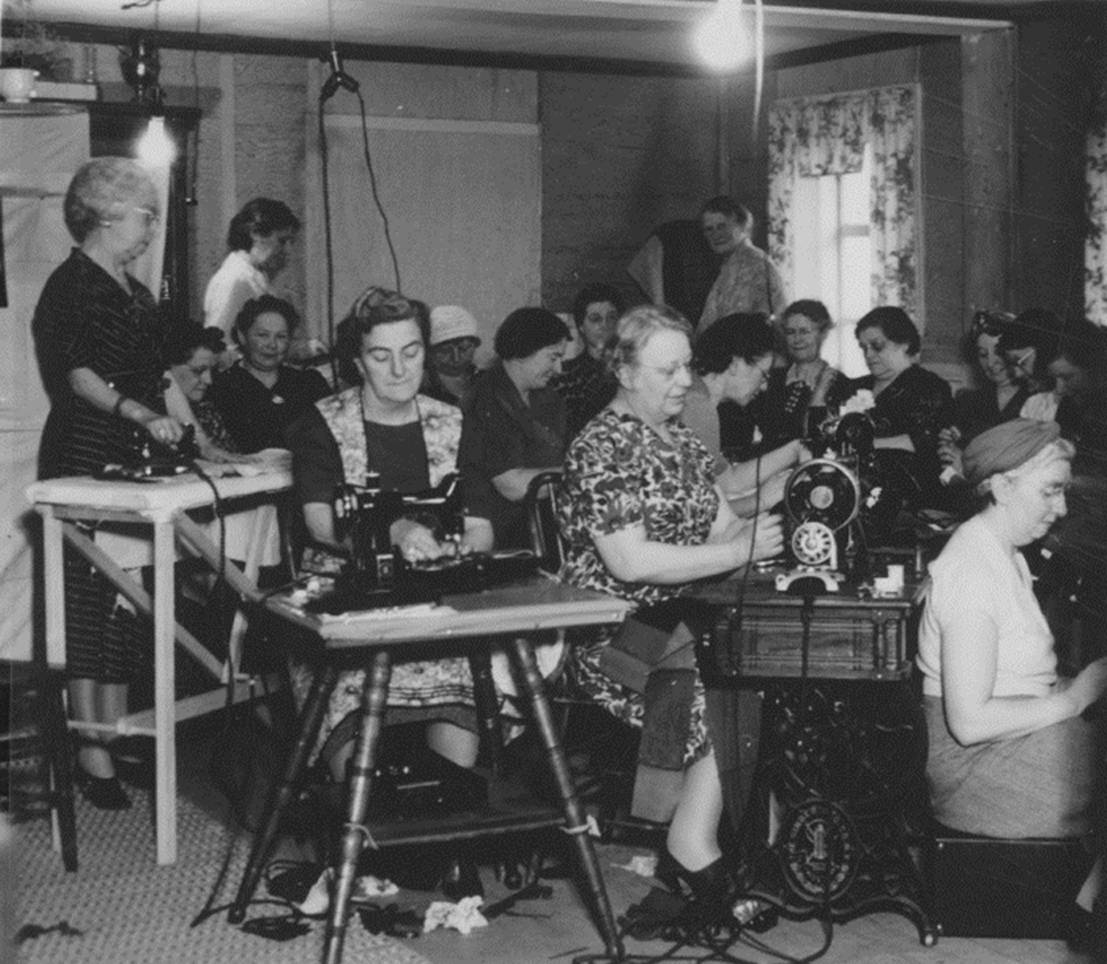
SITK25544.
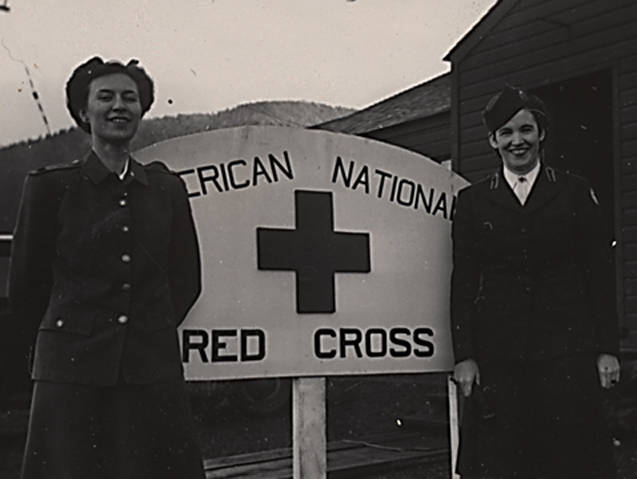
Red Cross sewing volunteers work in Sitka. Sitka History Museum E.W. Merrill collection,
