
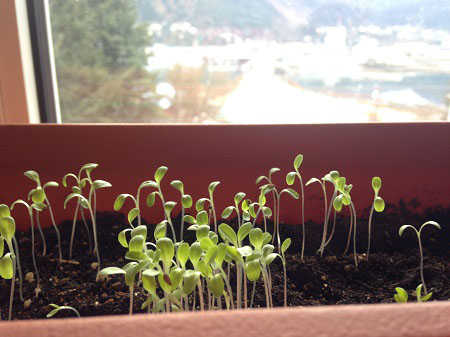
My neighbor greeted me the other day with a question: “Do you have any plants started?” I shrugged my shoulders to answer her obvious question. The truth is, I don’t really have an ideal space to create starts, but I can’t help but try.
Some people have the luxury of indoor gardening space this time of year. The time when plants need warmer temperatures to germinate. Unlike growing temperatures, most plants prefer the temperature to be around 70 degrees F. Even kale, that cold loving friend, likes to germinate between 60-65 degrees F.
People make do with all sorts of concocted nooks to help spring begin that much earlier. They use a heated garage with shelves and lamps. Some use a table set up by a window that gets that early morning light or a heating mat under their plants to warm the soil. Others are more fortunate.
Sandy Williams has two rooms in his house that he uses this time of year to begin new plants. He told me that the light needs to be placed directly above the seedlings. Plants are driven to grow towards the light. Placing it 12 or 18 inches away will cause the plant to grow vertically.
This growth leads to spindly plants that often don’t survive transplant. Plants that already need support, such as tomatoes and peppers, need to develop a strong stalk to create the ability to bear the weight when it fruits. A leggy plant just doesn’t do as well.
Sandy’s lights are on chains that are positioned to the correct height. He has a hook, so that when it’s time to raise the lights, he merely shortens the chain.
Ed Buyarski, at a Juneau Garden Club meeting, said he keeps the lights the same height, but uses wooden blocks to raise the plants to the correct height. As the plant grows, he removes some of the wooden blocks. This way, he can adjust the plant, rather than the light, which allows him to adjust to the specific needs of each plant.
Ideally, the light is just a few inches above the plants. If you use florescent lights, you don’t need to worry about overheating the plants because the bulb is cool. Check to make sure you aren’t burning your plants if you use a different light system.
One day I hope to have the kind of set up that Ed and Sandy have. For now, I’ve taken over the boat. The papier–mâché globe my daughter made three years ago is gone, replaced by a tray of leek seedlings, broccoli, cabbage and Brussel sprouts that I planted last week.
I’m hoping the angle windows above the steering column will provide adequate light but prevent that leggy growth. My fingers are also crossed that these sturdier type of vegetables will survive transplant.
If they don’t, then I will head over to the Williams in early May to pick up the tomatoes, cucumbers and zucchinis that he so tenderly preps. Sandy’s wife, Suzanne will be happy when some of those plants leave because she’ll have some room back for her plants. I’m sure she is not the only one who is glad when the starts currently taking over windowsills grow up and go away.
• Corinne Conlon is a freelance writer based out of Juneau. She can be reached at dirtgirlgardening@gmail.com.
