
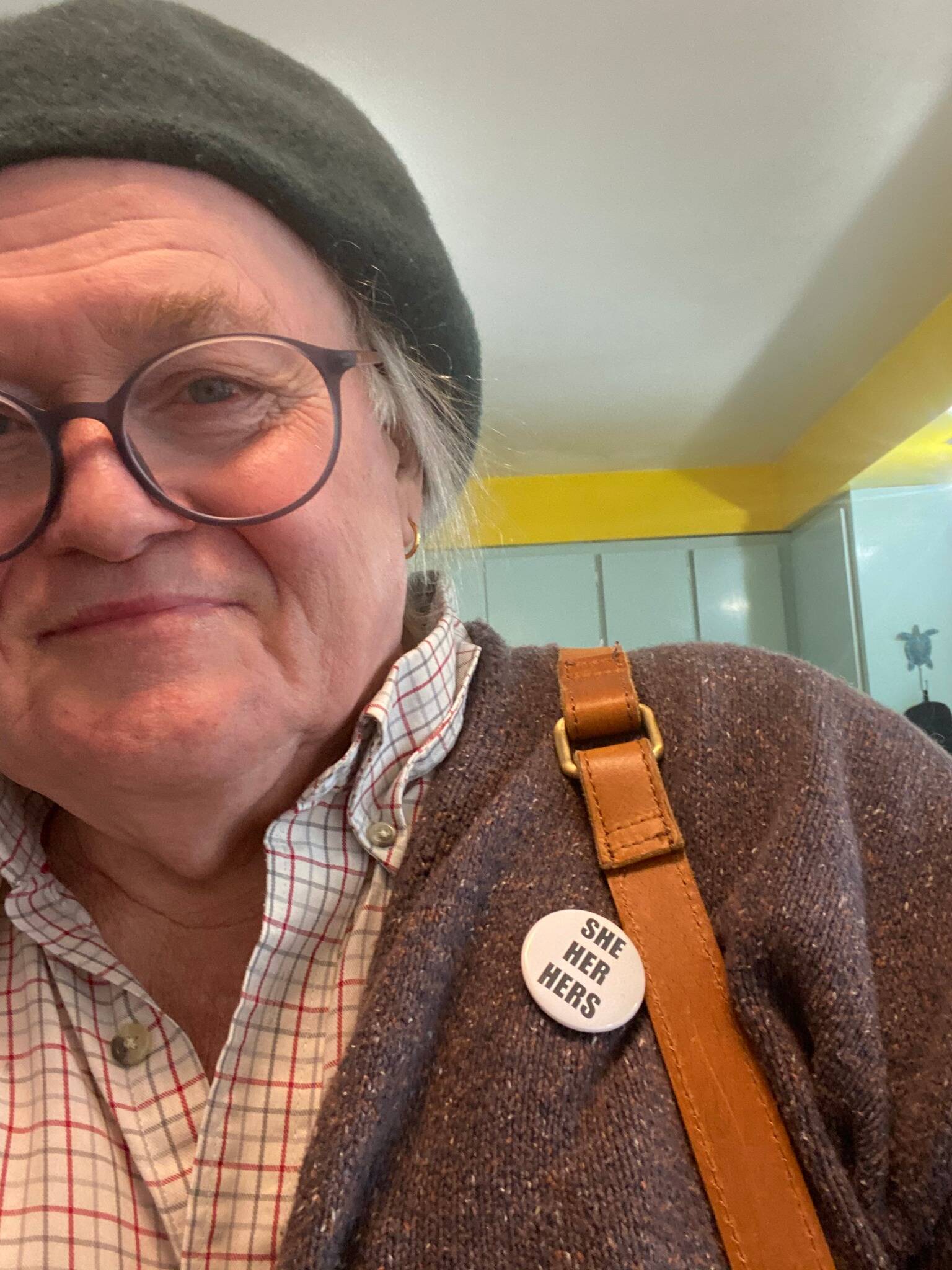
By Jane Hale
I didn’t know where it would lead when I started down this road, but I had made up my mind to explore, openly at long last, this abiding sense of myself as feminine. It wasn’t long before I began looking into hormone replacement therapy, HRT.
Feminine HRT for transgender persons consists of a regimen of estradiol, a form of estrogen, which can be taken in various forms, the safest of which for older persons like myself seems to be through a skin patch.
The hormone’s effectiveness can be heightened by the simultaneous administration of an anti-androgen or testosterone blocker, typically a medication called spironolactone, or spiro for short.
Over the last decade, researchers have found numerous problems with spiro. Summaries of those problems can be found in two articles that review spiro’s controversial side effects and examine the assumptions and financial incentives that keep medical practitioners prescribing it for transgender care: Beverly Cosgrove, “The Case Against Spironolactone” (2018) and Alex V Green, “Spironolactone, a Standard Drug in Hormone Treatment for Trans Women, Has Controversial Side Effects” (2019).
In my case, the problem with spiro was its potential to interact with a blood pressure medication I was on, Lisinopril. Both spiro and Lisinopril are “potassium-sparing” diuretics, which means that they make you urinate but don’t rid your body of potassium. In combination, the two can elevate your potassium to dangerously high levels.
I had not yet come out publicly when I decided to explore HRT, and I was still reluctant to come out to friends — in this case, my friends at Valley Medical, some of whom I’ve known for 20 years and who have always given me the best health care.
Coming out to strangers is easy. There’s no emotional investment to protect, no love for you to fear losing. What’s difficult is coming out to the friends and family who matter most and whose opinions you value. You know in your heart that they will love you and care for you wisely, but nevertheless, there’s no small trepidation in trying to find just the right words to say “I’m trans”—and then actually saying it.
So instead of relying on my friends, the professionals at Valley Medical, I opted to let another medical provider prescribe and manage my hormone replacement therapy — people I didn’t know but who boasted some experience providing hormone replacement therapy for other transgender folks.
Things went fine for the first month. The estrogen was having some delightful effects. The first change I noticed was in my fingertips; they felt drier, smoother, and that changed the way everything felt to the touch. I found myself reaching out to feel random objects: an apple, water, a brick wall, a wooden table top — random stuff. It all felt new.
But then, a month into the therapy, my dosages were increased. The increased estradiol was fine, but I began to experience some untoward side effects that, as I know now, came from the spiro: diarrhea, muscle cramps, lethargy. When the diarrhea persisted, I started worrying about dehydration. Unable to get an appointment right away at Valley Medical, whose staff have been way overworked during the pandemic, I returned to my HRT provider and was told simply that I needed more fiber in my diet.
The next day, despite my ingesting enough fiber to weave a blanket, the diarrhea and muscle cramps worsened, and I knew there was something more going on than not enough Raisin Bran. I got myself to the ER at Bartlett. Apparently, my HRT provider was not adequately monitoring my potassium levels. At Bartlett, the doctors promptly admitted me with hyperkalemia, a dangerous and potentially lethal elevation of potassium in the blood.
Hyperkalemia can kill you; it can stop your heart from beating. Normal levels range between between 3.5 and 5.0 mmol/L (millimolars per liter, a measure of a chemical compound’s concentration). Levels above 5.5 are defined as hyperkalemia. Mine was a potentially heart-stopping 6.5.
The first of the two doctors I saw in the ER told me point blank: “No more spiro. You are off spiro right now.”
I didn’t argue. I spent the next two days at Bartlett being closely monitored and having my potassium levels restored to normal before the doctors felt it safe to release me.
There’s no excuse for sloppy medical care, but ultimately, what imperiled me was the stigma of coming out, of going public about being transgender or non-binary. That stigma kept me from relying at the very start on those professionals I had learned to trust and whose medical care has guided me wisely through numerous medical crises over the last quarter century. Instead, I turned to strangers for medical care and could have died.
The stigma of being transgender or non-binary—that’s the danger we need to confront. It threatens not just our freedom to openly choose the life we want. When it interferes with our getting appropriate and adequate health care, that stigma can kill.
• Jane Hale spent her first 69 years writing as Jim. She is a longtime Juneau resident. “Coming Out” is a biweekly column. It appears on the Empire’s Neighbors page.
