
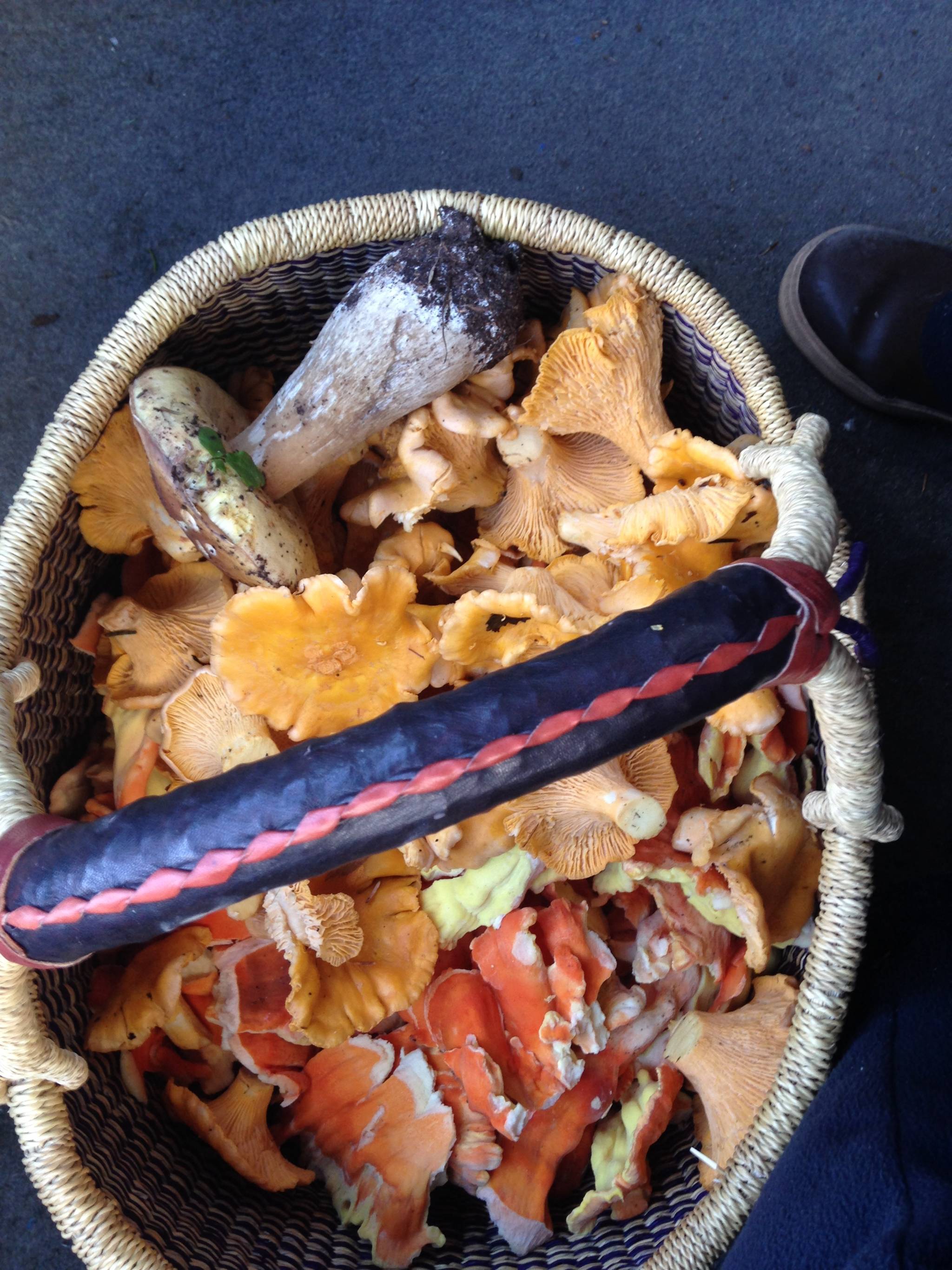
My friend back East cautioned me against mushrooms. She told me of someone she knew, a lifelong wild mushroom enthusiast, who ate the wrong one and died. For a long time, I stopped hunting mushrooms. Yet, it is difficult going back to store bought mushrooms when you’ve experienced local, fresh mushrooms. I’m still cautious, but I enjoy these fall days with the possibility of what is emerging from the mycelium layer underneath my feet.
Although there are other mushrooms that are safe to eat, I focus on those that can’t be mistaken for others. If I’m not 100 percent certain, I resist the urge to take a chance; even when I am 99 percent sure that it is non-toxic. In the end, restraint is best. I have concern for Facebook pages with inadequate photos of mushrooms with identification requests. I was taught that you should look at least at two guidebooks to determine what you have and even then, it was best to have a skilled person be with you for that identification.
There are four different types of mushrooms that I collect. Each of them has characteristics that make it difficult to confuse with other fungi. The first is the bolete or porcini. These mushrooms have a relationship with one specific spruce tree. So, if you find a bolete, mark that tree and keep searching for others that come up.
The bolete has a sponge-like bottom on the underside of the cap. This porous section isn’t something you’re going to want to sautee, but it is good to dry. I’ll later grind it into a powder to add to dishes. The top of the cap and the large stem are the prize sections. Slugs and worms love this mushroom. Most of the time you’ll break apart the stem and find it happily being digested by invertebrates.
Take a look around for a slight rise near the tree roots. Sometimes you can catch the mushroom before it emerges and you might not have to share this covetous treat. To preserve it, slice up the stem and the top portion of the cap to eighth or quarter inch pieces to dehydrate.
Chicken of the woods is a bright orange mushroom with a yellow underside. It’s a shelf mushroom that grows on decomposing trees, which can still be upright or logs on the forest floor. As I walk in the under canopy, I stop occasionally to look up and pivot to see if I can spot the orange color. I harvest what can easily break off the wood. Some people bring knives to slice them off, but that woody, hard part usually needs to be removed before cooking anyway.
As this mushroom appears earlier, I tend to eat it rather than preserving it for later. You can cut it up into fine slices and dehydrate it. It makes a nice mushroom powder to add as a seasoning. Chicken of the woods also can be sliced and frozen as it freezes well. This method can be a little less taxing then dehydrating.
Hedgehog mushrooms are another edible. They are a toothed mushroom, which have eighth-inch or smaller spikes or teeth on the underside. Although looking for mushrooms based on color is like determining what kind of bear you’re seeing. Colors can vary widely, but usually, hedgehogs are a beige color with a small stalk.
Another favorite is the Pacific Golden Chanterelle. This has a false gill. Gilled mushrooms run the risk of being misidentified, but a false gill has a fused-like quality to it. I’ve heard references comparing it to an upside down lightning bolt. Normally this fungi has an ochre color.
Both the hedgehog and the golden chanterelle caps and stems can be eaten. The smell of these mushrooms sliced and sautéed with a bit of butter reminds me of fall in the same way that roasted vegetables tells me that the seasons have changed.
Another variety is the winter chanterelle. Currently, these are popping out all over. They are fragile compared to the golden variety, but they have the same fused gills. Take a careful look as there is another mushroom, a gilled one, with a similar appearance. Check to make sure it has false gills as the other variety can cause some stomach irritation.
I tend to throw the whole winter chanterelle in soups for a lovely bit of flavor. When I dehydrate, I dry the whole mushroom, rather than slicing it into small segments.
As with any wild food, different people react differently. It’s good to sample a small bit and see how you react to that food. But, if you find yourself in the woods and you come across mushrooms that are edible, you are in for an earthy treat. Better yet, find someone who knows mushrooms to take you out on an adventure.
Corinne Conlon lives and writes in Juneau.
