

SITKA, Alaska (AP) — A group of kids gathered in the Japonski Island boathouse, sporting safety goggles and noise-canceling earmuffs, to begin to assemble pieces of two dories in the making.
The budding boatwrights are participating in a 4-H program to build two rowing and sailing dories in weekly Sunday afternoon installments and under the supervision of local boatwrights Paul Rioux, Tom Crane, Terry Perensovich and Joe D’Arenzio. The project kicked off in early April and is scheduled to conclude at the end of May.
The goal is for the program participants and others to be able to use the boats this summer: 4-H is partnering with Southeast Alaska Independent Living for a boating camp in June, and will host monthly boating days as weather allows.
Rebecca Poulson, director of the Sitka Marine Heritage Society, which owns the boathouse, said she did not know if any boats have ever been built in the historic Japonski Island building, whose original purpose was for boat maintenance and repair.
During an earlier session, the dories were just beginning to take shape, and the boathouse was in a flurry of activity.
Rioux, one of the adult supervisors, put out a call for copper nails and a hammer, and several sets of sneakers scurried across the sawdust on the floor in search of the items.
“Incoming! Giant clamp,” shouted one kid from the other side of the shop, as he carried the tool across the threshold of the back door.
Eliot Holloway, 12, sanded a piece of wood he believed would ultimately be a seat in one of the dories.
“I’ve learned that a boat takes a while before it actually starts looking like a boat,” he said.
A boat takes a lot of community support, too, before it can enter the water.
In Sitka, the national 4-H youth program is co-run through the UAF Cooperative Extension Service and the Sitka Conservation Society, which rustled up some Southeast wood for the project. The Sitka Maritime Heritage Society partnered with the local 4-H chapter for their boat-building endeavor, contributing a space for the dories to be assembled and stored, and the tools necessary to build them. And Mark Sixeby of both the Sitka National Park and the Sitka Tribe of Alaska will help the kids build oars in an auxiliary project in June.
The boat-building project is Sitka’s “largest youth build 4-H project to date,” said Jasmine Shaw, the UAF Cooperative Extension point-person in Sitka.
While many of the project’s partners have signed on in recent months, for Rioux, a boat-building course has been in the works for years.
Rioux, originally from Maine, procured the plans currently being used for the dories during a trip back East over a decade ago.
The boats’ model is a “Teal,” he said, and the designer is Phil Bolger from Massachusetts.
“Bolger had a partner named Dynamite Payson that lived in Spruce Head (Maine), and my oldest son and I, when we were home visiting my parents, drove out and met Dynamite Payson and got the plans from him originally,” he said. “That was a long time ago.”
Each boat will have two rowing stations, Rioux said. They will also have the capacity to be set up for sailing — “not simultaneously,” the 4-H leader joked — and Rioux has a collection of salvaged sails for such a purpose.
As Rioux began to voice his idea for a boat-building program around town, he found that several others shared his vision, each with a skill set to bring to the table.
“Once we started having conversations about town, it kind of got around, and eventually formed into this,” said Rioux, who works at Precision Boatworks. “Personally, I have tool skills, and layout skills because I work on boats all the time, but Terry and Joe and Tom are the real actual shipwrights. They’ve professionally done wooden boatwork before.”
Just as the subject matter fell squarely within the four leaders’ wheelhouses, the boat-building project aligned with the mission of the Sitka Maritime Heritage Society, which has been breathing life back into the historic boathouse.
“Ever since we got the building, in (the) mid-2000s, the idea has been to restore it as a public, interpretive working boat haul out (and) workshop, and turn the storeroom into a multi-use exhibit and gathering space,” Poulson said. She noted, too, that the organization aims to preserve maritime heritage and “pass that along to young people to carry it on.”
Originally constructed in 1941 for storage and maintenance, the boathouse was expanded for boat repair during World War II. It has a marine railway that was used to haul out and repair the wooden shoreboats that ferried passengers between town and Japonski Island before the O’Connell Bridge was built in the early 1970s.
In the early 1980s, “the federal government divested of most of Japonski Island, and the boathouse and a huge chunk of property went to the state,” Poulson said.
The state began to tear down the scores of wooden buildings built on Japonski during the war, and the boathouse was on the list for demolition when local historic preservation activists and members of the Sitka Shipwrights Cooperative stepped in.
Working with city officials, they had the state deed the boathouse property to the city, with the understanding that it would be turned over to the new non-profit Sitka Maritime Heritage Society under a long-term lease.
Since then the society’s formation, its members have replaced the structure’s foundation and roof with their own labor, and have obtained grants for continued upgrades. This summer, they will be focusing on installing a small addition and insulation.
As far as Poulson knows, over the boathouse’s long and varied history, “no boats were built there…It was a repair shop.”
The SMHS entered into a contract with 4-H earlier this year, allowing the program to make use of the boathouse, and plans to build on the project’s momentum in the months to come with educational events, a work party, two classes next winter (including one on wooden rowboats), and exhibits.
As long as the list of the project’s community stakeholders may be, the list of benefits for its participants is even more extensive. Shaw cited “youth empowerment, development of direct hands-on skills, independence, job training, positive adult mentorship, new partnerships, discovery of new passions, self-esteem development, (and) social skills” as a few of the things kids stand to gain through the project, and also emphasized the value of working toward “a tangible goal.”
Rioux, who has also taught 4-H courses in shooting sports and animal tracking, pointed to the benefit of kids having adults in the community they can look up to and rely on.
“It’s a mentor situation, where they’re developing a relationship with an adult in their community outside of their parents,” he said. He emphasized the challenge of the task at hand, and the pride that would come with its completion. “They’re taking something that’s a drawing — it’s just something on a piece of paper with a bunch of numbers and lines — and they’re recreating that into something in real life,” he said. “The fact that they get to see the project through from beginning to end, actually make something useful, is part of that, as well. You don’t see a lot of people using handmade boats anymore, but it used to be a super common thing, especially in this community.”
For many of the participants, the project is also just plain fun.
Marina Marley, 10, said she had signed up because “it sounded cool, and I wanted to build a boat.”
She had been familiar with a couple of saws and drills the boatwrights are using prior to the project, she said, but it had been fun to learn about others, like the block plane.
Now, Marley said, she’s having such a good time on Sunday afternoons at the boathouse that she’s hoping her parents will help her continue with her new hobby after the dories are finished.
“They say that maybe we could build one at home,” she said.
Julia Nabua, 11, said this was her first 4-H project.
Already, she said, she had learned about several different tools and developed a favorite: the band saw.
“I didn’t know this tool ever existed,” she said.
Nine-year-old Garrett O’Brien’s parents looked on as the kids made their way around the boathouse.
“He’s absolutely loving it,” his mother, Lisa, said. “It’s an opportunity to learn something you wouldn’t otherwise get a chance to learn.”
Garrett’s father added that his son’s decision to participate in the program hinged, in large part, on its leaders.
“He really likes being a part of Paul Rioux’s programs,” he said. “He’s been in several, and he’s had a lot of fun with everything that he’s done with him.”
This project, he said, was “definitely a bit different” from the other projects Garrett had done with Rioux.
“All the kids seem to be enjoying it so far — I know ours is,” he said.
The program is, in fact, so popular that organizers call kids up off of the wait list if they know one of the registered participants will be absent. There are 13 participants any given Sunday, but some 18 kids have been able to take part in the project, Rioux estimated.
Among the many ‘firsts’ the project represents – for the boathouse, for example, or 4-H – are new experiences for the kids who participate.
Silas Marley, 7, said that he had signed on to the project because he was eager to learn “how to make boats and stuff.” In the early weeks of the project, he remembered, certain tools were off-limits to him because of his young age, but the seven-year-old has since grown into greater responsibilities.
“They said that I couldn’t really use electric tools,” he said. “Now they’re letting me, so I’m kind of glad.”
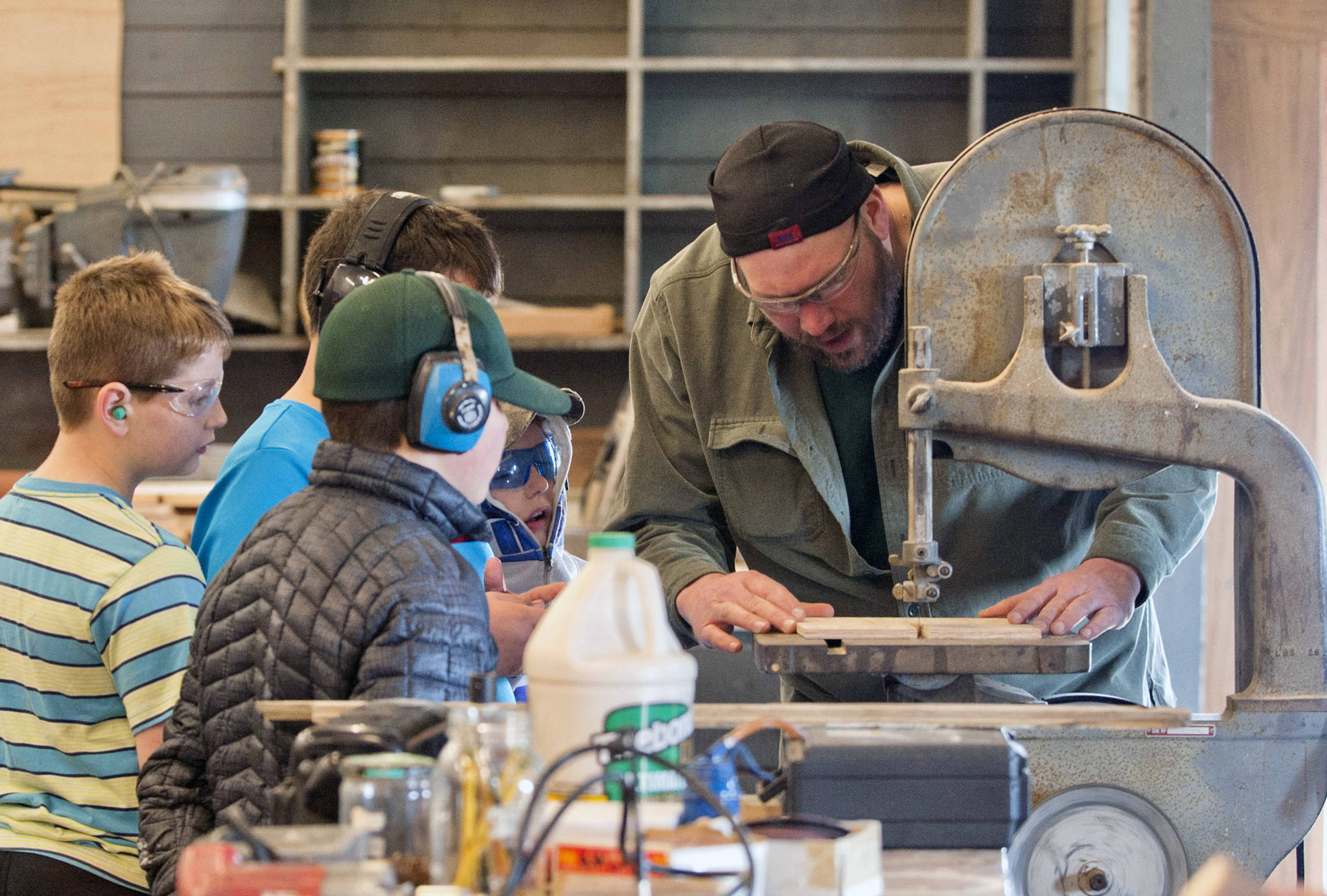
In this April 29, 2018 photo, Paul Rioux shows 4-H students how to use a bandsaw at the Sitka Maritime Heritage Society’s WWII-era boathouse in Sitka, Alaska. The budding boatwrights are participating in a 4-H program to build two rowing and sailing dories in weekly Sunday afternoon installments and under the supervision of local boatwrights. James Poulson | Associated Press
