
What’s a restless naturalist to do, when most of the ground in covered with soggy snow and strong signs of spring seem reluctant to appear? Although the varied thrushes and juncos are singing, and the skunk cabbage has poked up in some places, some of us get a little impatient for more. One option for our edification is walking the beaches in hopes that something of interest will show up (it almost always does!).
On the way to Crow Point via the Boy Scout trail, small gaggles of garrulous geese flew from the river over to the far end of the wide, flat meadow. (Do they ever stop talking, except maybe when sleeping?)
Crows were beach-combing, dozens of them, all scattered along the line of the advancing tide, perhaps nabbing small prey that were activated by the onward rush of water.
Overhead, winging northward, were three elegant trumpeter swans. Although most trumpeters nest in the Interior, a few nest near the north end of Lynn Canal. It’s always a treat to see them, if only in passing, and that was the main “payoff” for post-holing my way out to the beach. There had been strangely little foot traffic out this way, so post-holing was the only way to go.
On another day, for no accountable reason, I suddenly was possessed of the notion to look for mermaid’s purses. These are the egg and embryo cases of skates (relatives of rays and, more distantly, sharks). So I went to a beach where I’ve occasionally found them before, washed up on a big tide. Bingo! I found four of them: one black, dry, and dead, two much fresher, yellowish green, but ripped open, perhaps by an enterprising raven, and the embryos gone. The other one was intact, and I tossed back into the water, in case the embryos had survived their stay on the beach.
A short chunk of timber had washed up on the shore of Eagle Beach. It was completely riddled by smooth tunnels, about the diameter of a finger. Aha! Teredos had been at work. They’re also known as shipworms for their unpopular habit of mining into wooden ships. Teredos are really molluscs, albeit with a worm-like body. They can get to be over 2 feet in length, long, soft, and quite slender, with two very small, ridged shells at the front end. Those shells grind their way into wood as a teredo rasps its way along. The wood particles are digested, with the help of symbiotic bacteria that live in special cells in the animal’s gill. Teredos also eat plankton, which are inhaled by a siphon at the rear end of the body, and pass over the gill on the way to the mouth.
A teredo gets its start when a free-swimming larva finds a suitable piece of wood and settles down, attaching itself by means of byssal threads, such as one sees on mussels and other sedentary molluscs. The larva softens the wood at the attachment point, and then transforms into the adult shape and starts boring. Naturally, the tunnel gets bigger as the teredo grows and moves ahead.
Teredos are somewhat related to piddocks, another kind of clam that tunnels into hard substrates (and which have appeared in these essays before). Piddocks are clearly recognizable as a type of clam, but the stout shell is more curved and has “teeth” along the edge. Piddocks use their burrows just for shelter and filter-feed on plankton, like “normal” clams. A likely evolutionary link between teredos and ordinary piddocks is a group of distinctive wood-borers that use symbiotic bacteria to aid digestion, as teredos do, but the shells are more complex and substantial than those of teredos, a little more like the huskier ones of piddocks. Tunneling into wood (and rock, in the case of piddocks) is the way of life for a considerable array of clams, apparently, a surprising twist on our conventional view of more familiar, sediment-dwelling clams.
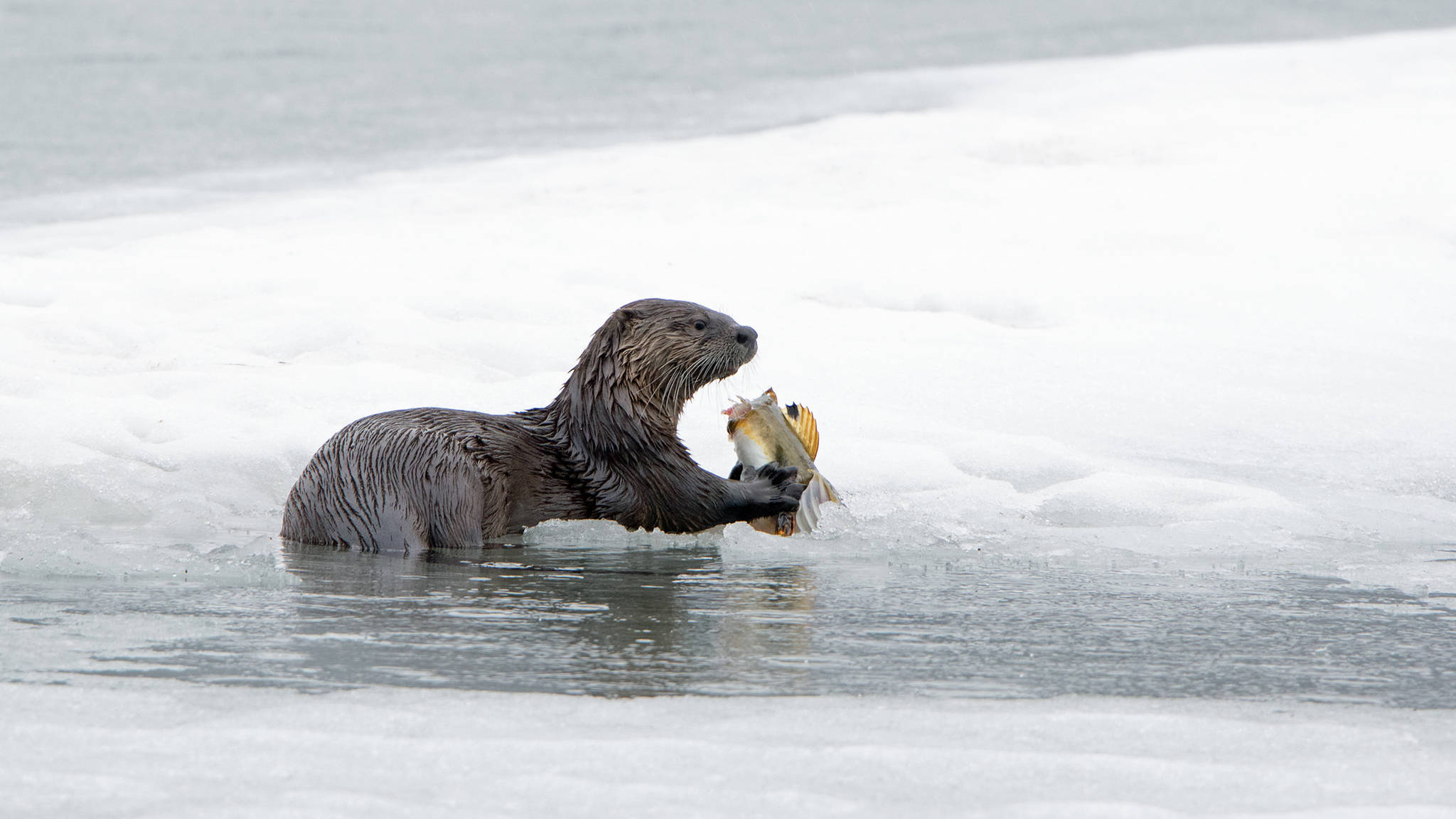
At Twin Lakes, the ice was dotted with open holes. A friend watched a river otter that was actively fishing — it caught and ate almost a dozen fairly small fish in a couple of hours. Then it caught a starry flounder; an eagle was watching and came down to snatch it away, but the otter saw the eagle coming and dove quickly, holding onto its prey. Later, the otter caught a big staghorn sculpin, hauled it out onto the ice, and began eating it, looking around for that thieving eagle. Down came the eagle, very fast, and ripped the sculpin right out from the otter’s feet. The otter dove beneath the ice, and the eagle had a good breakfast.
Thanks to Aaron Baldwin, Alaska Department of Fish and Game, for expanding my knowledge of teredos and their relatives.
• Mary F. Willson is a retired professor of ecology.
