Alaskaepoedia — The Whale Edition
Published 10:39 am Friday, June 22, 2018
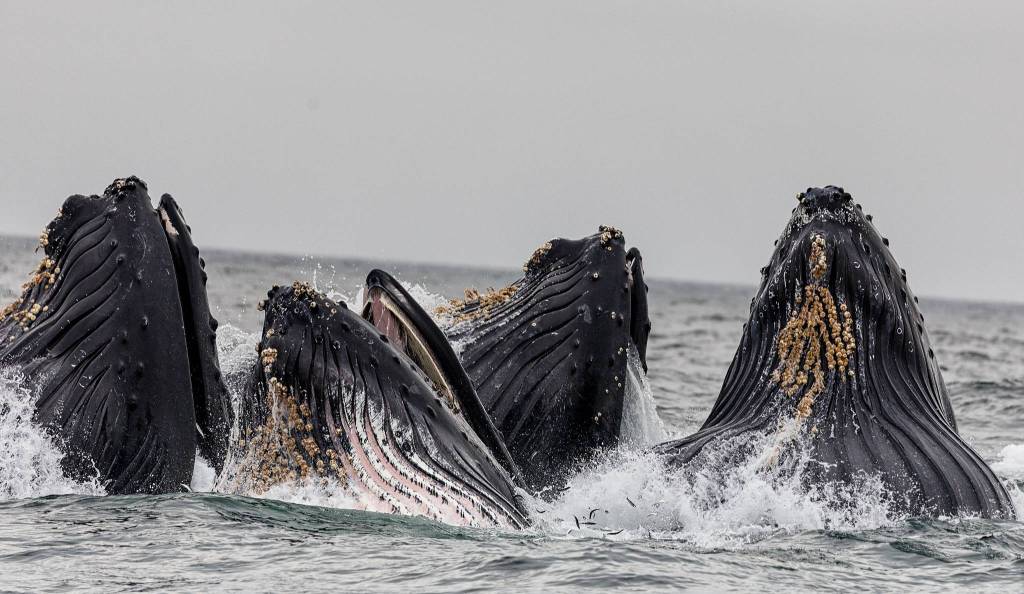
Whales are a diverse group of fully aquatic placental marine mammals, although the term “whale” may also refer to a Swedish alternative band, a deep cut from the 1977 Electric Light Orchestra double-LP “Out of the Blue” and a hamlet in the Eden District of Cumbria, England. Aren’t you glad you kept your newspaper subscription, so you could learn those fun facts?
Whales evolved from — or, if you prefer, were intelligently designed based on blueprints for — terrestrial animals, leaving land approximately 50 million years ago. Today, they are completely adapted to life in the open ocean, feeding, mating and raising their young at sea. In a growing trend, most whales opt for a “water birth.”
Known for their intelligence, sociability and physical presence, whales range in size from the nine-foot, 300-pound dwarf sperm whale to the 100-foot, 200-ton blue whale. In fact, blue whales are the largest animals that ever lived (although best not mention it — they tend to be touchy about their girth, especially during swimsuit season).
Humans have long prized whales for their meat and blubber, as well as their baleen, primarily for use a living room wall decoration, usually hung between some type of string band instrument you don’t actually play and a Rie Muñoz print. As such, whales play a prominent role in the arts, culture and mythology of numerous human societies. They also turn out to make really contentious public sculpture subjects.
Once relentlessly hunted for their products, whales are now protected by international law. In Alaska, subsistence whaling remains an important part of Alaska Native culture, while whale-watching rates as one of the state’s most popular tourist activities. Speaking of, have you ever gone whale watcher-watching? Man, when those whale watchers finally come up from their iPhones to group feed on smoked salmon and cream cheese bagels … intense.
Types
Whales are divided into two major groups: Mysticetes, baleen whales, and Odontocetes, or toothed whales. Both can vote in either primary.
Six species of dolphins, including the orca, or killer whale, have the word “whale” in their name, even though they’re not whales at all. Don’t worry. Lawsuits have been filed.
Biology
Whales have torpedo shaped bodies featuring non-flexible necks, limbs modified into flippers and a large tail fin. When swimming, whales rely on their tails to propel them. The flippers — which actually contain four digits, analogous to human fingers — are for steering (and flicking off porpoises).
All whales have a thick layer of blubber. This helps with buoyancy, protection from predators and energy for migrating; but blubber’s primary usage entails providing insulation from the harsh marine environment. Plus, I don’t know about you, but I like a cetacean with a little meat on its bones.
As mammals, whales must breathe air, but can dive to great depths for long periods of time. This makes them extremely frustrating to play “Marco Polo” with.
Odontocetes lack olfactory bulbs and can’t smell prey. However, equipped with biological structures for sending and receiving sound pulses, all toothed whales echolocate. So if you’re a young toothed whale reading this, don’t worry, totally normal — you won’t go blind or grow hair on your fins.
All whales are carnivorous and predatory. Toothed whales mostly feed on fish and cephalopods, unless they had fish and cephalopods for lunch, in which case, they may not be in the mood for fish and cephalopods. Got any crustaceans? Mysticetes eat krill and plankton … and, every once in a while, a long-nosed wooden puppet on his quest to become a real boy.
Behavior
Whales are known for their sound-making behavior, producing a wide variety of vocalizations. For instance, pretty much every whale does a passable Borat. Some species, such as the humpback, communicate using melodic sounds, known as whale song. Male humpbacks produce an especially complex whale song, typically 10-20 minutes in length, repeated for hours at a time. Like techno. Its purpose is not clear, though scientists believe it has a role in mating. Also like techno.
Most whale species prefer the colder oceans of the Northern and Southern Hemispheres, seasonally migrating to and from the tropics to give birth. During these journeys, whales are capable of traveling thousands of miles without feeding. Not me; I’m like non-stop Northwest Picnic Packs all the way to Seattle, then it’s straight to Q’doba — by way of Beecher’s Handmade Cheese.
Seven species of whales frequent Alaska’s waters each summer: beluga, humpback, grey, bowhead, blue, right and Minke. And not a single one pays a head tax. Outrageous! Whose public bathrooms do they use? What fire department do they call?
Of course, whales also enjoy a notoriously strong maternal instinct; mothers will nurse their young for up to two years. This may sound like a long time, but then, you probably know several humans who breast-fed their human children until they were old enough to request it — in writing.
How do you circumcise a whale?
Send down four skin divers.
• Geoff Kirsch is an award-winning Juneau-based writer and humorist. “Slack Tide” appears every second and fourth Sunday.