
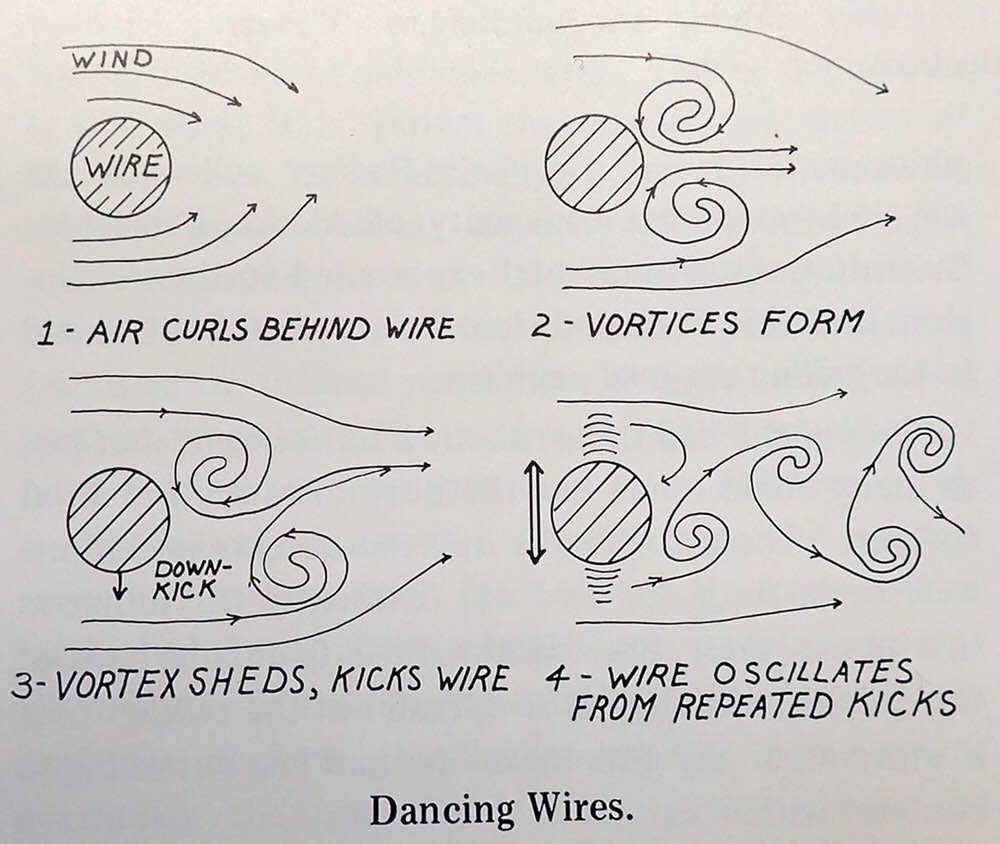
An illustration of wires affected by air movement, drawn by Patricia Ann Davis, from the book Alaska Science Nuggets by Neil Davis.

An illustration of wires affected by air movement, drawn by Patricia Ann Davis, from the book Alaska Science Nuggets by Neil Davis.

Alaska Science Forum: Mystery of the dancing wires revealed

In this quiet, peaceful time of year, with all the noisy birds flown south and all the scary bears in hillside dens, little things catch our attention. Like wires that move as if by magic.

Aurora scientist and interested-in-all-things guy Neal Brown contacted me to see if I had written about why power wires sometimes dance to their own beat when there seems to be no wind or other force pushing them. He notices it seems to happen when the temperature is rising. I pulled out Neil Davis’s Alaska Science Nuggets and found the answer.

First, though, a refresher on that book — a compilation of 400 of these columns — and why you are reading this right now.

Neil Davis was a do-all scientist at UAF’s Geophysical Institute from the 1960s to the 1980s. He started this column in 1976 at the urging of a newspaper editor. Davis wrote hundreds of the columns, which the Geophysical Institute has distributed free to newspapers. Other writers took over the column from Davis. I am the latest in that line, having started in fall of 1994. The directors of the Geophysical Institute have supported the column since its beginning.

Back to the dancing wires. Each wire out there has a certain tune to which it responds, known as a resonant frequency. It’s what a little girl finds when she twirls a jumprope at just the right speed and gets a perfect loop whistling through the air.

Sometimes, even if we can’t feel it, a slight breeze nudges a power wire. Wires are even more responsive to wind when snow clings to them, as it often does up here in the Interior.

“If the wire can be repeatedly tickled ever so slightly at the proper frequency, it will build up a major oscillation,” Davis wrote.

To move, wires need energy applied at their ends or in the middle. The latter is similar to a finger picking a guitar string. In this case the wind is acting as the finger.

As a guest writer of this column in 1978, late butterfly and moth expert Ken Philip described the process:

“Air moving past the wire is impeded by the wire; the air closest to the wire moves the slowest. The result is a curling up of the air behind the wire to form vortices — rotating spirals within which the air spins faster the closer it is to the center.”

These invisible little curls of air shove the wire as they depart. Sometimes those kicks happen at the sweet frequency of the wire, which responds by moving.

For the overly curious who must confirm things, Philip suggested blowing soap bubbles. They will float on a breeze that no cheek or anemometer can detect, allowing you to visualize the air that tickles the wire.

Since the late 1970s, the University of Alaska Fairbanks’ Geophysical Institute has provided this column free in cooperation with the UAF research community. Ned Rozell is a science writer for the Geophysical Institute.

More in Neighbors

Peggy McKee Barnhill (Courtesy photo)
Gimme a Smile: How much snow can one backyard hold?

Snow, snow, everywhere, and no place to put it!

The Spruce Root team gathers for a retreat in Sitka. Spruce Root, is an Indigenous institution that provides all Southeast Alaskans with access to business development resources. (Photo by Lione Clare)
Woven Peoples and Places: Wealth lives in our communities

Sustainable Southeast Partnership reflects on a values-aligned approach to financial wellness.

Actors in These Birds, a play inspired by death, flowers and Farkle, hold ‘flowers’ during a performance at the UAS Egan Library on Saturday, Jan. 31. (photo courtesy Claire Richardson)
Living and Growing: Why stories of living and dying in Juneau matter

What if we gave our town a safe space to talk about living and dying with family and friends?

calendar
Weekly events guide: Juneau community calendar for Feb. 2 – Feb. 8

Visit Juneau Arts and Humanities Council at JAHC.org for more details on this week’s happenings.

calendar
Weekly events guide: Juneau community calendar for Jan. 26 – Feb. 1

Visit Juneau Arts and Humanities Council at JAHC.org for more details on this week’s happenings.

Courtesy photo
Adam Bauer of the Local Spiritual Assembly of Bahá’ís of Juneau.
Living and Growing: Surfing into the future

Many religious traditions draw strength from the past.

calendar (web only)
Weekly events guide: Juneau community calendar for Jan. 19-25

Visit Juneau Arts and Humanities Council at JAHC.org for more details on this week’s happenings.

(web only)
Weekly events guide: Juneau community calendar for Jan. 12-18

Visit Juneau Arts and Humanities Council at JAHC.org for more details on this week’s happenings.

Four members of the Riley Creek wolf pack, including the matriarch, “Riley,” dig a moose carcass frozen from creek ice in May 2016. National Park Service trail camera photo
Alaska Science Forum: The Riley Creek pack’s sole survivor

Born in May, 2009, Riley first saw sunlight after crawling from a hole dug in the roots of an old spruce above the Teklanika River.

Sun shines through the canopy in the Tongass National Forest. (Photo by Brian Logan/U.S. Forest Service)
Opinion: Let’s start the New Year with an Alaskan-style wellness movement

Instead of simplified happiness and self-esteem, our Alaskan movement will seize the joy of duty.

January community calendar
Weekly events guide: Juneau community calendar for Jan. 5-11

Visit Juneau Arts and Humanities Council at JAHC.org for more details on this week’s happenings.

Kaa Yahaayí Shkalneegi Muriel Reid photo
In 2024, SSP’s Regional Catalysts attended and helped with the Kake Culture Camp hosted by the Organized Village of Kake. The goal was to be in community, grow our relationships, and identify opportunities to support community priorities determined by the community itself.
In 2024, SSP’s Regional Catalysts attended and helped with the Kake Culture Camp hosted by the Organized Village of Kake. The goal was to be in community, grow our relationships, and identify opportunities to support community priorities determined by the community itself. (Ḵaa Yahaayí Shkalneegi Muriel Reid photo)
Woven Peoples and Place: Don’t be an island, be amongst the people

Láaganaay Tsiits Git’anee and Shaelene Grace Moler reflect on celebrating values in action.