
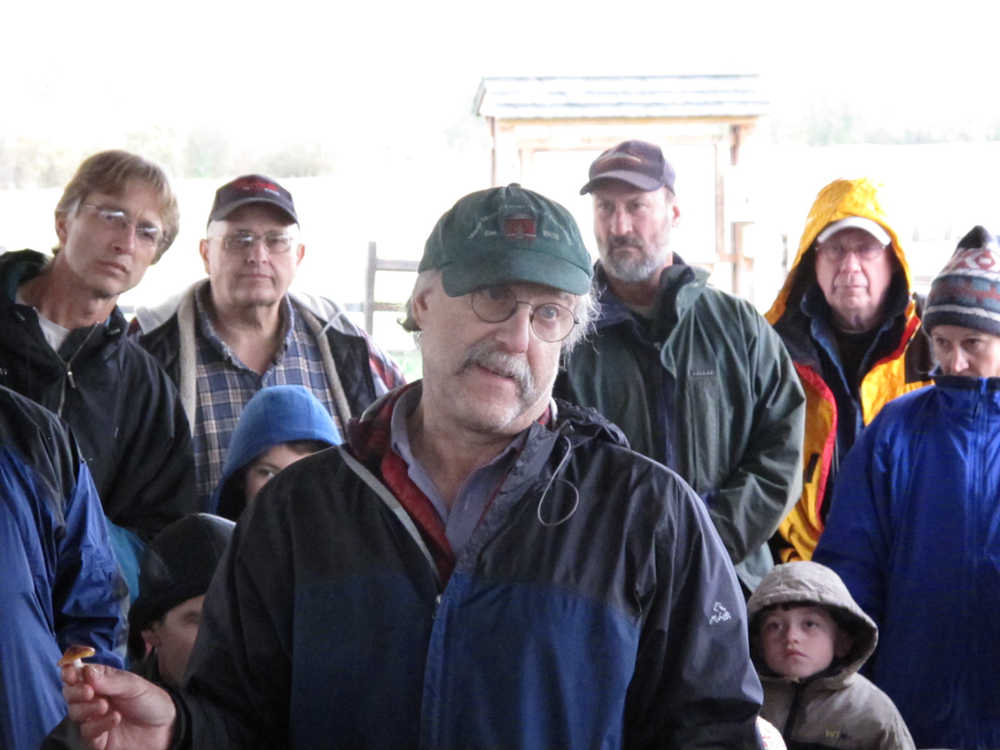
Alaskans love fungi. This was evident one Saturday when author and mycologist Lawrence Millman offered a mushroom walk at Creamer’s Field on one of the wettest days of the yellow-leaf season.
“Eighty people showed up in the rain, all eager to learn about fungi,” Millman said by email after returning to his home in Massachusetts. “I dare say the hunter-gatherer instinct is alive and well in Fairbanks.”
And why shouldn’t it be, since Fungus Man made life possible? During a lecture at the University of Alaska Fairbanks, Millman introduced the crowd to Fungus Man, a character in a Haida myth. Millman showed a drawing depicting a wide-eyed Fungus Man paddling a canoe. Fungus Man guides Raven, who sits in the front on the canoe holding a spear.
As the legend goes, Fungus Man paddled Raven the Creator to the land of female genitalia, “thus making it possible for (man) to appear on our beleaguered planet,” Millman said.
Robert Blanchette of the University of Minnesota once fleshed out Fungus Man in the journal Mycologia: “Fungus Man originated from a bracket fungus with a white undersurface upon which Raven drew a face . . . Of all the creatures that Raven placed in the stern of the canoe only Fungus Man had the supernatural powers to breach the spiritual barriers that protected the area where women’s genital parts were located.”
So, we owe a lot to fungi, one of five kingdoms of living things, chock full of puffballs, mushrooms and other examples of what Millman calls “incredible and essential biomass.”
The kingdom of fungi includes mushrooms, which are the fruiting bodies of a more complex organism hidden underground. Without fungi, the boreal forest would neither grow nor decay.
Fungi were important enough to Southeast Alaska and other Pacific Northwest Natives that figurines carved from “conks” (shelf fungus that grow from birch and other trees) were placed upon the graves of shaman to protect them during their “long death sleep.” Blanchette wrote this in an article about bear, eagle and human figurines, swiped from the shaman graves in Southeast Alaska by collector George Emmons from 1880 to 1900. Emmons shipped them away to a museum in Chicago, where people mistook them for wood.
But Millman, a frequent visitor to the far north, noted in his lecture that Interior and coastal Alaskans didn’t seem to have the same reverence for fungi as the Southeasterners. Though he notes the use of puffballs to stop bleeding (the spores are about the same size as blood cells), he has found little evidence of ancient northern Alaskans eating mushrooms, the fruiting body of a fungus.
Perhaps, he said, it was because a Yupik translation of mushroom means “that which makes your hands fall off.” Also, some Natives of the far north explained mushrooms as “the (excrement) of shooting stars.”
“You don’t invite people to dinner to eat (excrement),” he said.
Another possible theory for the absence of mushroom consumption among far northern people is because fungi are poor in calories. Millman mentioned the term “rabbit starvation,” a phrase used to describe how someone could perish on a lean diet of only snowshoe hare meat. Mushrooms offer even less of what it take to propel a body.
“If you’re on the move, you need calories,” he said.
Millman is a champion of fungi, essential to life but forgotten for most of the year until mushrooms pop up in August. He is also a great fan of its mythical embodiment that paddles the canoe of creation.
“You can quote me as saying that Fungus Man is a far more benevolent deity than the Christian God,” Millman said. “(It’s) a pity no one believes in Him anymore.”
• Since the late 1970s, the University of Alaska Fairbanks’ Geophysical Institute has provided this column free in cooperation with the UAF research community. Ned Rozell is a science writer for the Geophysical Institute. This column first appeared in 2011.
Read more Outdoors news:
After ruling, next step in salmon management unclear
