
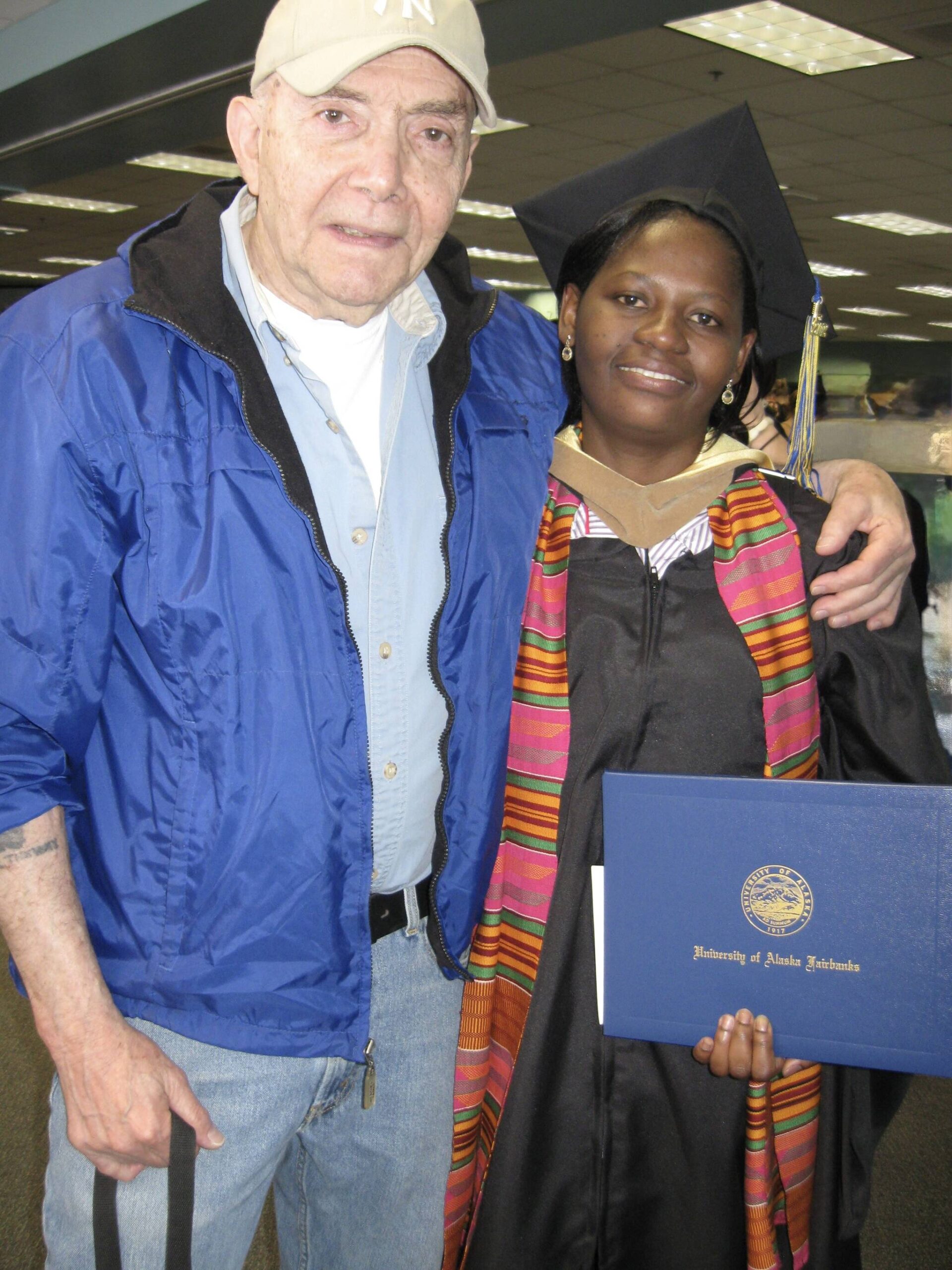
It’s a long way from the Bronx to Barrow. It’s even farther from Fairbanks to Ghana. Lewis Shapiro covered a lot of ground during his 90 years.
Shapiro, a sea-ice expert here at the Geophysical Institute of the University of Alaska Fairbanks, died on Aug. 24, 2025.
“Lew” was born in the Bronx borough of New York City on Oct. 23, 1934. He lived more than half of his 90 years in Alaska, but you always knew where he came from.
“Stick him in front of a baseball game, it was like he never left the Bronx,” his daughter Lee Shapiro, a librarian in Maryland, said at a recent memorial service in Fairbanks.
Shapiro loved the Yankees. And playing steel drums, and traveling to Barrow (now Utqiaġvik) with a fledgling scientist to extract a chunk of sea ice from a frozen lagoon at 40 below.
He was also an engineer who tried to fix things. An example: Twenty years ago in Ghana, on the west coast of Africa, he saw a taxi roll up to a village medical clinic.
He watched as people inside the cab handed out several 5-gallon jugs of water, bucket-brigade style. The medical officer at the clinic told him a woman was going to have a baby at the clinic, which had no water supply.
“I’ll bet we can do something to get water to this clinic,” Shapiro said later to his friend, Josie. “I’ll bet we can find some money to mechanize a water system.”
Josephine-Mary “Josie” Sam grew up near that Ghanaian village, in a city called Cape Coast. More than 50 years Shapiro’s junior, Josie recently recalled her journey with an unlikely friend who led her to become an assistant professor at the University of Alaska Fairbanks, 7,500 miles from her home country.
In 2005, then 71-year-old Shapiro flew from his home in Fairbanks for a volunteer opportunity in Ghana. Before he left Alaska, he asked a volunteer from the previous year if she had a friend in Ghana to which he could deliver a present.
Shapiro’s contact mentioned a young woman who loved John Grisham books but had trouble finding them. Shapiro stuffed 14 paperbacks into his suitcase.
On the Good Friday holiday in 2005, Sam took a taxi to a hotel in Accra, Ghana, to pick up her new John Grisham books. Shapiro handed them over, then asked if she wanted to sit down with him for breakfast.
Sam was impressed to learn this bald American with tattooed forearms (from a former life as an Army paratrooper) was volunteering for a women’s rights organization with which she was familiar.
After breakfast, Shapiro’s ride to a nearby event never showed up. Sam offered to be his guide for the day. He accepted an invitation to her church picnic a few days later, stunned to be amidst 5,000 people who attended.
“He met my friends and my sister there,” Sam said recently in her office on the UAF campus. “From there, we just kept communicating.”
Shapiro returned several times to Ghana. Sam helped match him with volunteer projects.
“Lew knew just the right questions to ask people,” she said, “Like, ‘What do you need most right now?’”
Shapiro and Sam were in the village of Enyan Abaasa when they witnessed the need for clean water at the health clinic. Shapiro then extended his stay in Ghana to attend an international water conference.
“The more he learned, the more he figured there was a way to help,” Sam said.
After Shapiro visited his brother in New York City on his way back to Alaska, he called Sam.
“He was so excited,” she said. “He said ‘We’re going to start a foundation.’”
Shapiro and his brother Barry, along with Sam, became leaders of the Nyarkoa Foundation, dedicated to bringing clean water to places like the clinic in the town of Enyan Abaasa, which now features running water in the clinic and staff quarters.
“That made a huge difference,” Sam said. “That village is now the local health hub.”
Donated funds to the foundation helped improve water conditions in other Ghanaian villages. And the friendship soon paid unexpected dividends for Sam.
Over the phone, she had told Shapiro she had been accepted into a graduate school in the Netherlands but needed to wait a year to receive a government fellowship to help pay for it.
“Lemme see what I can do,” Shapiro said.
He called her back not much later. While he was talking to a colleague at a basketball game, he said, he heard of a UAF master’s program in natural resource management that might interest her.
Shapiro put Sam in contact with faculty member Susan Todd. After months of correspondence about topics ranging from rural development to women’s empowerment, Todd asked Sam if she wanted to do an independent study. Sam later applied for the natural resources management program. UAF accepted her.
Sam arrived at Fairbanks International Airport on a January night in 2009. Shapiro’s wife Judi wrapped their equatorial visitor in blankets as she sat on a seat hardened by exposure to minus 35 Fahrenheit air.
“I think I was in shock,” Sam said.
The Shapiros drove her to their home, which they had recently expanded to add a room for Sam.
“I was just so touched,” said Sam. “They helped make my dream come true.”
From that start in Fairbanks, Sam finished a graduate degree and later wrote her Ph.D. on the community characteristics that contribute to successful rural water projects.
In 2022, she applied for a position at UAF’s College of Indigenous Studies and got the job. She is now an assistant professor and is co-chair of the Department of Alaska Native Studies and Rural Development.
“Lew and Judi (who died in 2013) helped make it all possible,” Sam said. “It was just really, really amazing how everything came together.”
Remembering the man who had such an influence on her life, Sam recalled Shapiro’s wisecracks and his ability to boost her when she needed motivation.
“I lost my own dad when I was very young, but I remember he, along with my mom, inspired me to excel academically,” she said. “Lew was just the same. He was my biggest cheerleader.”
Since the late 1970s, the University of Alaska Fairbanks Geophysical Institute has provided this column free in cooperation with the UAF research community. Ned Rozell ned.rozell@alaska.edu is a science writer for the Geophysical Institute.

Lew Shapiro poses with Josie Sam in 2016 after she earned her Ph.D. degree at the University of Alaska Fairbanks. (Photo courtesy of Josie Sam)

Lew Shapiro poses with Josie Sam in 2016 after she earned her Ph.D. degree at the University of Alaska Fairbanks. (Photo courtesy of Josie Sam)

Lew Shapiro cuts into sea ice north of Utqiaġvik, then called Barrow, during his long career with the Geophysical Institute. (Photo courtesy of UAF Geophysical Institute)
