
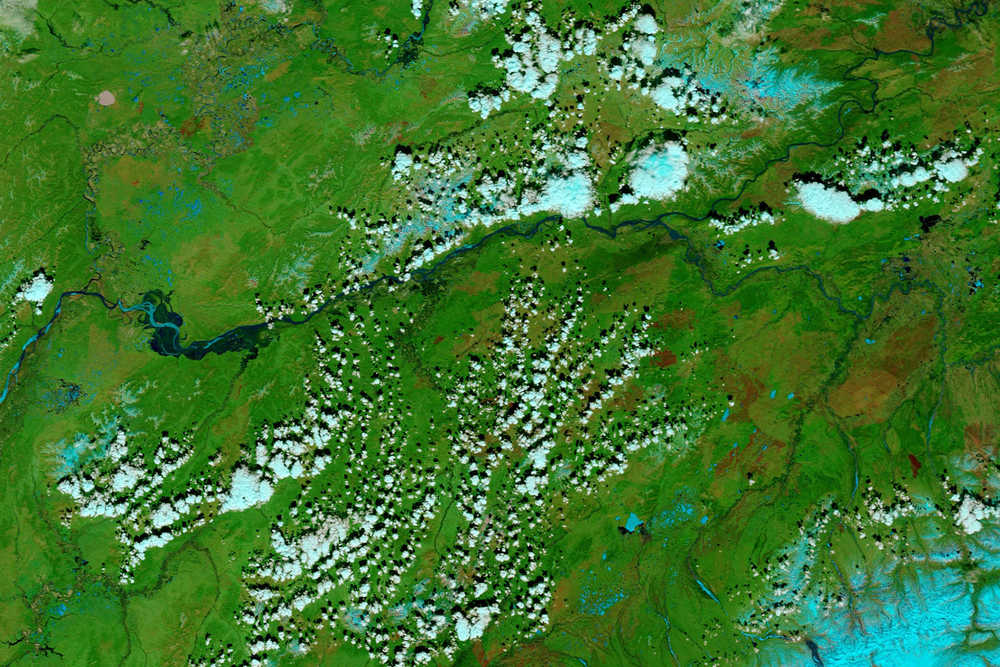
NASA's Terra satellite captured this image of the Yukon River flood from 443 miles overhead on May 28, 2013. Image courtesy of NASA.

NASA's Terra satellite captured this image of the Yukon River flood from 443 miles overhead on May 28, 2013. Image courtesy of NASA.

Alaska Science Forum: Broken ice causes the worst spring breakup floods

For half the year, Alaska’s big rivers provide a somewhat flat surface, allowing travel by snowmachine, dog team, ski, bike, snowshoe and foot. For a few weeks during their spring transition to liquid water, those useful ribbons of ice become a threat to river communities.

Massive ice-jam floods happen every few years on Alaska rivers. Some of them are large enough to cause more than $80 million in damage, and officials call for both state and federal disaster relief funds.

Those large floods happened four times in the last nine years. The two most recent happened on the Yukon River. Ice jams backed up catastrophic amounts of water into Eagle in 2009 and Galena in 2013.

Ice-jam floods — caused when river water shoves table- and roof-sized chunks into a blockage point — sometimes happen at places like Bishop Rock, which juts into the Yukon River downstream of Galena. Behind the dam, river water backs up in a hurry, spilling over riverbanks and into villages.

Spring floods caused by ice jams are hard to predict, agreed a number of scientists gathered in Fairbanks for the Arctic Science Summit Week. Winter snowfalls or thickness of river ice might seem to be good warning signs of ice dams waiting to happen, but other factors are better forecasters.

“April and May temperatures are the most important climate drivers of breakup,” said Rick Thoman of the National Weather Service in Fairbanks.

If April and May are sunny and warm, river ice tends to dissolve peacefully in place until it disappears. Thoman described that as a thermal breakup.

The worst-case scenario for river communities: If April and May are cloudy and cold, ice remains strong and thick until the 70-degree days arrive. This increases the chance of what hydrologists call a dynamic breakup.

An example can be found during May 2013. That year featured a cold spring in Interior Alaska that resulted in the latest river breakup in the 99-year record of the Tanana River at Nenana. The tripod on the ice there did not move enough to trip the clock until the afternoon of May 20. The historical average breakup date is May 5.

A few hundred miles west, on May 27, a procession of broken-up ice rammed an intact ice sheet at Bishop Rock. All those pieces bunched up to clog the Yukon River. Water backed up flooding the lowlands, including the village of Galena. An image taken by a NASA satellite shows the river swollen like a python that just swallowed a pig. After flooding most of Galena beneath about 10 feet of water, the ice jam broke two days after it formed. The Yukon dropped to normal levels.

Climate models are predicting a warmer than average April and May this year for Alaska, Thoman said. That favors a calm, thermal breakup of Alaska rivers this year. And while there are always surprises like 2013, easier river breakups may be in Alaska’s future.

“Springs are warmer than they used to be,” Thoman said.

• Ned Rozell is a science writer for the Geophysical Institute. Since the late 1970s, the University of Alaska Fairbanks’ Geophysical Institute has provided this column free in cooperation with the UAF research community.

More in Neighbors

Fred LaPlante serves the Juneau community as the pastor of the Juneau Church of the Nazarene. He is passionate about encouraging others to see life more clearly through faith in God’s Word.
Living and Growing: Love listens first

‘Loving people well requires more than speaking clearly; it requires listening carefully.’

Weekly events guide: Juneau community calendar for Feb. 9 – 15
Juneau Community Calendar

Weekly events guide: Feb. 9 – 15

Jeff Lund/contributed
The author would rather fish for steelhead, but he’ll watch the Super Bowl.
I Went to the Woods: Super Bowl spectacle

At some point on Sunday, dopey characters, hopelessly addicted to Doritos, will… Continue reading

Peggy McKee Barnhill (Courtesy photo)
Gimme a Smile: How much snow can one backyard hold?

Snow, snow, everywhere, and no place to put it!

The Spruce Root team gathers for a retreat in Sitka. Spruce Root, is an Indigenous institution that provides all Southeast Alaskans with access to business development resources. (Photo by Lione Clare)
Woven Peoples and Places: Wealth lives in our communities

Sustainable Southeast Partnership reflects on a values-aligned approach to financial wellness.

calendar
Weekly events guide: Juneau community calendar for Feb. 2 – Feb. 8

Visit Juneau Arts and Humanities Council at JAHC.org for more details on this week’s happenings.

Actors in These Birds, a play inspired by death, flowers and Farkle, hold ‘flowers’ during a performance at the UAS Egan Library on Saturday, Jan. 31. (photo courtesy Claire Richardson)
Living and Growing: Why stories of living and dying in Juneau matter

What if we gave our town a safe space to talk about living and dying with family and friends?

calendar
Weekly events guide: Juneau community calendar for Jan. 26 – Feb. 1

Visit Juneau Arts and Humanities Council at JAHC.org for more details on this week’s happenings.

Courtesy photo
Adam Bauer of the Local Spiritual Assembly of Bahá’ís of Juneau.
Living and Growing: Surfing into the future

Many religious traditions draw strength from the past.

calendar (web only)
Weekly events guide: Juneau community calendar for Jan. 19-25

Visit Juneau Arts and Humanities Council at JAHC.org for more details on this week’s happenings.

(web only)
Weekly events guide: Juneau community calendar for Jan. 12-18

Visit Juneau Arts and Humanities Council at JAHC.org for more details on this week’s happenings.

Four members of the Riley Creek wolf pack, including the matriarch, “Riley,” dig a moose carcass frozen from creek ice in May 2016. National Park Service trail camera photo
Alaska Science Forum: The Riley Creek pack’s sole survivor

Born in May, 2009, Riley first saw sunlight after crawling from a hole dug in the roots of an old spruce above the Teklanika River.