
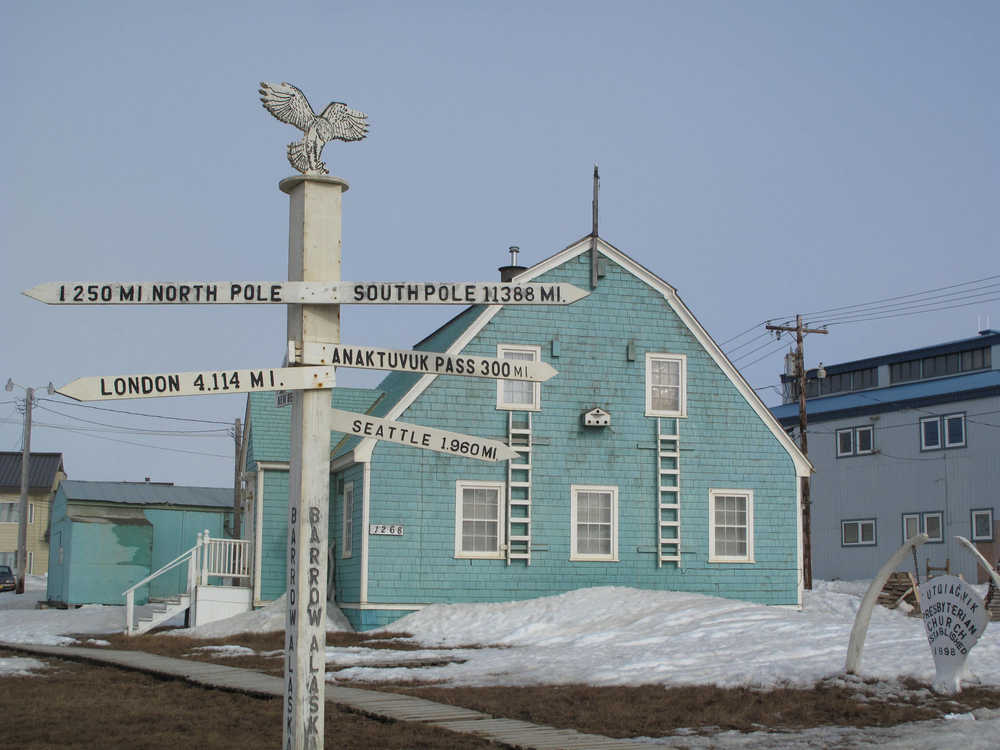
For a town of its size (4,300 people), Barrow receives more visits by scientists than any place in America. The northernmost community in the U.S. has hosted researchers since Army Lieutenant P. Henry Ray built a polar observatory there in 1882.
This different-than-anywhere-else place with fewer people than a one-stoplight town in Texas has attracted scientists from all over the globe. Why? Because Barrow has housing, electricity and is way north of the Arctic Circle.
Those features led to the construction of the Arctic Research Laboratory in 1947. Today, Barrow hosts the Barrow Arctic Science Consortium, the Barrow Environmental Observatory, the NOAA Barrow Observatory and the Atmospheric Radiation Measurement Climate Research Facility.
Some scientists live in Barrow. Many others fly in from other places to study sea ice, whales, frozen ground, a vast underwater canyon just offshore, snow and other northern features.
All those instruments and people were in a good spot to record a noteworthy spring last year. In 2015, Barrow set some new climate-related records and came close to breaking others.
Some examples:
The snow melted on May 28 at the NOAA Barrow Observatory. That’s the earliest date recorded since 1940 by Robert Stone, a retired scientist from Boulder, Colorado. It was the second-earliest snow-melt day recorded (in 2002 the snow disappeared on May 24). Last year’s early melt was the result of warm May temperatures that ate up Barrow’s above-average snowfall.
At 28 degrees Fahrenheit, the average temperature for May 2015 was 9 degrees Fahrenheit warmer than the longtime average. The entire state also set a May warmth record, 7.1 degrees above the 91-year average.
Biologist George Divoky has studied a colony of black guillemots on an island northwest of Barrow every year since 1972. In 2015, one of the seabirds laid an egg on June 8. It was the earliest Divoky has seen the laying of the first egg. In 1975, the earliest guillemot egg Divoky saw was on June 30.
Craig George, a biologist with the North Slope Borough, has noted the dates the ice vanished from Isaktoak Lagoon in Barrow since 1986. In 2015, the ice went out on June 27, the earliest George has recorded.
Like all of Alaska, Barrow was warm last spring because an atmospheric pressure system known as the Aleutian Low was parked far to the west of Alaska. That favored the flow of warm Pacific air across Alaska and into the Arctic, according to Diane Stanitski, who works in NOAA’s Global Monitoring Division in Boulder, Colorado. She has taken over the snowmelt measurements from Robert Stone.
“Early snowmelt has often been correlated with the Aleutian Low stationed farther west and a high pressure ridge that forms over the state,” she said. “During colder years the Aleutian Low is closer to Alaska and high pressure north of Barrow tends to block the flow of warm air northward. We want to know whether shifts in these patterns are good indicators of (coming warmth or cold).”
While 2015’s warmth was due to large-scale weather patterns, winter of 2016 has also been unusually warm up north. Will Barrow be even warmer this spring than last? The thermometer, ice and birds will tell the story.
Since the late 1970s, the University of Alaska Fairbanks’ Geophysical Institute has provided this column free in cooperation with the UAF research community. Ned Rozell is a science writer for the Geophysical Institute.
