
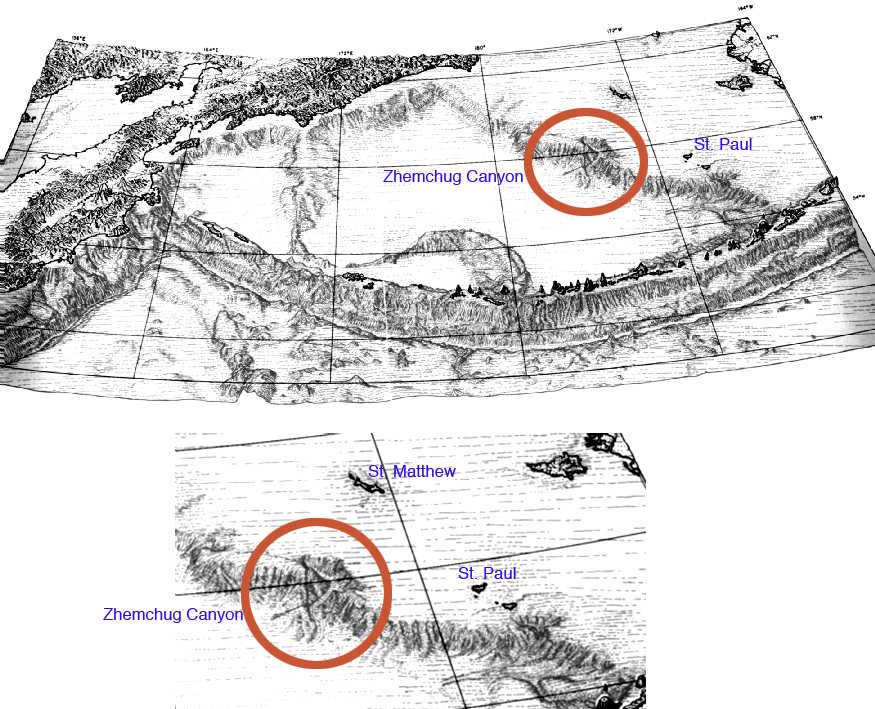
Pictured is a map of the sea floor off western Alaska showing Zhemchug Canyon, one of the largest canyons in the world. It is from a 1970 paper in Marine Geology by D. Scholl, E. Buffington, D. Hopkins and T. Alpha.

Pictured is a map of the sea floor off western Alaska showing Zhemchug Canyon, one of the largest canyons in the world. It is from a 1970 paper in Marine Geology by D. Scholl, E. Buffington, D. Hopkins and T. Alpha.

Alaska Science Forum: A visit to one of Earth’s greatest canyons

People wait years for permits to raft the Grand Canyon. Michelle Ridgway once visited a much larger canyon in Alaska, one that most people will never hear about.

Zhemchug Canyon, 20 percent longer and deeper than the Grand Canyon, is a t-shaped cut in the sea floor beneath the gray waters of the Bering Sea. On a Greenpeace-sponsored expedition, Ridgway, a marine ecologist and consultant from Juneau, descended into the canyon alone in a tiny submarine.

“I’d been through the Grand Canyon the year before and was expecting a real similar experience,” Ridgway said. “But I was humbled. (Zhemchug Canyon is) enormous.”

The ancient Yukon River may have contributed to the vastness of Zhemchug Canyon, according to a theory first presented by David Scholl and the late David Hopkins. During the last Ice Age, when more of the world’s oceans were locked up in glaciers, the Yukon flowed a few hundred miles farther southwest. The big river carved the vast gorge that is now Zhemchug Canyon, which lies about 170 miles northwest of St. Paul Island.

Named after a Soviet research ship and a word meaning “pearl,” Zhemchug Canyon cuts into the ocean floor at the western edge of the Continental Shelf, “one of the flattest and smoothest places on the planet,” Dan O’Neill wrote in The Last Giant of Beringia. “Its slope, at no more than three or four inches per mile, is almost unmeasurable.”

From that undersea plain, Zhemchug Canyon plunges more than 8,500 feet into the Aleutian Basin. Michelle Ridgway piloted an eight-foot-long submarine into that abyss.

As she descended and daylight began to fade, Ridgway noticed Dall’s porpoises darting by her tiny craft, which featured a titanium body and pressure-resistant acrylic dome. When she reached 300 feet, the porpoises shot down to her for a final glance before they headed back to the surface. And then she was the only mammal she knew of.

She kept dropping until she reached a bench at 1,757 feet beneath the surface. There, she entered a world of tangerine-colored life forms, including fish, corals, crabs and sponges illuminated by the submarine’s blazing halide beams.

“They ranged from pale gold to a brick red,” she said of the creatures in the dark world of the canyon. “It was very widespread.”

That peculiar color scheme intrigues Ridgway, as does the variety of life in Zhemchug Canyon.

“We didn’t expect such a diversity of sponges and corals,” she said. “And a huge surprise to me is what might be a correction to what we assumed about zooplankton distribution in the water column. The entire water column was teeming with a very dense aggregation of zooplankton.”

A common theory is that the tiny creatures that make up the plankton kingdom hang out nearer to the surface, and the bottom-feeding fish, sponges, and other life forms survive on the leavings of organisms higher up. That might not be true, at least in Zhemchug Canyon.

“It’s rich and living at every depth we examined,” Ridgway said.

Having descended only one-fifth of the canyon’s 8,500 feet, Ridgway hopes she can someday launch an expedition in a submarine equipped to get to the bottom of one of the deepest canyons on the planet. Who knows what unique forms of life await her visit?

“I’d love to go,” she said.

• Since the late 1970s, the University of Alaska Fairbanks’ Geophysical Institute has provided this column free in cooperation with the UAF research community. Ned Rozell is a science writer for the Geophysical Institute. He is taking a break for the month of November 2016 to finish a writing project. Fresh columns will reappear starting December 1. This column first appeared in 2007.

More in Neighbors

calendar
Weekly events guide: Juneau community calendar for Jan. 26 – Feb. 1

Visit Juneau Arts and Humanities Council at JAHC.org for more details on this week’s happenings.

Courtesy photo
Adam Bauer of the Local Spiritual Assembly of Bahá’ís of Juneau.
Living and Growing: Surfing into the future

Many religious traditions draw strength from the past.

calendar (web only)
Weekly events guide: Juneau community calendar for Jan. 19-25

Visit Juneau Arts and Humanities Council at JAHC.org for more details on this week’s happenings.

(web only)
Weekly events guide: Juneau community calendar for Jan. 12-18

Visit Juneau Arts and Humanities Council at JAHC.org for more details on this week’s happenings.

Four members of the Riley Creek wolf pack, including the matriarch, “Riley,” dig a moose carcass frozen from creek ice in May 2016. National Park Service trail camera photo
Alaska Science Forum: The Riley Creek pack’s sole survivor

Born in May, 2009, Riley first saw sunlight after crawling from a hole dug in the roots of an old spruce above the Teklanika River.

Sun shines through the canopy in the Tongass National Forest. (Photo by Brian Logan/U.S. Forest Service)
Opinion: Let’s start the New Year with an Alaskan-style wellness movement

Instead of simplified happiness and self-esteem, our Alaskan movement will seize the joy of duty.

January community calendar
Weekly events guide: Juneau community calendar for Jan. 5-11

Visit Juneau Arts and Humanities Council at JAHC.org for more details on this week’s happenings.

Kaa Yahaayí Shkalneegi Muriel Reid photo
In 2024, SSP’s Regional Catalysts attended and helped with the Kake Culture Camp hosted by the Organized Village of Kake. The goal was to be in community, grow our relationships, and identify opportunities to support community priorities determined by the community itself.
In 2024, SSP’s Regional Catalysts attended and helped with the Kake Culture Camp hosted by the Organized Village of Kake. The goal was to be in community, grow our relationships, and identify opportunities to support community priorities determined by the community itself. (Ḵaa Yahaayí Shkalneegi Muriel Reid photo)
Woven Peoples and Place: Don’t be an island, be amongst the people

Láaganaay Tsiits Git’anee and Shaelene Grace Moler reflect on celebrating values in action.

Fred La Plante is the pastor of the Juneau Church of the Nazarene. (Photo courtesy Fred La Plante)
Living and Growing: You are not alone

Those words can pull us back toward hope, especially when we’ve just heard painful news.

The whale sculpture at Overstreet park breaches at sunrise on Friday, Dec. 19, 2025. (Mari Kanagy/Juneau Empire)
Weekly events guide: Juneau community calendar for Dec. 22-28

Visit Juneau Arts and Humanities Council at JAHC.org for more details on this week’s happenings.

Jeff Lund photo 
The author practices in case he had the chance to be Jimmy from the 1986 movie Hoosiers. He never got the chance on the basketball floor, but had moments in life in which he needed to be clutch.
Opinion: Everyone wants to be Jimmy

Sports, and the movie “Hoosiers,” can teach you lessons in life

Laura Rorem (courtesy photo)
Living and Growing: Gracious, gentle power

Gracious power is grace expressed with kindness and mercy.