
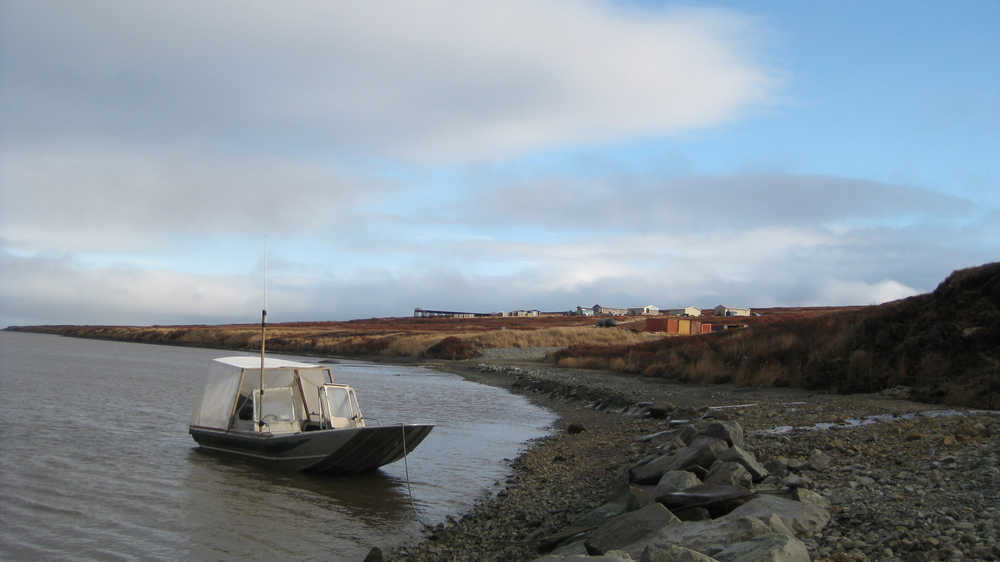
As a river eats its way into Newtok, residents are planning their moves to a new village site 12 miles away. One family will move into a house on skis with the ability to migrate as needed with self-contained water and electrical systems.
In his dozen visits to Newtok, a village of about 354 people 100 miles west of Bethel, Aaron Cooke has seen why the villagers have voted to move.
“In the seven or eight years I’ve been visiting there, I’ve seen football fields that have fallen away,” said Cooke, an architect for the Cold Climate Housing Research Center in Fairbanks.
The Ninglick River claims an average of 57 linear feet of Newtok’s land each year. If that loss continues, houses will fall into the water as soon as two years from now.
That prompted a call from a member of the Newtok Village Council to Cooke, who had worked on prototype energy-efficient housing for another village in the Kuskokwim River Delta. The people in Newtok had heard of his research center’s project in Atmautluak and wondered if he could design a similar one to be transported to their new village site. They had funding from the Bureau of Indian Affairs and they needed a house in less than one year.
Cooke said yes and got to work. He drew up a house with an adjustable foundation that rests on three long steel skis. The house has its own electrical systems that operate in concert with a generator and batteries. There is also a mini water treatment facility inside.
“The concept isn’t new by any stretch — think of a hunting or ice-fishing shack,” he said. “We’re taking a concept that’s pretty simple and applying it to a complex problem.”
Thirty one Alaska villages are “imminently threatened” by erosion problems, according to reports to Congress from the General Accounting Office in 2003 and 2009. Newtok was one of the five that most needed to move or undergo expensive protection measures.
Cooke’s demonstration house is not yet built. It is now in pieces under cold tarps at the new village site called Mertarvik. Mertarvik is upstream from Newtok on the Ninglick River. No one lives at Mertarvik yet, but the site has a road, barge landing and a few conventional homes built by U.S. Marines during a training exercise.
Cooke wanted to start building the house this fall, but the barge serving the area was two months late in delivering his trusses and other building materials. He and local carpenters — including someone who will live in the house — will start building his prototype near the barge landing after the ice breaks up next spring.
If everything goes well, a tractor operator will tow the house from the barge landing up the hill to a gravel pad. There, the crew will set it in place and level it using threaded pipe built into the foundation.
If the house functions, more could be built. The new village will need 64 additional homes. Some will be moved from the old village, but there will be a need for more.
As Cooke watches his design become reality for seven weeks next spring, he’ll think of how he can trim costs. Without counting the labor to assemble it, his house costs about $120,000 in materials. Next spring, he will see how much labor it takes.
“If we came in under $300,000 for a rural Alaska superinsulated home, I’d be happy with that,” he said.
If the house were a success, it would be a nice fit for communities on changing ground.
“More and more my job is taking me to places like Newtok,” Cooke said. “At the community meeting, there’s always an old-timer who says if this would have happened in the old days, we wouldn’t have meeting, we’d just go.”
The demonstration house on skis is designed to help people react a bit quicker to changes, such as thawing permafrost and eroding coastlines.
“We don’t want to kid ourselves and say how the land is now is how it will stay,” Cooke said. “Things seem to be changing faster than they used to.”
• Ned Rozell is a science writer for the Geophysical Institute.
Since the late 1970s, the University of Alaska Fairbanks’ Geophysical Insti-tute has provided this column free in cooperation with the UAF research community.
