
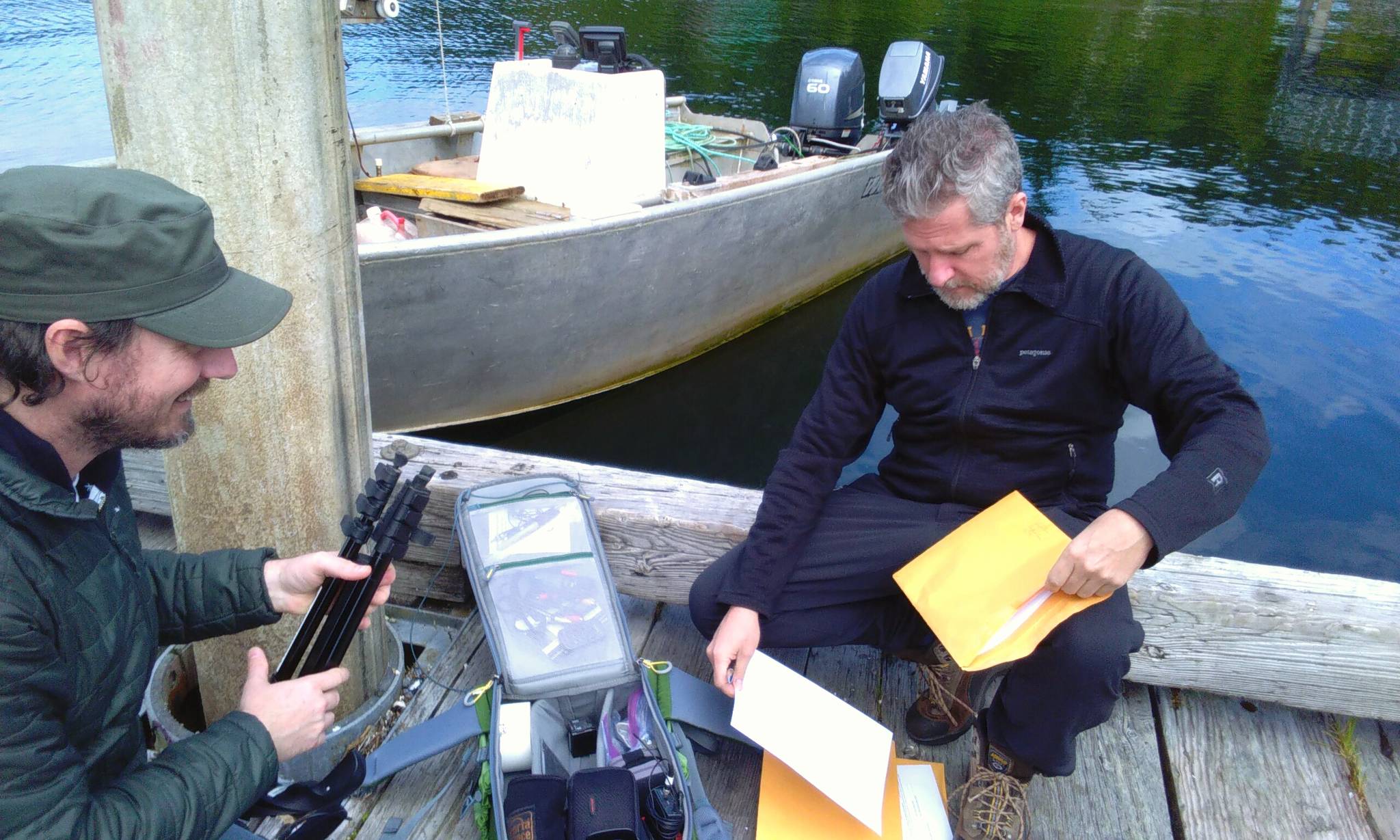
When my brother Jamie Neilson pulled up to the dock in Meyers Chuck I stepped out to shake hands with two strangers.
First was Travis, Senior Vice President of Unscripted Programming at a world famous TV studio; he’s also the executive producer of a proposed documentary series about people living an off-grid, subsistence lifestyle in the Panhandle of Alaska. Beside him stood Daniel, producer of a successful and critically well-received Alaska show.
When I told Daniel that a lot of shows about Alaska were disliked by Alaskans because of their scripted sensationalism that telegraphed fakery, but that the shows he’d worked on that I knew about were ones Alaskans actually watched and appreciated, he smiled but said seriously, “We actually take a lot of pride in that.”
They’d flown into Meyers Chuck a few hours earlier to interview Jamie and give him a film test. Jamie ran them around the Chuck (as it’s known locally) in his hard-used work skiff, showing them around his floathouse and attached cabin.
They got him telling some of his crazier stories of living out in the bush and he told me he talked so much he was a bit hoarse. Like me, he lived alone and wasn’t accustomed to talking so much for extended periods of time.
Meyers Chuck is pretty small but he hit the high spots, including my sister Megan’s island with the pink plastic flamingos on it that both she and Jamie are planning to build on shortly; and the small gallery that sold high quality, locally crafted art to the tourists that boat through every year — Cassie Peavey was kind enough to open it for them. Jamie said when Travis and Daniel learned that she usually made cinnamon rolls to sell to the boaters, they were disappointed that she hadn’t made any that day.
“What do you think of Meyers Chuck?” I asked after shaking hands.
“It’s beautiful. Like all of Southeast Alaska,” Daniel gestured with one hand, encompassing the luminous, once-experienced-never-forgotten beauty of the Alexander Archipelago.
It was immediately obvious that both men appreciated the adventure of their job, flying around Alaska and meeting the people who lived remotely. Travis did a double-take when I stepped out of Jamie’s skiff and he said, with a chuckle, “You’re the first remote-living Alaskan I’ve seen wearing a purse.”
It had taken me a while to get used to it, myself. Previously I’d lose my purse all the time when I went to a city because I was so unused to having a purse around. But I needed this one to carry my tablet, paper and pen and everything else necessary for my blogging and writing needs.
When I laughed and explained he asked, “How long have you been writing?”
“Pretty much forever.” I shared that I’d recently gotten a book deal.
“Congratulations.” Daniel, standing on the other side of me, sounded like he took personal pleasure in the idea. “What’s it about?”
“Our childhood where we lived in a burned and abandoned cannery very remotely, with no other people around.”
Jamie had already mentioned that part of his background and they were quick to ask more questions. While talking with them, I noticed that both Travis’s and Daniel’s eyes were strikingly alert and open, absorbing details, revealing a very human interest in everyone they met and what they saw. They shared a quality of instant accessibility which put people at ease immediately.
“What was that like, growing up in the burned cannery?” Travis asked.
“Normal.” I smiled and half-shrugged. “It was normal to us. It was just our childhood, we didn’t know anything else.”
“When did you realize it was something different?”
“When I started blogging and writing the column.”
“And people started going, ‘whoah, that’s amazing!’” Daniel suggested, grinning.
It was true. It was from seeing my life through my readers’ eyes that had given me an all new appreciation and perspective on our childhood and the lifestyle I, Jamie, and so many other rural Alaskans lived.
It was actually through my blog that this moment, meeting the two of them, had come about.
“You just received a new submission to your blog’s Contact Form.” The notification popped up in my inbox on May 7 of this year. It was from a casting producer named Ally who worked for an instantly recognizable production company in Los Angeles. She said that in doing her research for an upcoming Alaskan project she’d come across my website and loved what she’d read. “I’d like to talk with you by phone. Would you be interested in scheduling a call?” she asked.
When I talked with her, I found Ally very easgoing and understanding, just about the least pushy person imaginable. She asked if I’d help her locate anyone who’d be interested in being filmed. I told her I’d give it a shot, since I had a lot of respect for the company she worked for.
However, I wasn’t surprised when a couple who had lived in Alaska for decades turned down the opportunity. They said the reason why they lived so remotely was because they valued their privacy. That was the response of a few other people I asked as well.
I expected this to be the answer I’d get from everyone I asked, including my family, and friends I went to school with in the bush.
Instead, once I said “unscripted documentary series” and named the production company, some of them listened and then agreed to talk to Ally and find out more. They were impressed with the way she emphasized how respectfully the team would approach the filming. She explained they weren’t after scripted sensationalism; they wanted to objectively observe the real lifestyle of people living “out.”
In fact, they were so impressed with her and what she said over the phone that several longtime locals, including Jamie, agreed to participate in the project.
Ally called me last week and said that the project was being fast-tracked and their team would be coming out to Meyers Chuck to interview Jamie, though there was no guarantee that anything long-term would come of it.
As Travis said, before getting on the plane to leave, “The project may get going in five days, five months, or five years — or not at all.” But I think I’ll be writing more about this for some time to come.
• Tara Neilson lives in a floathouse between Wrangell and Ketchikan and blogs at www.alaskaforreal.com.
