
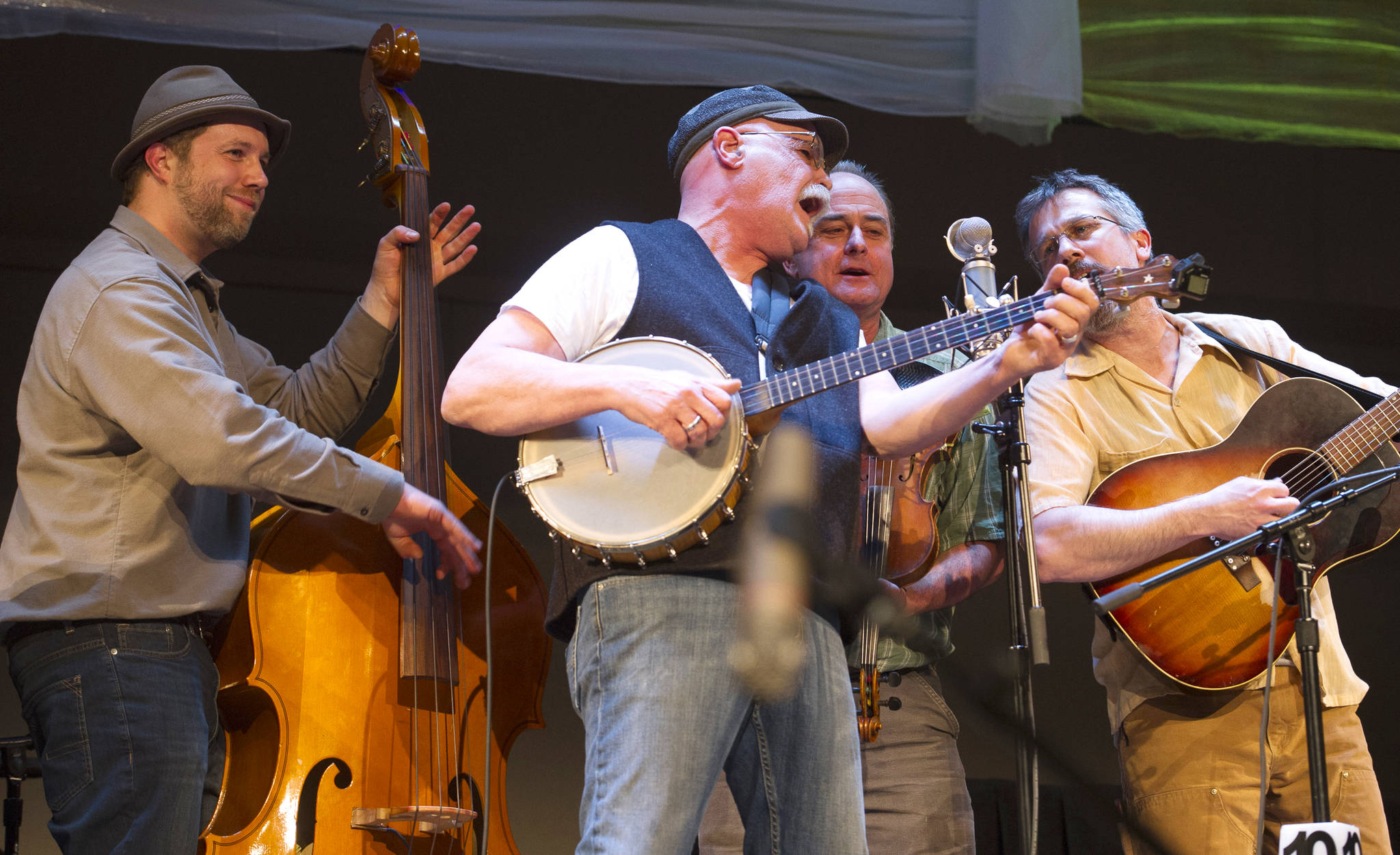
If you’re an Alaskan, you know what time of year it is. It’s time to turn in your application! And no, I don’t just mean your PFD. Alaska Folk Festival applications are due by March 15, and whether the stage is like a second home to you, or if your only 15 minutes of folksy fame was that time you accidentally chose The Wreck of the Edmund Fitzgerald on karaoke night at the Viking and had to sing the whole thing, there’s no reason not to dust off the banjo or autoharp, tune it up and spend hours coming up with a cool band name.
So, if this is your first time at Folk Fest, there’s some things you should know. For the duration of this illustrious week, you should remember: it ain’t a violin. It’s a fiddle. But what are those other instruments? I’ll clue you in with a quick guide.
If your fiddle is so big that you have to sit down to play, and you also went to music school, you’re playing a cello. If your fiddle is so big you have to stand up to play it, you’re holding a stand-up bass. But if you went to music school with the cello player, you’re playing a “double bass.”
If it looks like a cute little guitar with doubled-up strings, it’s a mandolin. You can remember it by the name: Amanda Lynn. Massive mandolins are called bouzoukis, pronounced like the giant shoulder-mounted artillery they remind mandolin players of.
Now take guitars: If it has way too many strings and somehow reminds you of the ‘70s, it’s a 12-string guitar. If he’s sliding a metal tube on it, it’s a slide guitar, but as soon as you lay it flat so the strings are on top, it’s a dobro. Don’t mess with dobro players, and never ask them what kind of guitar they’re playing.
Now, on the other hand, see that guy over there playing a guitar made entirely of shiny metal? It’s a resonator guitar. Definitely ask that person what kind of guitar they’re playing. They love that sort of thing. That’s why they bought it in the first place.
Now, musically speaking, maybe you’re more of a listener, but you’re pretty sure you love that Bluegrass, or that Folk music, or maybe it’s Blues you like, but you’re just not sure? Here’s a quick guide to tell the difference! Keep in mind, it’s only a rough guide, and it doesn’t include some of the older, regional styles like Irish, Cajun or Appalachian, but it’ll get you through most situations in the world of pickin’ and grinnin’.
If the instruments are made of unpainted wood, and the players look like they could easily be described as “folksy” they’re playing Folk music. Everything that follows is just a sub-genre of Folk. If they’re playing repetitive tunes featuring the fiddle, and never once make eye contact with the audience, it’s called Old Time.
If it’s just one guy playing a lot of guitar and saying lots of sad things twice in a row, it’s probably Blues. If he has a southern accent (any variety), wears a cowboy hat, or even once says the word “truck,” it’s not Blues, it’s Country. Country music can also include a small band, as long as the drummer doesn’t play anything but “boom BAP boom BAP.”
If it’s a string band, and it’s mostly men, and they’re also singing sad lyrics, but like a barbershop quartet with a banjo, you’re probably looking at Bluegrass. Think “Oh Brother Where Art Thou.” Similar to Bluegrass is Newgrass, which is a slick, polished version of the former, like Alaska’s own Bearfoot.
Lastly, if it sounds like you could hear it in a church, it’s Gospel. Anything else can be called plain old “Folk.” Or “Americana,” if you hold your pinky out when you say it.
I’ve been going to Folk Fests just about every year since I was much younger, and I’ve absolutely loved the cheerful atmosphere, mingling scents of patchouli and Pucker Wilsons, and the surround-sound of jam circles. I’ve learned that it’s a very encouraging environment for growing musicians, or even people who have never played before. From the dreadlocks and boho sweaters to the cowboy hats and leather vests, music and dance really are common languages for anyone willing to try them.
Feel free to cut this guide out and carry it with you in your pocket this year, and the next year, since anyone who goes once is hooked for a lifetime. You can find out more from the Alaska Folk Festival website, at http://www.akfolkfest.org/. Keep pickin’!
• “Guy About Town” is a column appears the first and third Sunday of every month and includes seasonal musings on what changes and what doesn’t in a small town. Guy can be reached at unzicker.music@gmail.com.
