
In mid-April, I had the privilege of observing a necropsy of a subadult male sea lion that recently died. The carcass lay near the end of a rocky point. I was fascinated not only to see the big beast close-up but also to watch the well-organized NOAA necropsy team in action, with lead veterinarian Kate Savage. The animal had no perceptible wounds, but it was very thin and its stomach held nothing more than a stone, a small clam and a cluster of round worms. Was it unable to feed, for some reason, or could it not find enough food? The lab reports might identify some ailment but we may never know why the big fellow came to lie on the rocks.
Several days later, I went back out to see if the remains were still there. The carcass had washed up on a high tide nearly to the trees. The bones had been picked quite clean, except for the flippers, which were still covered with skin. Two immature eagles tugged at stringy tissues but could nip off only tiny morsels — hardly worth fighting for. Despite the poor rewards to be had, the trees held several other eagles that were keeping a close eye on the bones. As often happens at carcasses, the intestines had not been eaten, even though the bones were picked bare. What makes that body part undesirable?
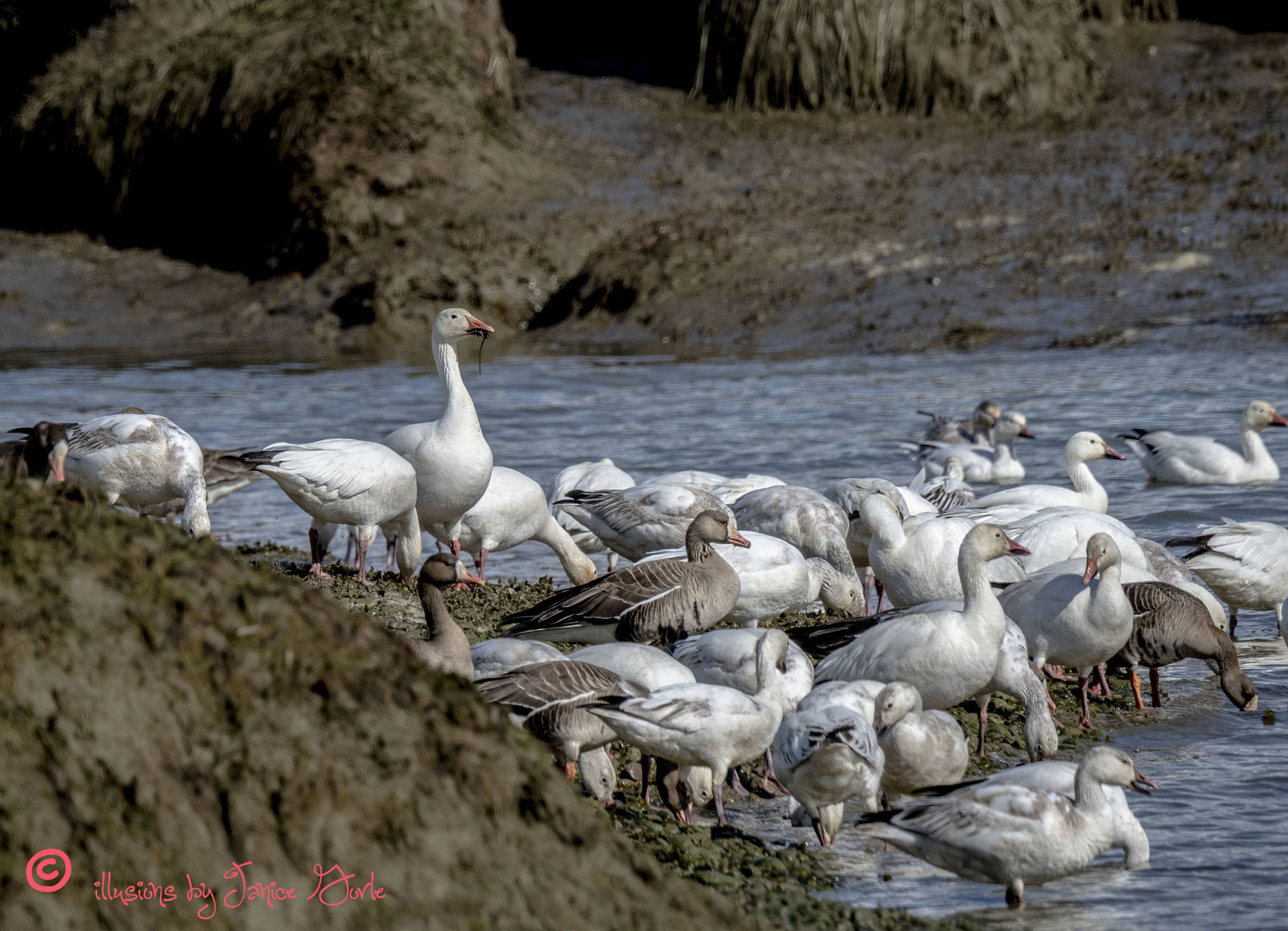
The next day, I went to Eagle Beach. Circling a bunch of grazing geese in the meadow (so as not to disturb them) and arriving at the berm near the mouth of the river, I saw a group of 14 snow geese, resting on a sand bar and wondered if the solo bird that had been around in previous weeks had finally found some friends of its own kind. Walking the beach past the day-use area, I noted that some irresponsible person had dumped an eight-cylinder engine from the highway lookout down onto the upper beach. What are the prospects of getting that big piece of junk out of there?!
As I returned to my car, I saw a very dark bird perched at the top of a small spruce. A merlin! Merlins of the Pacific race are charcoal-black on wings and back, and the chest streaks are thick and dark. This bird looked very burly and husky. Checking a bird guide, I found out that merlins are a bit bigger than kestrels in linear dimensions but considerably heavier. Merlins typically prey on small birds, which seemed rather scarce that day. This sighting was my good prize for the day (my other “prize” was a five-gallon bucket full of trash from the beach).
The following day, I went out on the Boy Scout/Crow Point trail with two friends. Good weather, this time, in contrast to a few days before, when stiff, cold winds had us hiding the trees and sent the ducks and geese into shelter well up the river. On this day, however, the waterfowl were spread out over the sand bars near the mouth of the river. Eagles stood at the edges of the sand bars exposed by the dropping tide. One of them was attended by two or three quick and daring crows that darted in to snatch bits from the big bird’s prey. Six snow geese, heads down, grubbed up food from the meadow soils while several Canada geese stood watch. Later, more snow geese flew in, gliding elegantly on black-tipped wings, bringing the total back to 14.
Some sea lions, large and small, cruised along the southern end of the beach, tightly packed together. They were soon joined by another group. The whole gang dithered back and forth but did not appear to be foraging. We wondered if the second group had brought word of a pod of transient killer whales somewhere not far away.
The sands were full of animal track: shorebirds of two sizes (although we saw none of the makers), geese, gulls, ravens, a mystery critter. The wrack line from the last high tide was a very thin line of small debris. We could see that a crow had marched along the line for some distance, no doubt looking for things edible.
The goose-flat meadow was empty of geese, so we strolled across it, looking for signs of emerging green shoots. A sharp whistle brought us bolt-upright and looking toward some trees, where three marmots stood on a small rise. There is presumably a colony of beach marmots nearby, perhaps under tree roots in a sand bank.
Songs of ruby-crowned kinglets and robins entertained out ears, filling out a good early-spring walk.
• Mary F. Willson is a retired professor of ecology. “On The Trails” is a weekly column and appears every Friday. Her essays can be found online at onthetrailsjuneau.wordpress.com.
