
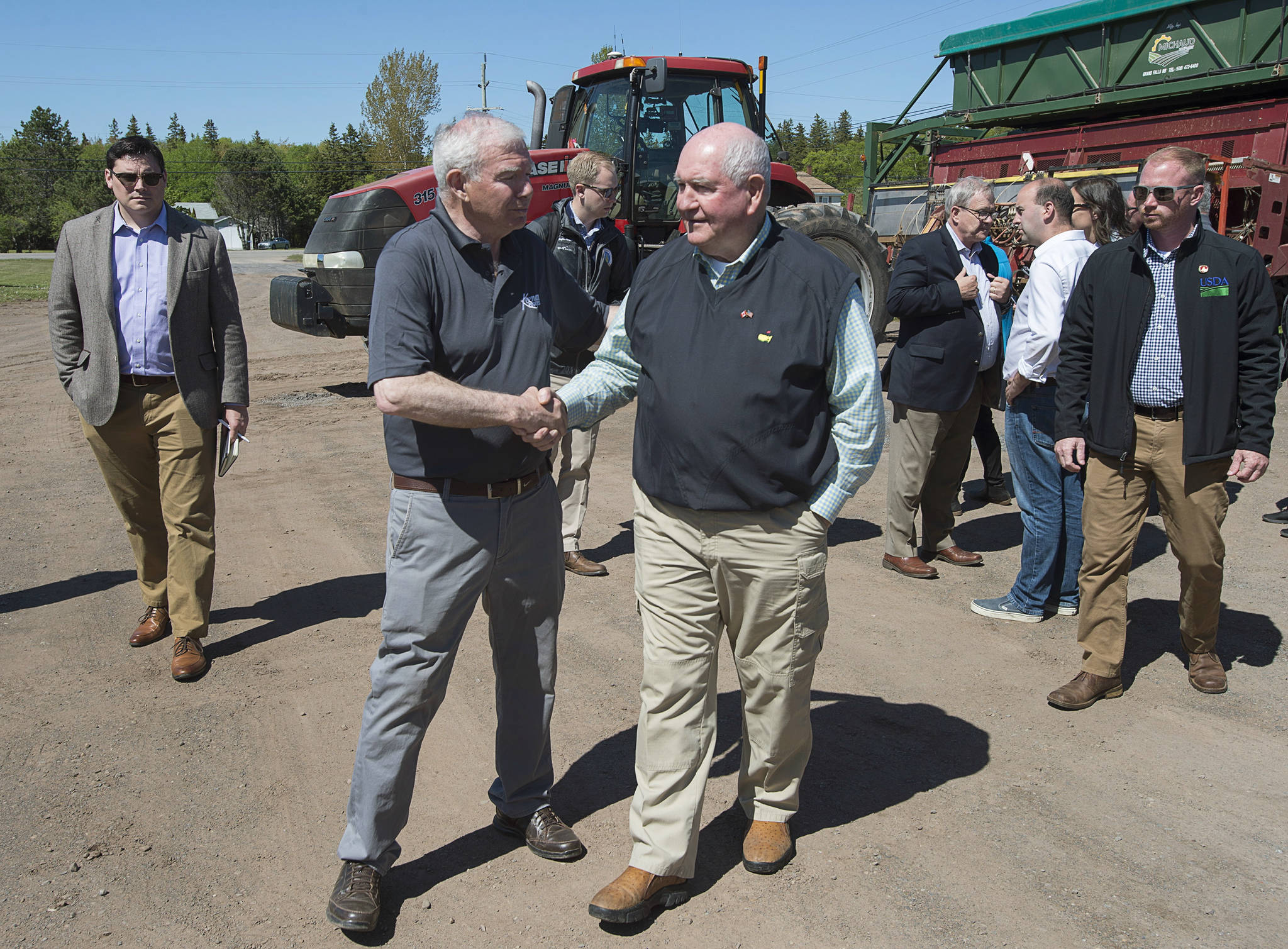
U.S. Secretary of Agriculture Sonny Perdue, right, shakes hands with owner Ray Keenan after touring Rollo Bay Holdings, which specializes in potato producing, marketing, shipping and exporting, in Souris, Prince Edward Island, Canada, on Friday, June 15, 2018. (Andrew Vaughan/The Canadian Press via AP)

U.S. Secretary of Agriculture Sonny Perdue, right, shakes hands with owner Ray Keenan after touring Rollo Bay Holdings, which specializes in potato producing, marketing, shipping and exporting, in Souris, Prince Edward Island, Canada, on Friday, June 15, 2018. (Andrew Vaughan/The Canadian Press via AP)

USDA Sec. Perdue: Logging, other Southeast industries not ‘mutually-exclusive’

2001 roadless rule an impedes industry, Perdue said after touring region’s few remaining timber companies

Correction: This article initially listed an incorrect figure for the number of acres the roadless rule would apply to in the Tongass National Forest. The article has been updated with the correct figure.

After visiting timber industry sites in Southeast Alaska on Thursday, U.S. Department of Agriculture Secretary Sonny Perdue said he’d like to alter federal law to allow more logging in the Tongass National Forest.

Perdue, the highest ranking official at the agency overseeing the U.S. Forest Service, toured logging companies and two timber stands on Thursday at the invitation of U.S. Sen. Lisa Murkowski. He told reporters afterward he hopes to develop an “Alaska-specific” version of the 2001 roadless rule, which bans logging and road building on national forest lands where roads have not been built. The rule applies to 9.6 million acres (57 percent) of the Tongass.

The State of Alaska has tried for years to secure an exemption to the rule in federal courts. The U.S. District Court of the District of Columbia shot down those efforts last year.

Perdue said he’d like to take a different tack: working with the state and the USDA to alter the rule, giving Alaska more control over what lands it logs.

“We believe that the best way to resolve and dissolve the concerns of Southeast Alaska with regard to Tongass, and all the things it affords and the multiple uses there, is to use an exemption for a state-specific, Alaska state roadless rule,” he said.

While logging has waned to a fraction of what it once 20 or 30 years ago, other industries like commercial fishing and tourism have remained steady or expanded. With the shuttering of Southeast’s mills, large USFS timber sales now have a hard time finding buyers.

The Tongass should be a “working forest” for all industries, Perdue said, and timber should have a larger place in Southeast’s forest economy.

“Healthy forests produce health in many ways, for humans, for wildlife, for fishing, for water quality and for beauty. Actually, we see this in many places. This is Senator Murkowski’s desire as well,” he said.

Tour operators are concerned a timber revival could harm those industries. But Perdue said logging and other industries are “not mutually-exclusive.” While his goal is not return the “logging days of old,” Perdue said he wants the USFS to support a “base layer” of logging in the region.

Murkowski, Gov. Bill Walker and Alaska’s congressional delegation have all spoken out against the roadless rule.


• Contact reporter Kevin Gullufsen at 523-2228 and kgullufsen@juneauempire.com. Follow him on Twitter at @KevinGullufsen.


More in Home

Downtown Juneau experiences its first significant city-level snow fall of the season as pictured on Saturday, Dec. 6, 2025. (Mari Kanagy / Juneau Empire)
Sub-zero temperatures to follow record snowfall in Juneau

The National Weather Service warns of dangerous wind chills as low as -15 degrees early this week.

Brenda Schwartz-Yeager gestures to her artwork on display at Annie Kaill’s Gallery Gifts and Framing during the 2025 Gallery Walk on Friday, Dec. 5. (Mari Kanagy / Juneau Empire)
Alaska artist splashes nautical charts with sea life

Gallery Walk draws crowds to downtown studios and shops.

A truck rumbles down a road at the Greens Creek mine. The mining industry offers some of Juneau’s highest paying jobs, according to Juneau Economic Development’s 2025 Economic Indicator’s Report. (Hecla Greens Creek Mine photo)
Juneau’s economic picture: Strong industries, shrinking population

JEDC’s 2025 Economic Indicators Report is out.

Map showing approximate location of a 7.0-magnitude earthquake on Saturday, Dec. 6, 2025. (Courtesy/Earthquakes Canada)
7.0-magnitude earthquake hits Yukon/Alaska border

Earthquake occurred about 55 miles from Yakutat

Gustavus author Kim Heacox talked about the role of storytelling in communicating climate change to a group of about 100 people at <strong>Ḵ</strong>unéix<strong>̱</strong> Hídi Northern Light United Church on Wednesday, Dec. 3, 2025. (Mari Kanagy / Juneau Empire)
Author calls for climate storytelling in Juneau talk

Kim Heacox reflects on what we’ve long known and how we speak of it.

The Juneau road system ends at Cascade Point in Berners Bay, as shown in a May 2006 photo. (Michael Penn / Juneau Empire file)
State starts engineering for power at proposed Cascade Point ferry terminal

DOT says the contract for electrical planning is not a commitment to construct the terminal.

A cruise ship, with several orange lifeboats visible, is docked in downtown Juneau. (Laurie Craig / Juneau Empire file photo)
CBJ seeks input on uses for marine passenger fees

Public comment period is open for the month of December.

A spruce tree grows along Rainforest Trail on Douglas Island. (Mari Kanagy / Juneau Empire)
Where to cut your Christmas tree in Juneau

CBJ and Tongass National Forest outline where and how residents can harvest.

Most Read