
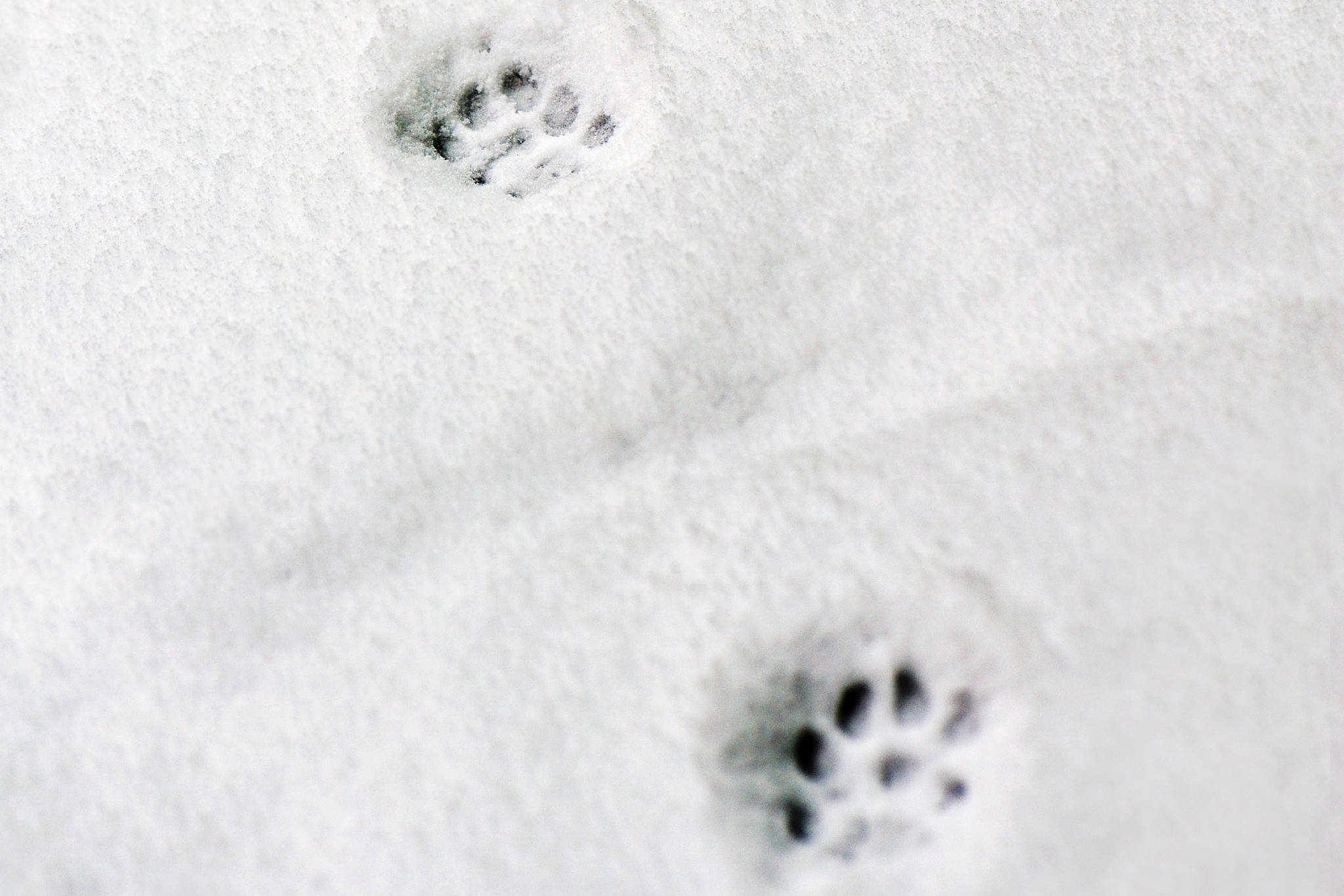
A warm, very wet spell in early December made the lichens and mosses all perky and colorful. Beavers left their distinctive foot marks in a thin dusting of snow and swam out around their winter caches of twigs, tail-slapping when we passed by. In a “real” winter, they would be tucked up into their lodges, snoozing a lot, talking quietly with their offspring and occasionally nibbling a twig from the cache. The kits of the year, however, would be chewing twigs all winter long, as they continue to grow. Bears were out and about too, mom and cub leaving their tracks near Dredge Lake, instead of entering into serious hibernation. That entails a profound reduction of metabolic rate, shutting down digestive processes, and very little activity inside the den, quite a contrast with beavers.
Then, in mid-December came a lovely and welcome snowfall, just a few inches at sea level. It wouldn’t last, of course, in this time of warming climate, so I dug up my snowshoes and headed to Eaglecrest. There the snow was maybe a foot or so deep and just right for poking around on a day when the lifts weren’t running. Snow was falling thick and fast, quickly covering any little tracks of mouse or shrew. But under the trees were prints of snowshoe hares. A small-footed canine creature had run across a wide open area, leaving a long, straight line of well-spaced prints. There was no evidence of any human anywhere nearby, so I guessed that a coyote had raced along. But very few critters made themselves visible — a porcupine that seemed to think that if it could not see me, then I could not see it; and one flying insect, probably a stonefly. Nary a bird to be heard or seen not even a hopeful, attendant raven.
A couple of days later, a nice little cold snap meant that even at sea level, there remained a few inches of snow cover. I went out the road to some meadows, where I plonked along on snowshoes — a convenient way to deal with snowy humps of frozen grass. Oddly, there were no shrew tunnels to be seen, nor any squirrel tracks, and again not a bird could be found.
But otters had been quite busy. They had fossicked along a tiny rivulet, trampling some spots quite flat; there were more than one of them, apparently, so perhaps a family of mom and well-grown pups. I lost their trail when it went under the trees where there was no snow. However, a few minutes later, I encountered their characteristic slide marks where they had crossed a snowy, open area, pushing off strongly with the hind legs and gliding smoothly even over flat ground. This is probably more fun than stomping around on snowshoes! A bit farther on, otters had come up out of a tiny stream and snuffled all around the nearly buried ends of several low, trailing spruce branches. What was going on there, I wonder.
[Winter trailside observations]
Some days later, I looked for tracks in another meadow out the road, but there had been little recent activity. A couple of squirrels had explored the meadow edges, out of the trees and back again, diving under humps of bent-over grasses. Before the last little snowfall, porcupines had trundled over the meadow in several places, on their usual meanderings. They seem to travel quite extensively, perhaps in search of just the right twig to nibble. Along a small creek, some critter had burrowed into the bank in several spots — possibly an otter.
Surprisingly, there were no little shrew-size grooves on the surface of the snow, no tiny holes where a shrew dove under the white blanket. Yet this was a meadow that, in previous years, had been laced with trackways of shrews. One shrew had even taken a dive off a vertical mudbank and gone skittering over a gravel bar in a creek. But where are all those shrews now?
A fluttering on the creek-bank caught my eye and eventually turned into a dipper. This bird was foraging along the water’s edge but apparently found little of interest, because it soon took off, upstream. That was the only living animal to be seen, except for one red squirrel crossing the creek on a broken-branch bridge.
Later that day, on another stream, I checked a long-occupied beaver lodge. There were no signs of recent beaver activity here, although the lodge may be currently occupied. However, other woodland folks were interested in the place: porcupines and mink had visited on more than one occasion in recent days. Was this perhaps a multi-species condo? It wouldn’t be the first time that happened.
The slanting light of midwinter that stabs one blindingly in the eye at certain times of day on Egan Drive, did some beautiful things out by the meadows. Some conifer-clad hilltops were brilliantly lit, contrasting with darker slopes below. Light mists collected in the valleys caught the light rays and turned golden. Overhead, some dark clouds gathered amid some white fluffy ones, but bright rays came through the many unclouded areas, where blue sky was a cheery sight.
• Mary F. Willson is a retired professor of ecology. “On The Trails” is a weekly column that appears every Friday. Her essays can be found online at onthetrailsjuneau.wordpress.com.
