
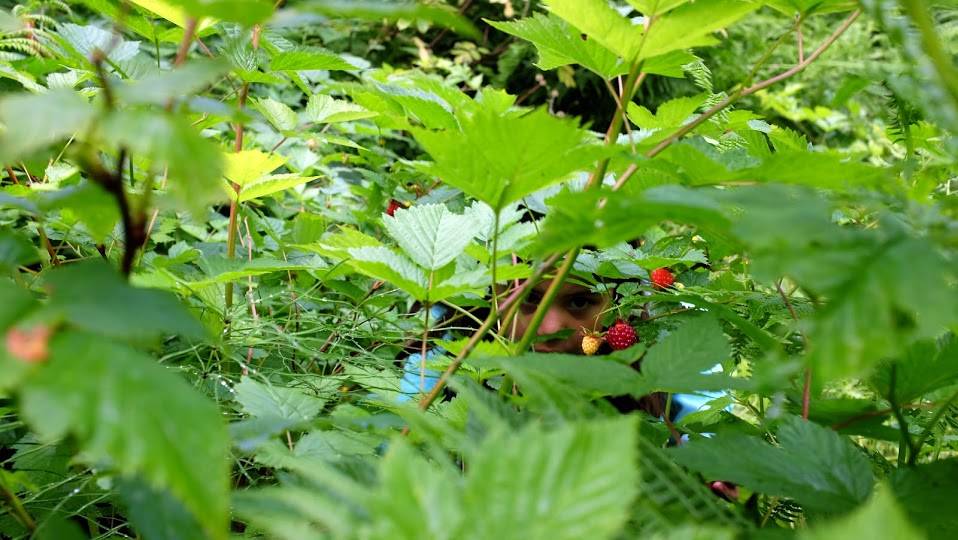
Where is Here?
At Discovery Southeast, this is the question we gravitate toward when fostering curiosity and understanding in our natural environment.
In our community, I hear more and more about people losing a sense of connection — connection to other people, to the community, to the natural environment, and to ourselves. We can reawaken this connection by being present in the natural world and letting our inner curiosity arise.
Discovery Southeast’s mission is to deepen our connection with nature through exploration and education.
Naturalists teach young children the skills of observation and making connections that will be the foundation for future science and math lessons with their classroom teachers.
Teachers know that students learn by being curious observers of their world.
When students learn to pay attention and connect to what is around them, be that people or the natural world, they become better prepared to navigate our increasingly complicated world.
On my field trips, we always have a goal in mind. Our focus may be landforms or the lifeforms residing on them. Yet always at the core is the experience of fully engaging with our whole body in the place itself.
This connection to place that develops is what creates the foundation for children’s ability to draw connections to what they are learning.
How do we foster that connection?
My outings often begin with an activity I call “Opening the Gate.” I guide students and adults to quiet down into stillness, thus connecting their “Observer” to the present environment through their senses.
I have children focus on tiny details like air moving across the skin of their face, distant sounds of birds, dappling light through the trees.
By connecting with their bodies, they calm the nervous system, which primes their attention to land here, now. This awareness potentiates curiosity and wonder, the gateway to exploration.
Once the “gate” has opened and we are walking in the rainforest, typical exclamations from students go something like this: “It’s colder out here than I thought.”
“This hill is steep!”
“This plant feels like …”
“Are we lost?”
“I love it out here!”
“It’s so awesome to see that.”
There are myriad questions that arise: “What is that?” “How did that get here?” “Can we go this way?” — all from the Observer within them. Children learn about their natural environment while also learning about themselves and each other.
Going “off trail” is my main method for inviting the Observer to arise organically. Traveling on uneven ground requires attention.
Often, we use trails for access and egress, yet, when we wander away from the purposeful construct of trails, a new kind of exploration ensues. We are given an opportunity to reclaim ourselves from the overzealous do-er that is inside us all.
Instead of doing something outside for the purpose of exercise, accomplishing so many miles, getting to that one viewpoint, we can be present.
Instead of an autopilot walk down a maintained pathway, our bodies must navigate other life forms, mainly in the way of brush, roots, mud and other obstacles.
Our attention comes sharply to focus on what is right here in front of us. Flying branches, devil’s club and uneven ground are expert at helping us be more present.
I invite and encourage you all to try this yourselves: Go outside, mute your phone, take a favorite trail and give yourself permission to turn 90 degrees and take a dozen steps off the trail.
Intentionally, deliberately and step off the “beaten path” and notice what you see, smell, touch, and hear.
Make some room for your Observer to arrive in the place you are standing or sitting.
Simultaneously have a sense that you, the Observer, are also the Participant. Connect with yourself; connect with the place you are in.
Where is Here?
There is no such place as Nowhere.
• Steve Merli has been a naturalist with local nonprofit Discovery Southeast for 28 years, teaching nature and science education for Juneau elementary classes. He is also a Somatic Experiencing Practitioner. STEM Corner is a monthly column about Science Technology Engineering and Math in Juneau, written by a rotating group of Juneau STEM Coalition members.
