
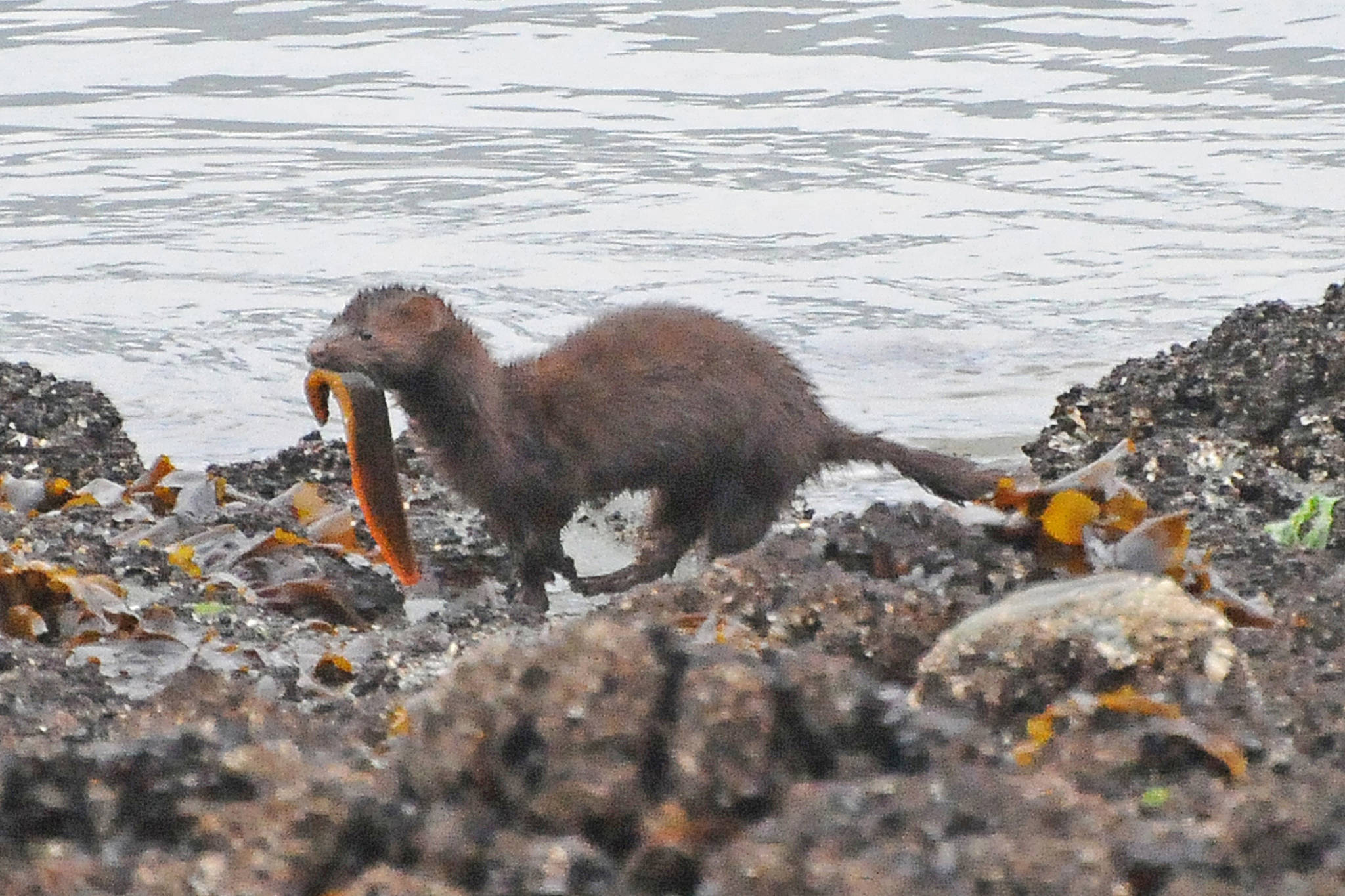
Right after a little (belated) snowfall in early December, I chanced to be prowling around some ponds in the Mendenhall Glacier Recreation Area. Mink feet had been there before me, leaving crisply defined footprints in the trails. That mink mostly kept to the foot paths rather than humping over and under the frozen grasses, but made occasional forays to the edges of the almost-frozen ponds. Mink — and deer, bear and porcupines — often use “our” trails, where there is easy going; snowshoe hares don’t seem to do so very often.
Mink can climb very well and have a rotatable ankle joint that lets them come down a tree headfirst (like a squirrel). But they usually hunt on the ground and in shallow water, both salt and fresh. They swim well, with partially webbed toes and can dive several meters deep. Their fur is water-repellent. They live all over Alaska, except for some islands and the very far north, reaching high densities in Southeast (except where heavily trapped).
Dens are usually near water — in hollow logs or burrows, under tree roots, often in an abandoned den of some other animal, such as a beaver or marmot. The video camera at the visitor center sometimes catches a mink exploring even the occupied beaver lodge in Steep Creek. Mink aren’t likely to use a burrow that belongs to an otter, however, because relationships between mink and otter are generally hostile. They share many of the same eating habits and otters sometimes kill and eat mink.
Mink are opportunistic foragers for meat of all sorts — everything from bugs and earthworms to fish, small mammals and birds. When foraging in the intertidal zone, they take crabs, clams, little fish and snails. Mink also gobble up bird eggs and carrion, including salmon carcasses. Cannibalism sometimes occurs. A big male mink sometimes may take down a hare or muskrat or a sitting bird twice its own size.
Mink are fierce enough to tackle prey that is bigger than themselves. Years ago, however, my old cat who was an experienced hunter, observed a mink travelling on the other side of my home pond and got wildly excited. She could hardly sit still at the window, bumping into the glass, whining, champing her teeth, twitching all over. Little did she know that she would become mink lunchmeat, had she been outdoors and free to engage with this so-attractive creature.
Mating, for mink, occurs in early spring and young are generally born in June. There may be as many as 10 of them in a litter, but four or five would be more usual. Both male and female mate promiscuously, so littermates may have different fathers. Mating often begins with a rough and no doubt boisterous fight that may leave the female with some wounds. The male then grabs the female by the back of the neck and they copulate, often several times. Copulation is a prolonged process, sometimes lasting as hour.
Eggs are fertilized over a period of several days but do not begin to develop immediately. Mink, along with other members of the weasel family, delay the implantation of the fertilized egg in the wall of the uterus. That egg may float around for several weeks before attaching to the uterine wall, getting a blood supply (via the placenta) from the motherand starting to develop. From implantation to birth takes only about a month but, as a result of delayed implantation, there can be as many as three months between copulation and birthing.
Kits are born blind, deaf, thinly furred and toothless. They get their milk teeth after about 16 days, and their permanent teeth begin to erupt after about six weeks. Their eyes open at a little over three weeks and weaning occurs at about five weeks. Kits start hunting, along with the mother, at about eight weeks of age, but become independent after another month and disperse to find their own home ranges. They mature by the next spring and can breed then.
American mink were introduced to Europe decades ago and now occur across much of northern Eurasia. They compete with the smaller, native Eurasian mink, whose populations have declined dramatically from that competition and many other factors. Mink were also introduced, more recently, to southern South America, which previously lacked any similar predator — no doubt the expanding mink populations cause consternation and carnage among the native riparian and shoreline birds there.
• Mary F. Willson is a retired professor of ecology. “On The Trails” is a weekly column that appears every Friday. Her essays can be found online at onthetrailsjuneau.wordpress.com.
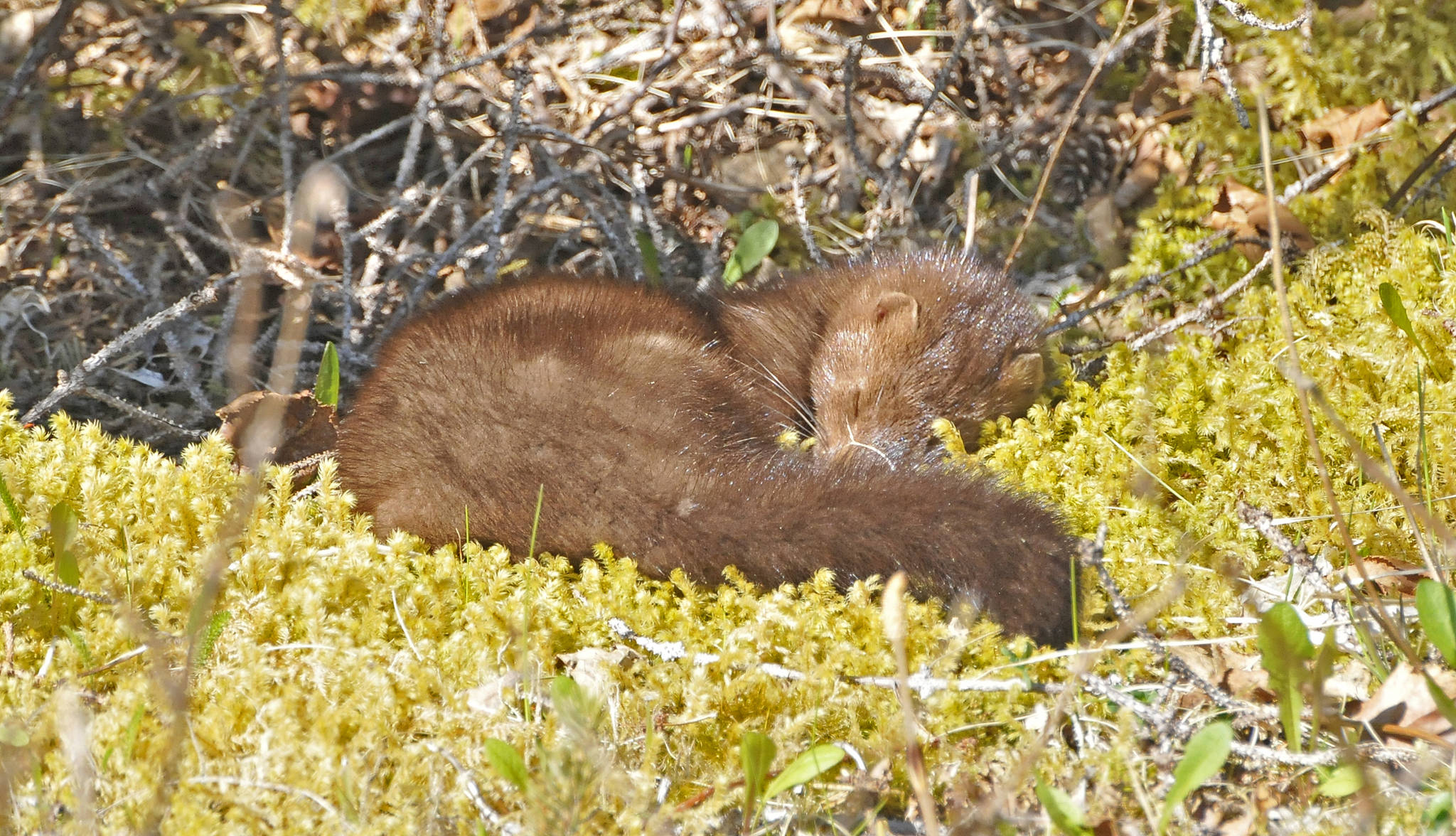
A sleeping mink. (Courtesy Photo | Bob Armstrong)
