
Clarification: an earlier version of this story said the Tongass Land Management Plan directs a transition to logging of young growth trees in Southeast. It does provide for that transition, but still allows for the logging of up to 5 million board feet of old growth after a 15 year transition period.
It’ll take about two years for U.S. Forest Service managers to craft an Alaska-specific version of the national Roadless Rule, which prohibits the building of roads on 9.2 million acres — or about 55 percent — of the Tongass National Forest.
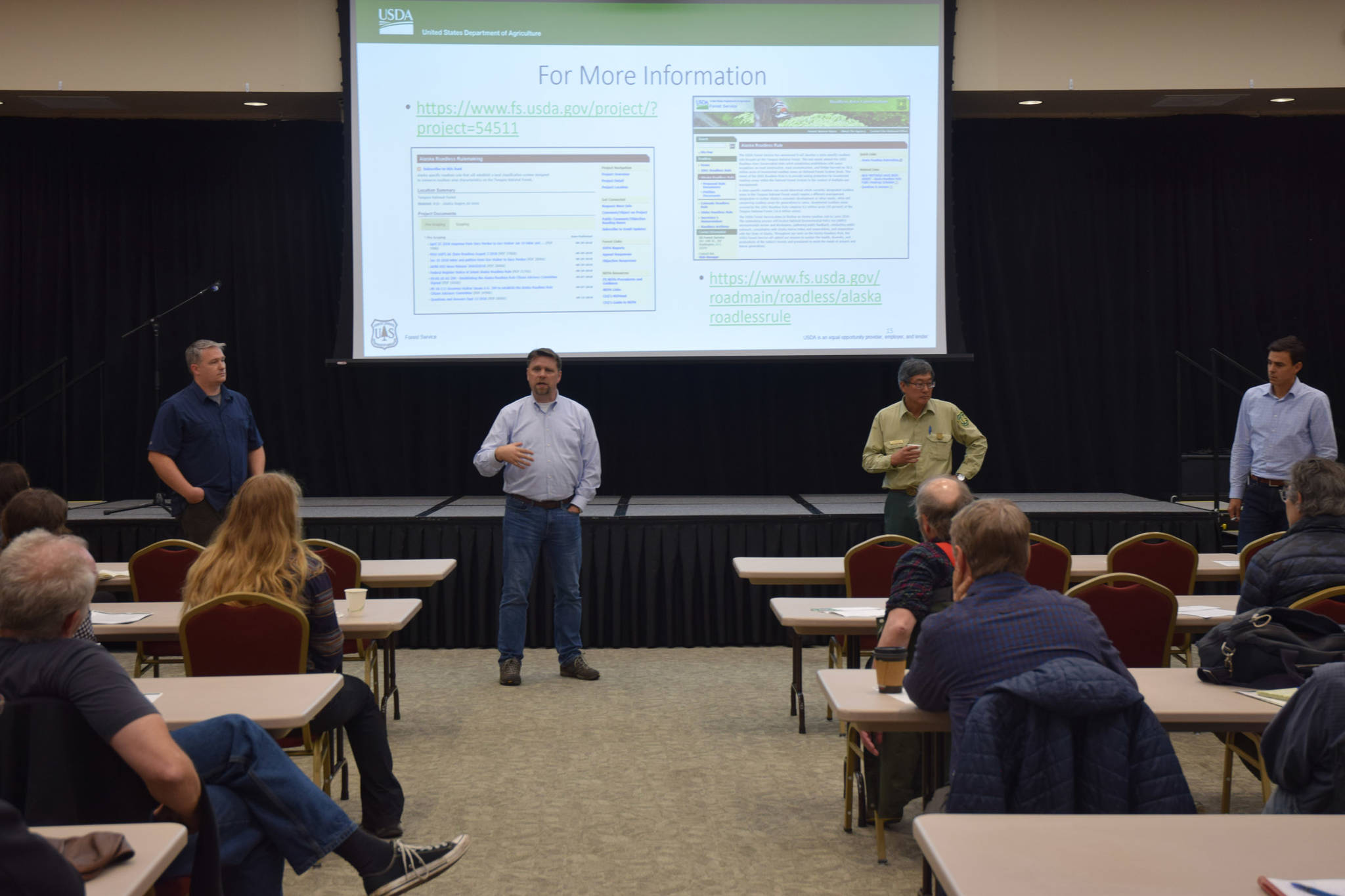
That process started Thursday night with the first of a series of informational public meetings.
What the final rule will look like, and if more public lands will be opened up to roads, will depend in part from what the public wants, according to Chris French, the acting deputy chief of the National Forest System.
French led the meeting and spoke about how a new rule would be formed.
Alaska’s rule will be shaped by three parts: public comment submitted to the Forest Service and consultation with the state of Alaska and tribes. Though Alaska has two national forests, the Chugach and Tongass, the new rule would apply to the Tongass only, a request the state made, French said.
Though U.S. Department of Agriculture Secretary Sonny Perdue will have final say over a state-specific rule, written public comments (due Oct. 15) will be “huge” in determining how much more land will be opened to road construction and logging, French said.
“That’s how we base our overall intent is based on what we receive in those comments,” French said.
About 75 people showed up to the Elizabeth Peratrovich Hall for the evening meeting Thursday. Many wore green stickers which read “Keep Roadless in the Tongass.” Those were handed out by Southeast Alaska Conservation Council, a Juneau nonprofit environmental advocacy group. SEACC is working to keep the new rule as close to the national rule as possible, said Executive Director Meredith Trainor.
She’s hopeful that the Forest Service will come up with a new rule nearly identical to the old one.
“What’s striking is that I don’t think Southeast Alaskans really want this. We don’t want to spend our time on another process like this,” Trainor said.
David Albert attended the meeting wearing one of SEACC’s stickers. Like several who attended the meeting, Albert was skeptical of the process.
He said the crafting of a new rule “smacks of political opportunism.” Perdue has sided with the state of Alaska and Alaska’s Congressional Delegation in their opposition to roadless protections on the Tongass.
Albert is worried that a new rule might be rushed through by state officials who are sympathetic to logging industry interests. That industry, he said, would harm Southeast fishing and tourism.
“Timber is important in this region, but it’s just one of the pieces. Fisheries are more important. Tourism is more important. There are a lot of more important things. Timber sucks all the air out of the room. That’s what’s happening now, this is really about timber,” Albert said.
“Once you log, it removes a lot of those other values,” Albert said.
There was some audience concern that an Alaska-specific rule would override the 2016 Tongass Land Management Plan, which prescribes a transition to the logging of younger tree stands in Southeast while still providing for the logging of up to 5 million board feet of old growth annually after a 15-year transition period.
The TLMP (or T-Lump, as it’s known) is in part based on the Roadless Rule. If the Roadless Rule changes, the TLMP may need to be amended.
French said that’s not quite accurate. TLMP changes would occur only to the extent which the state-specific rule differs from the national one.
The idea for a state-specific rule dates to January of this year, when Department of Natural Resources Commissioner Andy Mack petitioned Perdue to develop a state-specific rule to spur economic activity in rural Southeast, he said.
The state and Forest Service — a federal agency which works under the USDA’s umbrella — then agreed to hash out a new rule together.
Alaska’s rule wouldn’t be without precedent: Idaho and Colorado have their own state-specific rules.
Written comments on the state-specific Roadless Rule can be submitted electronically to https://www.fs.usda.gov/project/?project=54511.
The Forest Service plans to finalize an Alaska roadless rule by June 2020. Fifteen more public meetings are scheduled, most of them in Southeast Alaska. A full list can be found at https://www.fs.usda.gov/Internet/FSE_DOCUMENTS/fseprd594125.pdf.
“Any opinion on this is valuable,” French said.
• Contact reporter Kevin Gullufsen at 523-2228 and kgullufsen@juneauempire.com. Follow him on Twitter at @KevinGullufsen.
