
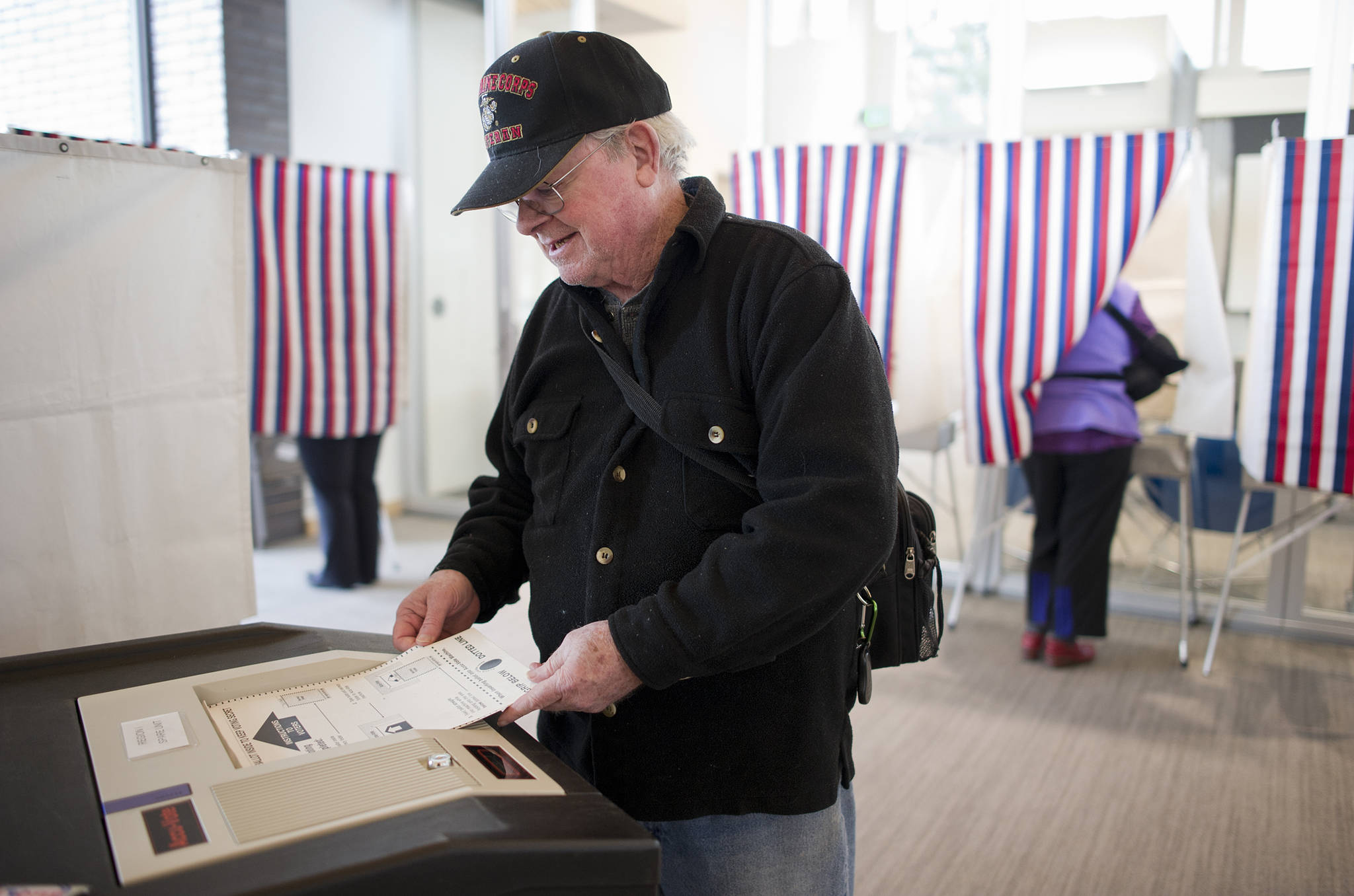
Dr. Johnny Holland feeds his ballot into a counting machine while voting during a special election for mayor of Juneau at the Mendenhall Valley Public Library in 2016. The Alaska Division of Elections is considering new voting equipment statewide. (Michael Penn | Juneau Empire file)

Dr. Johnny Holland feeds his ballot into a counting machine while voting during a special election for mayor of Juneau at the Mendenhall Valley Public Library in 2016. The Alaska Division of Elections is considering new voting equipment statewide. (Michael Penn | Juneau Empire file)

Prepping for 2018 election, state looks at 2020

Contractor will analyze costs of possible changes to voting system

The Alaska Division of Elections is in the middle of preparations for this fall’s statewide primary and general elections, but in a meeting Wednesday, the division showed it also has its eyes on 2020.

In a meeting of the statewide election policy task force, division officials said they are preparing to acquire new voting equipment even as they consider whether the state should change the way it conducts elections.

“It’s kind of two separate projects. It’s equipment replacement and it’s expanding options for ballot access in the future,” Josie Bahnke, the division’s director, said by phone after the meeting.

Nothing will change before this year’s Aug. 21 primary or the Nov. 6 general election. Voters will still go to polling stations across the state, they’ll still pick up pens, and they’ll still fill in ovals on paper ballots, then feed those ballots into 20-year-old scanners.

Those scanners are aging, and the state hopes that it won’t have to use them by 2020. This year, the Alaska Legislature appropriated $4.8 million in the statewide construction and renovation budget for new equipment.

The state could buy new machines or lease them, but Bahnke said the state is using the replacement process as an opportunity to examine voting in a fresh way.

“The Alaska Division of Elections (DOE) is at a critical juncture,” said a report presented to the work group. “Alaska’s voting equipment and technology are outdated, difficult to repair, and prone to failure. At the same time, there are concerns about the security of the voting process and increasing numbers of voters are choosing to cast their ballots in ways other than the traditional voting in person at their local precinct.”

On Wednesday, members of the task force, which includes elected officials, municipal clerks, and members of civic organizations from across the state, were presented with the results of surveys conducted across the state. Those surveys ruled out a strictly vote-by-mail elections process but seemed to indicate support for a hybrid model, one where ballots are mailed to voters, but voters then have multiple means to submit a completed ballot.

That hybrid system can’t be operated under current law, so the division has hired Resource Data Inc. to determine what statutory changes would be needed and how much it would cost.

The same company is analyzing other ways to conduct elections, and a full report is expected in December, after the 2018 vote is finished.

Bahnke said the new equipment being considered will have the flexibility to work regardless of any changes made to the state’s voting system.


• Contact reporter James Brooks at jbrooks@juneauempire.com or 523-2258.


More in Home

Map showing approximate location of a 7.0-magnitude earthquake on Saturday, Dec. 6, 2025. (Courtesy/Earthquakes Canada)
7.0-magnitude earthquake hits Yukon/Alaska border

Earthquake occurred about 55 miles from Yakutat

Gustavus author Kim Heacox talked about the role of storytelling in communicating climate change to a group of about 100 people at <strong>Ḵ</strong>unéix<strong>̱</strong> Hídi Northern Light United Church on Wednesday, Dec. 3, 2025. (Mari Kanagy / Juneau Empire)
Author calls for climate storytelling in Juneau talk

Kim Heacox reflects on what we’ve long known and how we speak of it.

The Juneau road system ends at Cascade Point in Berners Bay, as shown in a May 2006 photo. (Michael Penn / Juneau Empire file)
State starts engineering for power at proposed Cascade Point ferry terminal

DOT says the contract for electrical planning is not a commitment to construct the terminal.

A cruise ship, with several orange lifeboats visible, is docked in downtown Juneau. (Laurie Craig / Juneau Empire file photo)
CBJ seeks input on uses for marine passenger fees

Public comment period is open for the month of December.

Browsers crowd into Annie Kaill’s gallery and gift shop during the 2024 Gallery Walk. (Juneau Empire file photo)
Gallery Walk guide for Friday, Dec. 5

The Juneau Arts & Humanities Council announced community events taking place during… Continue reading

A spruce tree grows along Rainforest Trail on Douglas Island. (Mari Kanagy / Juneau Empire)
Where to cut your Christmas tree in Juneau

CBJ and Tongass National Forest outline where and how residents can harvest.

Michael Wilson of Keet Enterprises offers staffs, salves and more at the Juneau Public Market on Friday, Nov. 28. (Mari Kanagy /Juneau Empire)
Five faces of the Juneau Public Market

Of the more than 175 vendors, the Empire spoke to five across different mediums.

The Alaska Marine Highway System ferry LeConte at the Auke Bay Terminal on Monday, March 5, 2018. (Juneau Empire file photo)
Update: Public comment period extended on proposed Cascade Point ferry terminal

The $28 million first phase would extend Glacier Highway and prepare the site on Goldbelt land.

Local nonprofit St. Vincent de Paul delivered over 500 meal baskets on Saturday as part of its Thanksgiving Basket Drive. (Photo courtesy Jennifer Skinner)
St. Vincent de Paul delivers 521 Thanksgiving baskets amid rising need

The annual holiday drive saw a 30% increase in demand.

Most Read