
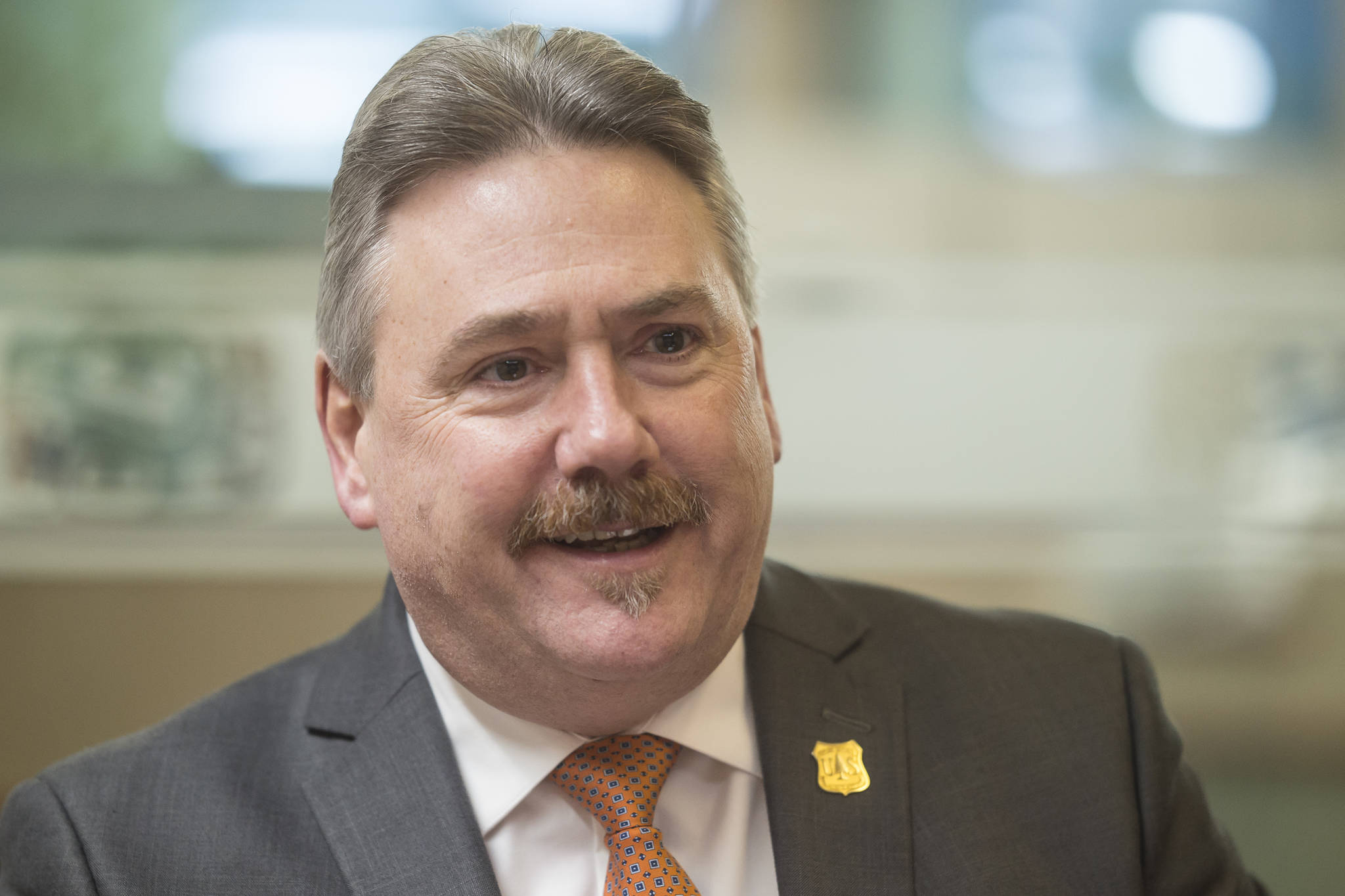
Dave Schmid is ready to move out of the Juneau Hotel.
For eight months, Schmid has been the acting regional forester for the Alaska Region of the U.S. National Forest Service. Though he’s been treating it like a long-term job, it wasn’t officially permanent until this November. A Nov. 30 press release announced that he was taking over the post full-time.
“I think the employees in the region and the external community leaders, how much do you really invest in someone that’s got an ‘acting’ in front of their title? I tried to break through that a lot with folks,” Schmid said. “I think that just helps with the discussion, knowing that I’ll be here for a while.”
Schmid, 57, replaces Beth Pendleton in the position and now oversees 22 million acres of forest in Southeast and Southcentral. Pendleton retired earlier this year after working as the regional forester for eight years and for a total of 30 years for the Forest Service.
Schmid has worked in Alaska for 23 years, working as a fisheries and watershed program leader on the Chugach National Forest and as a district ranger on the Tongass National Forest in Southeast.
He described the Tongass as a place “where national politics and everything play out on a daily basis.” When he worked as a district ranger in Thorne Bay in the late 1990s, the federal government canceled contracts with Ketchikan Pulp Mill workers and he had to deal with the fallout.
With national government again getting involved in Alaska’s forests, Schmid said he feels prepared to handle it.
When Congress passed the 2001 Roadless Rule — which blocks construction of new roads on millions of acres of the Tongass — Schmid was working in Alaska. Now, as state and federal officials are working to create an Alaska-specific rule, Schmid is right in the middle of it.
Most of the process so far has been collecting public input, he said. The Forest Service got more than 144,000 comments, Public Affairs Specialist Dru Fenster said. Now, Schmid said, he and his colleagues are taking those into consideration and developing a list of options.
“What we’re developing right now is a range of alternatives, and that will reflect everything from no action to an exemption from the rule,” Schmid said. “It’s bookended on both ends with some alternatives in between.”
He said they should have an Environmental Impact Statement by next summer laying out the environmental effects that changing the Roadless Rule would have. The deadline to have the whole process finished is the summer of 2020, which Schmid said is “an aggressive timeline.”
Schmid said he feels prepared to meet those deadlines and work with the state, the federal government and tribal governments to find the best solution for the state’s forests.
[USDA Sec. Perdue: Logging, other Southeast industries not ‘mutually exclusive’]
Though the Roadless Rule is the hot-button issue at the moment, Schmid said he has a number of other goals for his time as regional forester.
Chiefly among those goals is creating a better work environment. In mid-November, Forest Service Chief Vicki Christiansen testified in front of a Congressional panel and pledged to address reports of sexual harassment, bullying and discrimination among Forest Service employees over the years. Schmid said he and his colleagues are taking those allegations seriously and are working to find solutions.
Secondly, Schmid said he’d like to make more of an effort to work with local communities to make sure manage young-growth forest and improve forest conditions as a whole.
Third, he said he wants to improve customer service. He said he’s heard feedback requesting better communication and easier processes for those looking to work in the forests. Schmid said he hopes to make it easier for people to contact the people they need to contact at the Forest Service.
“We’ve got this kind of wall of bureaucracy out there,” Schmid said.
Schmid said this is his last stop before retirement. He isn’t looking to jump to another job. Like so many transplanted Alaskans, Schmid said he and his wife came up to Alaska for a summer and decided they wanted to stay.
He worked for a time in Montana, but knew he wanted to come back to the Last Frontier.
“I fell in love with Alaska and I fell in love with the landscapes, the lifestyle, the culture,” Schmid said. “I lived in rural Alaska most of that time and we raised our daughter in that environment. It’s a special place for me.”
• Contact reporter Alex McCarthy at 523-2271 or amccarthy@juneauempire.com. Follow him on Twitter at @akmccarthy.
