
Larri Spengler has seen her fair share of avalanches.
Spengler, who is Secretary for the Thane Neighborhood Association, said that’s just the reality of living in the shadow of Mount Roberts.
“My husband and I have lived out here since 1989, so we’ve had invited and uninvited avalanches come down,” Spengler said.
The invited avalanches prevent the uninvited avalanches, and for years have been prompted by a howitzer cannon fired by the Alaska Department of Transportation & Public Facilities.
“It was noisy for the dogs who don’t enjoy fireworks,” Spengler said. “It would just be rolling thunder just about the same as fireworks.”
“That wasn’t a complaint,” she added. “We would welcome the booms, but it would confine the dogs.”
[Avalanche surprises downtown Juneau neighborhood]
The reason Spengler spoke in the past tense is because during this afternoon’s avalanche mitigation, the department of transportation will use a new piece of equipment known as a DaisyBell on the slopes over Thane Road rather than the howitzer folks may be accustomed to seeing and hearing.
“The howitzer was very dramatic,” said Aurah Landau, public information officer for Alaska Department of Transportation & Public Facilities Southcoast Region. “This is much less dramatic —more effective but less dramatic.”
Thane Road will be closed from noon-2 p.m. today for the hazard reduction.
An explosion cone
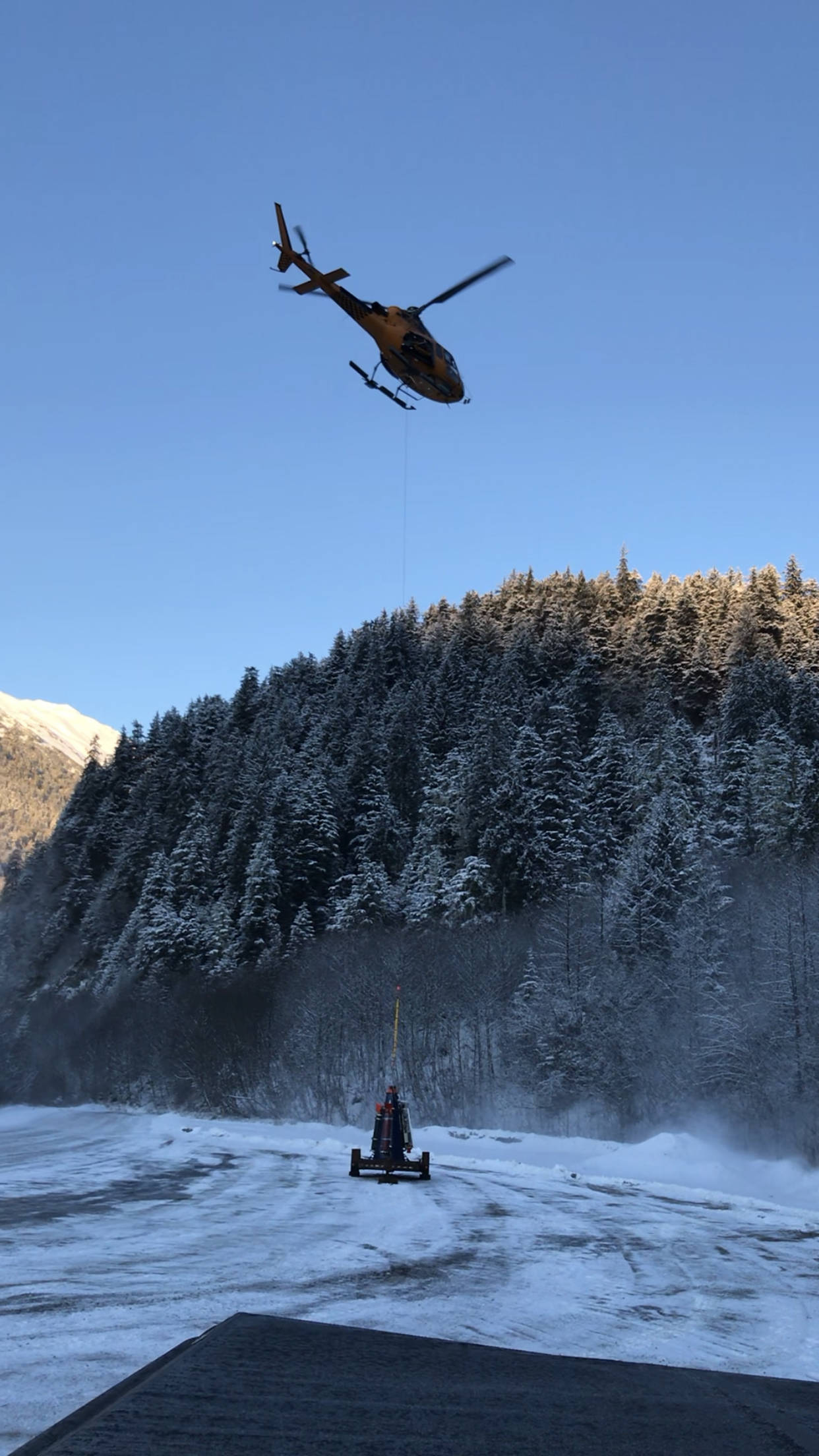
The DaisyBell looks like a megaphone pointing at the ground, and during usage it dangles underneath a helicopter.
Gas is ignited inside the DaisyBell, and the explosion from ignition creates force that is amplified and directed by the conical device. The pressure wave is what clears out snow and reduces avalanche risk.
The product isn’t yet widespread.
Landau said there are just six in the U.S., but the DaisyBell is surprisingly common in the capital city.
There are three DaisyBells in Alaska, Landau said, and two of them are in Juneau. One is with the department of transportation and the other has been with Alaska Electric Light and Power Company for almost a decade.
Mike Janes, avalanche forecaster for AEL&P, said the power company has had its DaisyBell since 2010 and was among the earliest adapters of the device, which has received frequent use.
“I think we’ve used 800 or 900 shots (explosions) with it,” Janes said. “We were the first ones in North America to use it operationally.”
[Avalanche forecaster shares knowledge]
Landau said residents will be able to see the DaisyBell and helicopter flying above slopes over Thane Road, but it might not heard.
The explosion inside the device is about as loud as a rifle shot, Landau said.
“It depends on where you are,” Janes said. “If you’re a couple of hundred yards away, it might be louder than a hunting rifle, but that’s a good approximation.”
Why use it?
Landau said using the DaisyBell has several advantages over the howitzer.
“We can do much more targeted avalanche mitigation,” Landau said. “We don’t need to do all that securing of the beach since we can be operating from across the channel.”
“This is where avalanche mitigation is going,” she added.
Gunner certifications also aren’t needed to use the DaisyBell, while they were needed for firing live ordinance at a mountain.
The DaisyBell cost $160,000, Landau said, but that one-time price is expected to be offset by future savings.
Janes said in AEL&P’s case, the DaisyBell replaced using explosives to trigger avalanches rather than a howitzer, but the device paid for itself in about three seasons. Explosives cost about $300 per explosion, while one DaisyBell “shot” costs about $5.
That’s part of the reason AEL&P bought one of the avalanche mitigation devices in the first place.
“We were trying to find a way to make our avalanche program sustainable,” Janes said. “It was costing too much, and when you’re an electric utility all of that cost gets passed on to the rate payers.”
A cheaper cost and quick reload means mitigation can be more complete in Janes’ experience.
“You can be a lot more liberal about how many shots you use and where you’re putting them,” Janes said. “It lets you be a lot more thorough.”
On average, a howitzer mission sots about $28,000, Landau said, and while exact figures for a DaisyBell mission won’t be known until one happens, Landau said using the DaisyBell will be cheaper on a per-round basis.
Plus, fewer employees will be required for the operation.
“It took seven to 10 employees every time we wanted to use the howitzer,” Landau said.
Spengler will not be around to see the DaisyBell in action Thursday, but said she’s glad it will be in use and wondered how it might affect local parlance.
“We are so grateful DOT has this new system,” she said. “We used to call them avalanche shoots. They’re not really avalanche shoots at all. They’re avalanche efforts.”
• Contact arts and culture reporter Ben Hohenstatt at (907)523-2243 or bhohenstatt@juneauempire.com.
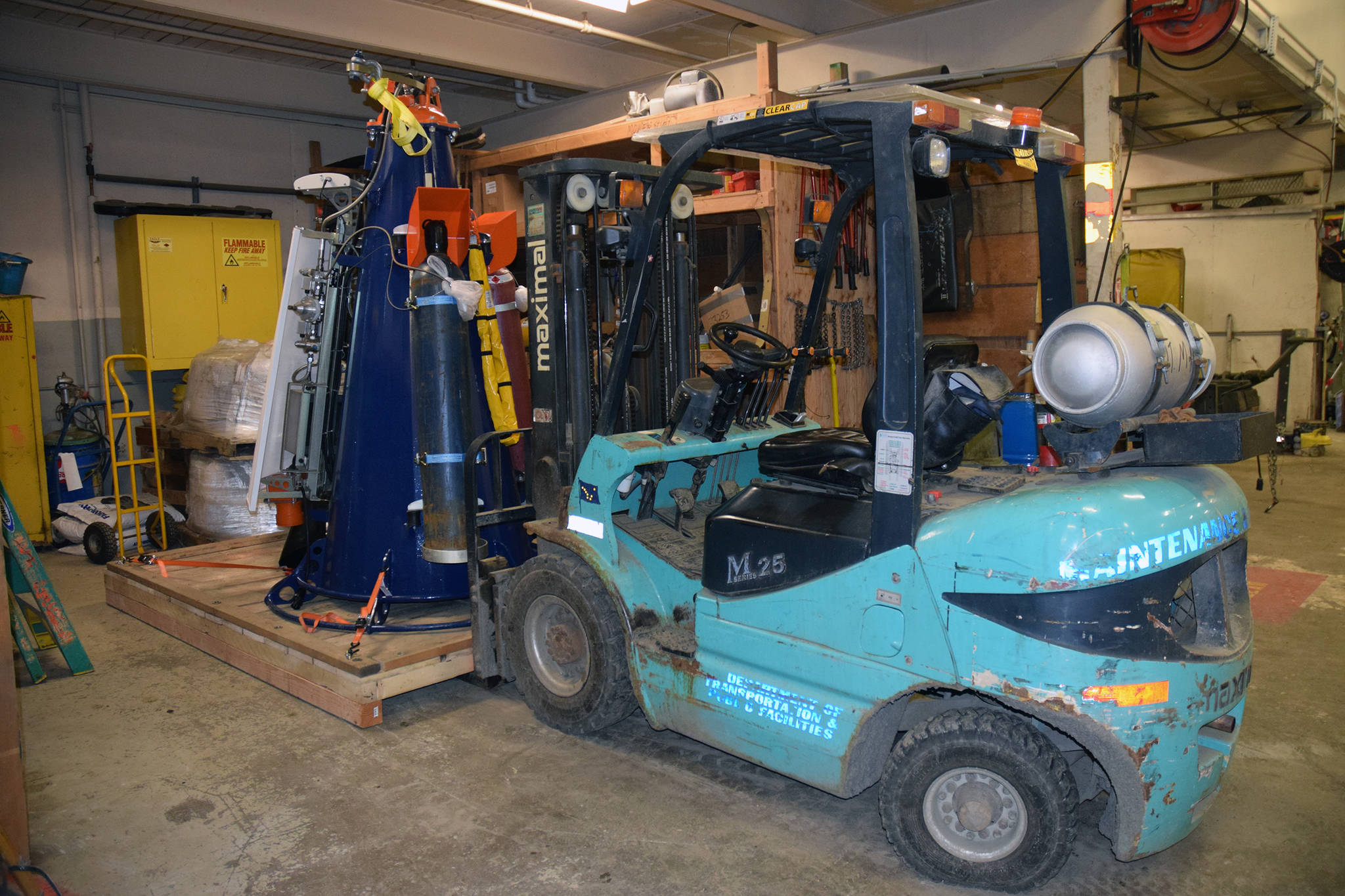
The dark blue, megaphone-shaped device is a DaisyBell. It will be used Thursday afternoon to clear snowpacks off of the slopes of Mount Roberts that could potentially prove hazardous to Thane Road. (Mollie Barnes | Juneau Empire)
