Correction: An earlier version of this article said that Gov. Bill Walker approved a climate action plan. It is more accurate to say he accepted, rather than approved, the plan as revisions will be ongoing. The article also mistakenly said the press conference took place at University of Alaska Southeast; it took place at University of Alaska Anchorage. The article has been updated to reflect these changes
Gov. Bill Walker on Wednesday accepted a wide-ranging list of recommendations to address climate change impacts in Alaska and announced a series of “early actions” the state could take.
The Alaska Climate Action Plan is the product of 10 months of work by a group of Alaskans representing the oil and gas industry, science, tribal entities, conservation and development, among others. After Walker signed an administrative order last year calling for the plan, the team of 21 Alaskans developed the 38-page document and a shorter list of Alaska Climate Policy Recommendations.
The plan is non-binding, meaning it doesn’t change Alaska statute. At a University of Alaska Anchorage press conference Wednesday morning, Walker described it as a “menu” from which the state could develop legislation and policy.
Lt. Gov. Byron Mallott said that adapting and mitigating global warming effects like permafrost melt, coastal erosion and threats to Alaska’s fisheries are state priorities.
“The work of the Climate Action Leadership Team team was premised on the need to take action that addresses these threats,” Mallott said.
On the plan’s menu is a smorgasbord of actions broken into six broad categories: communities and partnerships, human and ecosystem health, economic opportunity, clean energy, outreach and education, and investment.
It’s an ambitious plan that calls for studying the effects of climate change on an ecosystem level, and in the marine environment.
Implementing all or part of it may prove expensive, and the state will need a way to pay for it. The plan proposes that the state look into a carbon tax, a system that would disincentivize the use of carbon-based fuels (gas, diesel) by making them more expensive.
When media present asked about carbon taxes, Walker said that he wouldn’t pursue any ideas that could make energy more expensive for Alaskans, telling reporters that he favors incentives over punitory measures.
“[I’m] not interested in anything that increases the cost,” Walker said at the press hearing.
The plan
Two of the heavier lifts the plan calls for are to lessen Alaska’s reliance on fossil fuels for energy and transition away from its economic dependence on the oil and gas industry.
Alaska Climate Action Plan Recommendations by Kevin Gullufsen on Scribd
To accomplish the former, the plan calls for a reduction in Alaska’s greenhouse gas emissions from industry, electricity generation and heating.
Alaska has the fourth-highest per-capita greenhouse gas emissions, according to a Department of Environmental Conservation report updated in January, with about 57 percent of annual emissions coming from industry.
The plan recommends that oil, gas and mining industries reduce greenhouse gas emissions in Alaska by 30 percent (from 2005 levels) by 2030. The reductions are consistent with the United Nation’s Paris Agreement on climate change, which President Donald Trump rejected last year.
A slightly larger decrease is called for in electricity generation. The plan calls for the decrease in greenhouse gas emissions within electricity generation by 33 percent over 2010 levels by 2030.
Smaller reductions in greenhouse gas emissions are called for from building heating. The team recommends that a new statewide code be developed for residential building, and that the state should finance programs to support building retrofits. The plan calls for new public buildings by 2030 to be constructed using net-zero energy designs.
To mitigate the effects of warming ocean temperatures and acidification, the plan calls for the state to assess marine climates, something that’s largely done by university researchers and the National Oceanic and Atmospheric Administration.
Transitioning away from Alaska’s economic dependence on the oil and gas industry will mean incentivizing growth in other areas of the economy, the report says, while using natural gas as a bridge fuel.
Mariculture and so-called “blue jobs” in marine construction, tourism, recreation and energy should be encouraged, the plan states. Alaska should also promote value-added economic activity in the oil and gas industry by encouraging the in-state manufacturing of petroleum-dependent products. The team also recommended that priority be given to energy-efficient community development and that a micro loan program be established for businesses that focus on carbon-neutral products.
State agencies are also called on to add carbon sequestration as a option for the use of state lands.
Department of Environmental Conservation Commissioner Larry Hartig announced four “early actions” the state will take to address climate change. They include lowering state government’s energy costs and reducing carbon emissions; facilitating the state’s transition to a more energy-efficient and a less carbon-intensive economy; identifying and addressing long-term risks to coastal erosion, flooding and permafrost degradation; and identifying impacts to coastal fisheries and facilitating adaption and planning.
Alaska Climate Policy Recommendations by Kevin Gullufsen on Scribd
What the candidates think
The plan is Walker’s, and as such, it risks being ignored if the sitting governor loses the Nov. 6 general election. Walker said he was confident that his successor wouldn’t be able to ignore climate change issues in the state.
“We are at ground zero … You cannot step over this issue, it is right in front of us,” Walker said.
Democratic gubernatorial candidate Mark Begich said in an emailed statement to the Empire that while Walker’s climate plan is a result of a lot of hard work, Alaska has lacked climate change leadership under the Walker administration.
“A roadmap is only helpful if you know where you are going … Bottom line: we need more action and less studies and task forces,” Begich wrote. If elected, he said he would identify items to pursue in the plan, while supplementing them with new ideas like a faster decrease in greenhouse gas emissions.
Multiple email requests for comment sent to a representative for Republican candidate Mike Dunleavy weren’t returned.
The process
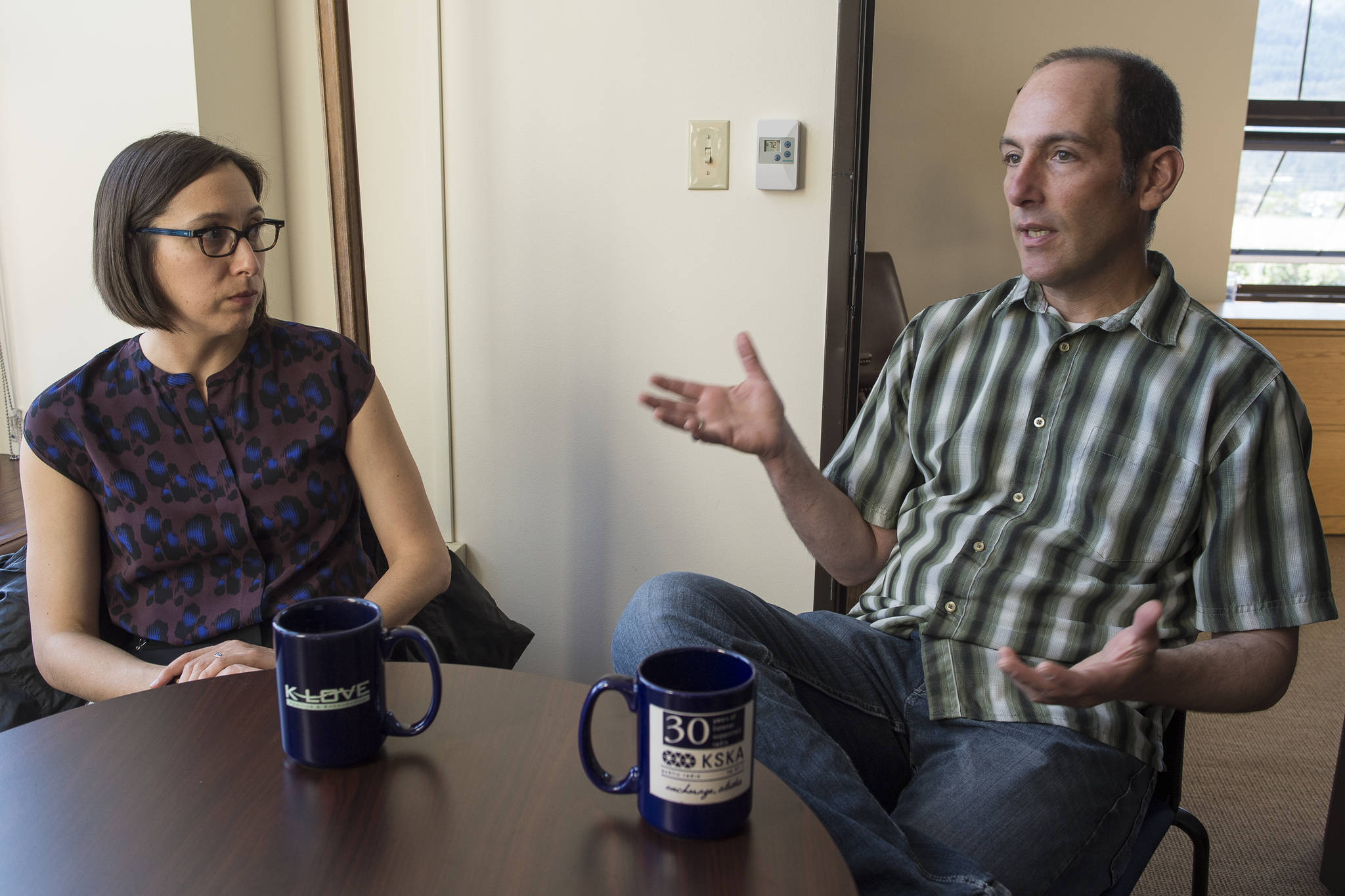
In early September, the Empire sat down with Walker senior advisor C. Nikoosh Carlo, PhD, and leadership team member Michael LeVine to talk about how Walker’s climate plan developed.
The plan is the result of more than 20 phone conferences and in-person meetings between leadership team members, Carlo explained. The team met with experts on carbon pricing and the impacts of climate change on infrastructure and considered 300 pages of public comment. They also depended on two technical advisory panels: one on oil and gas and one on climate science.
Levine, senior Arctic fellow with the Ocean Conservancy, said there was a wealth of expertise on the team. Though team members represented groups which sometimes don’t seem eye-to-eye on resource issues, the level of agreement was “remarkable” Levine said.
“My experience of the team was uniformly respectful, consensus-driven and very much focused on problem solving,” Levine said.
There was a back-and-forth on the strength of language to use in the plan, Levine said. “The concepts are largely intact,” from earlier versions of the plan, Levine said, and much of what he characterized as a small amount of internal discord in the group revolved around the plan’s language.
“There’s been a lot of conversation about how bold the language is that we feel comfortable using in these documents,” Levine said.
“How do we balance the political sensitivities on some people’s part with the activist tendencies on some people’s parts?”
• Contact reporter Kevin Gullufsen at 523-2228 and kgullufsen@juneauempire.com. Follow him on Twitter at @KevinGullufsen.