
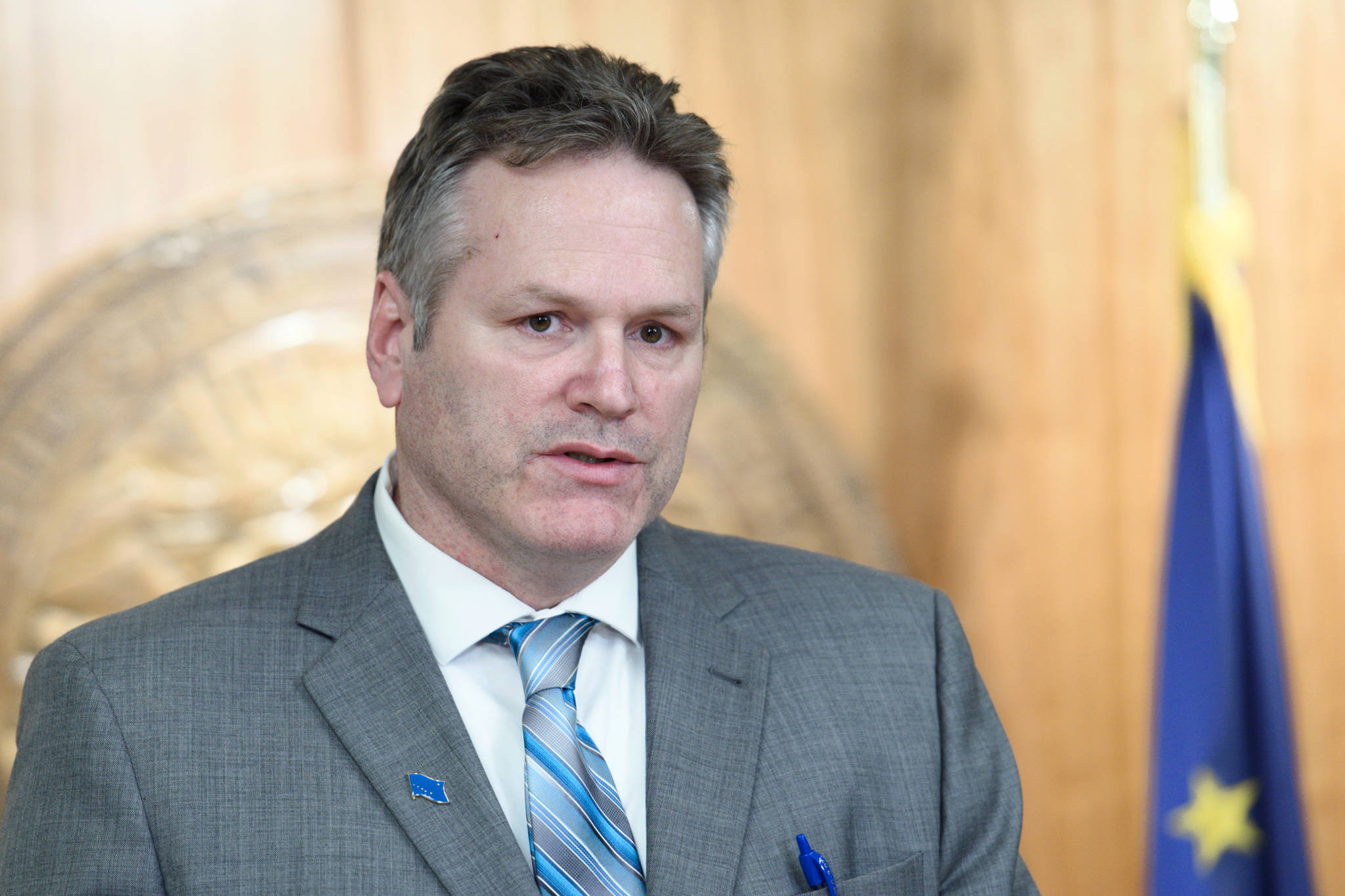
Gov. Mike Dunleavy’s plan for paying back recent years’ Permanent Fund Dividend will happen over a three-year span, according to legislation filed Wednesday. The legislation would also cement the PFD payments using the original formula through 2023.
Senate Bill 23, filed Wednesday, outlines Dunleavy’s plan to fulfill one of his key campaign promises — returning people the portions of their PFDs that were used to help balance the state’s budget under former Gov. Bill Walker.
According to the bill, Alaskans who were eligible for the PFD in 2016 would get an additional $1,061 in their 2019 PFD. Residents who were eligible for a PFD in 2017 would get $1,289 in 2020, and people who were eligible for a PFD in 2018 would get $1,328.
That money, according to the bill, would come from the earnings reserve account. Current data provided by Commissioner of Revenue Bruce Tangeman listed that amount today of that account as $16.6 billion. But, just two months ago it was $17 billion. The maximum back payments would total about $2.4 billion, but he said he thinks actual payout totals would be less as some people who were eligible in 2016, 2017 and 2018 have moved away and won’t be eligible the next three years.
“That’s the worst case scenario and the high end,” Tangeman said.
Senate President Cathy Giessel, R-Anchorage, referred the bill to the Senate Finance and Senate State Affairs committees during a brief Senate session Wednesday. The Senate Rules Committee filed the bill on Dunleavy’s behalf, along with its accompanying bill SB 24. SB 24 further defines an “eligible individual” as someone who received PFDs in 2016, 2017 and 2018.
“This is going to be a sticking point if we don’t move forward,” said Dunleavy. He said he thinks there are a number of legislators on both sides of the aisle that agree with this payout plan.
In 2016, Walker cut the amount of money available for PFDs to help fund state government in the midst of a budget crisis, and the Alaska Supreme Court upheld that decision. Lawmakers limited subsequent payments with legislation such as Senate Bill 26 in 2018, which approved using a portion of Permanent Fund money to help fund the state budget.
As for the regular PFD, Dunleavy has pledged to return to the original formula for calculating the dividend, which was used prior to Walker’s cuts in 2016. The state of Alaska was facing a $4 billion budget gap at the time. Dunleavy’s budget office said his current operating budget draft leaves a $1.6 billion deficit.
Dunleavy’s bills stand in contrast to two bills proposed by Sen. Bill Wielechowski, D-Anchorage. Wielechowski’s bills — SB 13 and SB 17 — aim to return people their full PFD all in one year. Wielechowski’s bills would also pay the lump sums ($3,740 each) out of the earnings reserve.
According to the text of SB 17, this would be a total of just shy of $2.4 billion from the earnings reserve. Wielechowski’s bills were also referred to the Senate State Affairs and Senate Finance committees.
Wielechowski also said he expected Dunleavy’s plan to also have the back payments go out this year instead of over the next three years.
“I was surprised,” Wielechowski said. “My understanding from his campaign was that he was going to pay it back from a lump sum.”
Tangeman said at a press conference Wednesday the main reason for spreading it out was to benefit Alaskans who have been here, and who plan to stay here.
In the eligibility requirements for the PFD one of the qualifications states residents must “have the intent to remain an Alaska resident indefinitely.”
“This is intended for Alaskans that were here and are still here and intend to remain here in the future,” Tangeman said. “Instead of giving people that did qualify that are now gone the full lump sum for all three years, we think this is a reasonable way to spread it out.”
Wielechowski said the main concern he and others have with Dunleavy’s plan is that future Legislatures “could simply ignore it,” and that it’s not binding beyond this year, as legislation cannot bind future sessions.
“Why should Alaskans have to wait three years to get their full payment? The money is in the earnings reserve,” Wielechowski said.
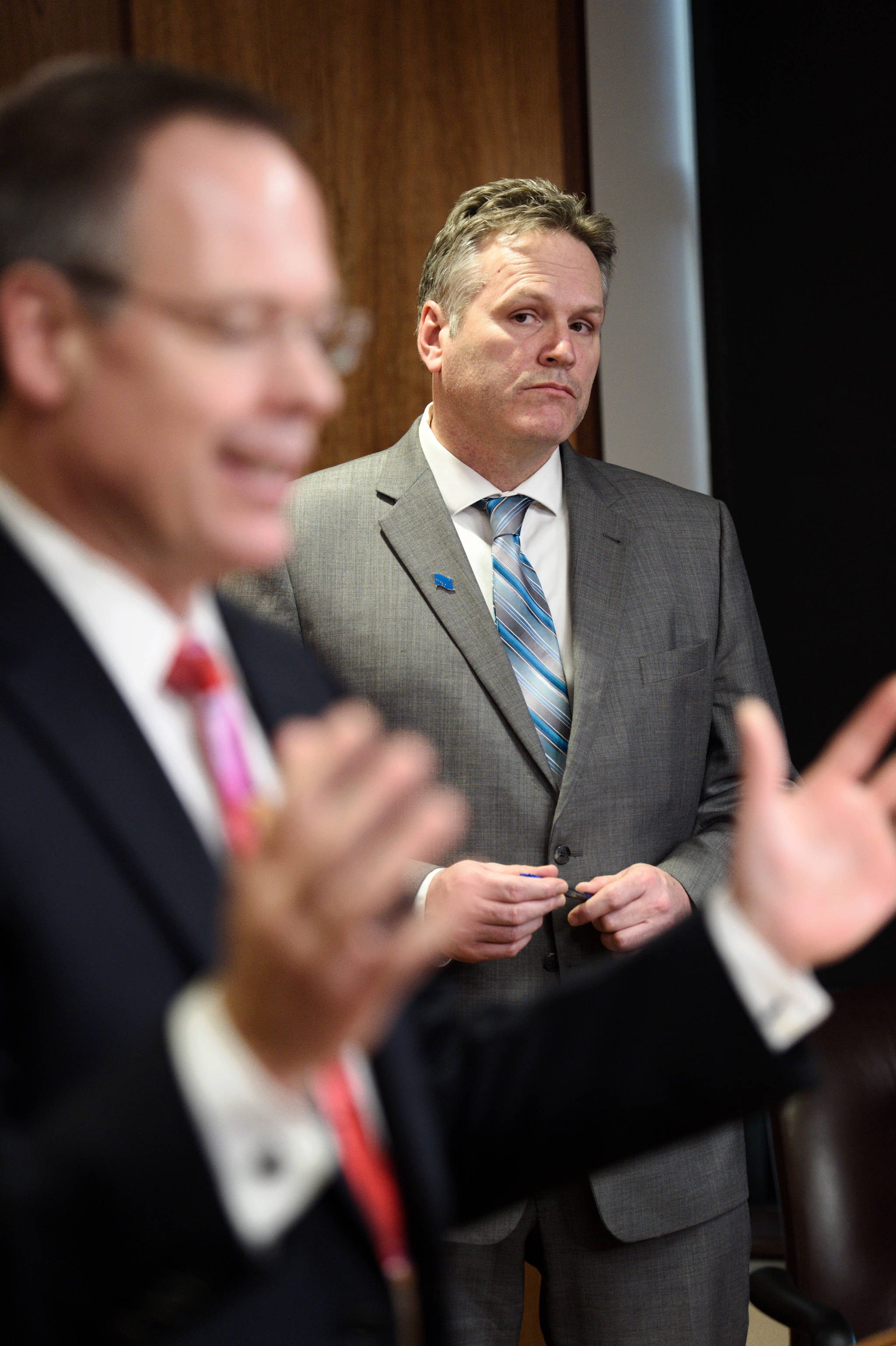
Commissioner Designee Bruce Tangeman presents bills to pay residents cut PFD funds as Gov. Mike Dunleavy watches during a press conference at the Capitol on Wednesday, Jan. 16, 2019. (Michael Penn | Juneau Empire)
