
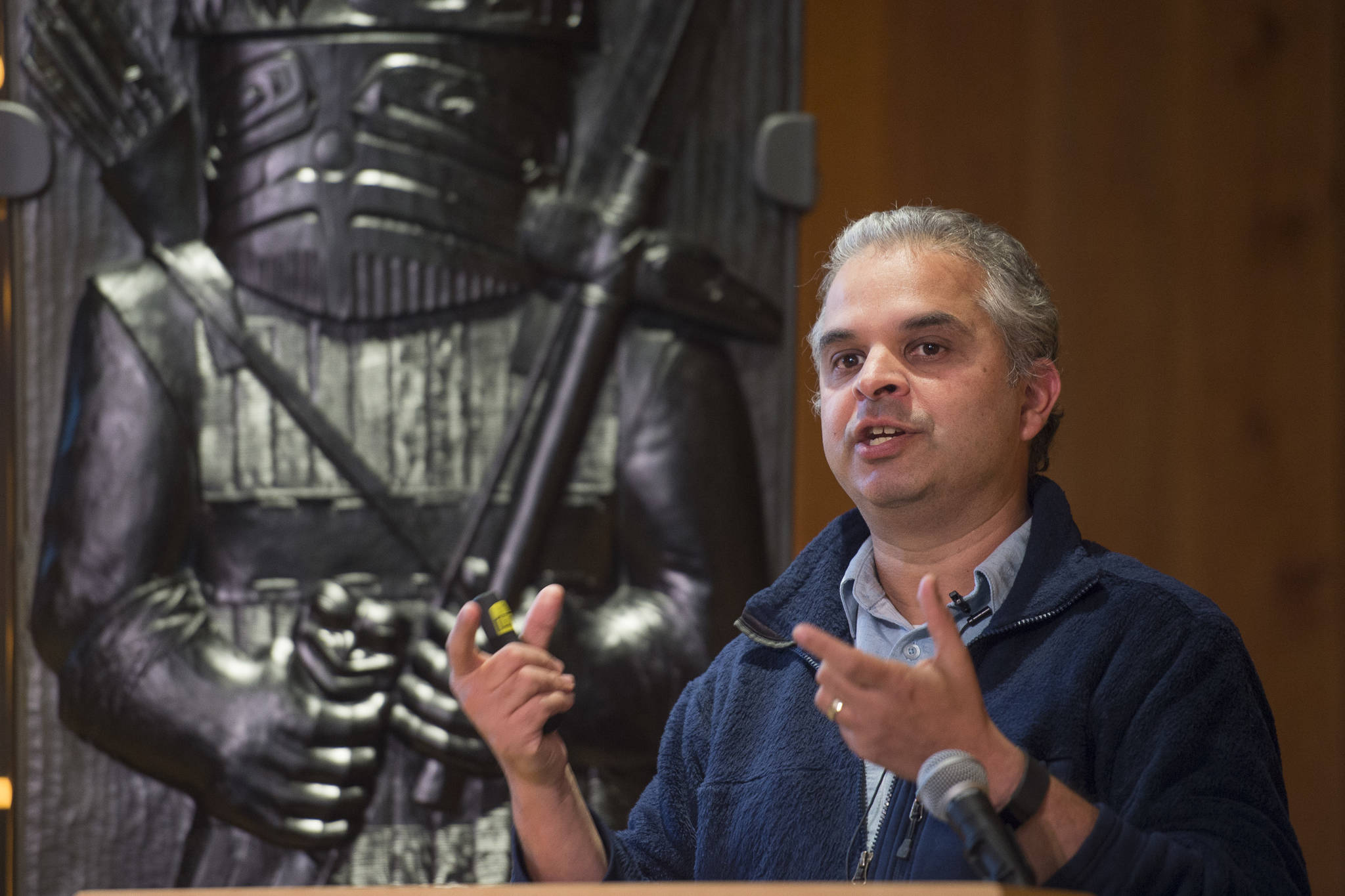
DNA science lent credence to thousands of years of Alaska Native oral history, and tradition allowed that to happen.
Ripan S. Malhi, a professor for the Department of Anthropology at University of Illinois, spoke about studying ancient DNA and what insights Shuká Káa, a Native man found in Southeast Alaska in the ’90s, offered about the regions’ Native population, during a lecture Thursday at the Walter Soboleff Building.
“Last year, we showed there’s genetic continuity from 10,000 years ago to today,” Malhi told the Capital City Weekly prior to his presentation. “Before paleogenomics, there was lots of talk about movements of people across different areas. It seems people mostly stayed in one geographic area, and trade was extensive.”
Malhi said it can be difficult to distinguish trade from travel, but through paleogenomics, the study of ancient DNA, a throughline was discovered that connected Shuká Káa’s DNA to a 6,000-year-old ancient Native, who in turn was able to be connected to modern-day Native people.
“We were able to show genetic continuity through today through three ancient individuals,” Malhi said.
This supports oral tradition, said Sealaska Heritage Institute President Rosita Worl.
“It validated belief in our oral traditions that we had lived in our homeland since time immemorial,” Worl said.
That validation came, in part, because Native people in Southeast Alaska were willing to allow testing.
Malhi said in the past, some DNA researchers have been less-than scrupulous in their studies, and had taken DNA samples from members of indigenous communities and never shared results, which can erode trust and lead to future unwillingness to participate in studies.
During his lecture, Malhi detailed the ways in which he and colleagues formulated research ethics that place an emphasis on working closely with indigenous communities.
“Ancestral remains should be treated as human relatives who deserve respect,” Malhi said.
Another reason some communities may not participate in a study: Native beliefs may also discourage disrupting an ancient body.
However, Worl said core cultural values, Haa Latseen and Haa Shuká — strength of body, mind and spirit, and valuing ties to ancestors — led Southeast Native peoples toward participating in such studies.
“Southeast Natives really believe in education and science,” Worl said. “I would say, Southeast Natives were among the first to do DNA studies. That was a cultural value in action and adopted to a new study.”
Other findings
Malhi also presented results from studies involving ancient Natives on Prince Rupert island and current British Columbian Tsimshians.
They also supported genetic continuity from thousands of years in the past to the present day and showed the impact of colonization.
For example, the DNA showed an over 50 percent reduction in effective population that coincided with a smallpox epidemic. There was also a shift in present day Native people sampled toward a genetic profile closer to that of Europeans.
A young science
Malhi’s lecture, which is part of a series of November talks sponsored by SHI for Alaska Native and Native American Heritage Month, also detailed some of the history of paleogenomics.
The field started in the ’80s, and studies were often undermined by contamination or other errors.
“DNA in the early history of this field had a very rocky start,” Malhi said.
Now, Malhi said there are facilities such as the lab in which he works in Illinois that employ rigorous safeguards to prevent contamination and ensure reliable results.
Additionally, Malhi said researchers have endeavored to improve industry ethics, and there is a push to get indigenous people involved in paleogenomics, and there is an ongoing internship oppotunity for interested community college, undergraduate and graduate students.
The Summer internship for INdigenous peoples in Genomics (SING) Workshop is currently accepting applications online at sing.igb.illinois.edu.
“We would love to see people from this community apply,” Malhi said.
• Contact arts and culture reporter Ben Hohenstatt at (907)523-2243 or bhohenstatt@juneauempire.com.
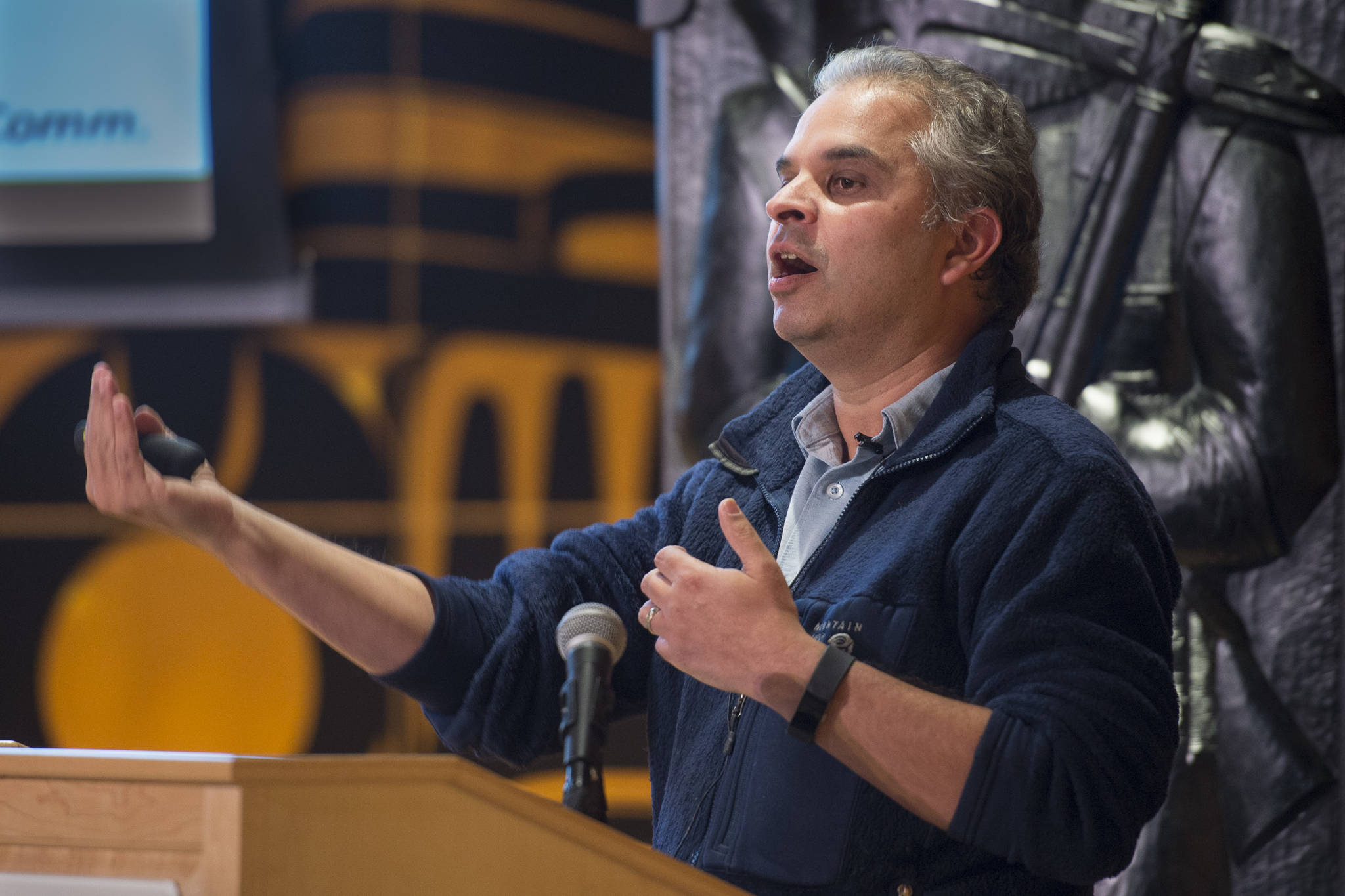
Ripan S. Malhi, Ph.D., speaks at the Walter Soboleff Center on Thursday, Nov. 8, 2018. Malhi is a Richard and Margaret Romano Professor at the University of Illinois at Urbana-Champaign with affiliations in anthropology, the School of Integrative Biology, and the Carl R. Woese Institute for Genomic Biology. The lecture is part of Sealaska Heritage Institute’s events in recognition of Native American Heritage Month. (Michael Penn | Juneau Empire)
