
Correction: The previous version of this article included a reference to Kathryn Dodge when it should have referred to Bart LeBon in possible electoral outcomes. That error has been corrected.
Democratic candidates lead two Fairbanks elections considered key for control of the Alaska House and Senate after additional ballots were counted Tuesday.
Figures released by the Alaska Division of Elections show Kathryn Dodge, the Democratic candidate for House District 1, leading Republican Bart LeBon by 10 votes after remaining early and question ballots were counted. Scott Kawasaki, the Democratic candidate for Senate District A, leads Republican Senate President Pete Kelly by 152 votes.
Entering Tuesday, LeBon led Dodge by 67 votes and Kelly led Kawasaki by 11 votes.
“I guess I lost my lead,” LeBon said by phone Tuesday evening. “At this point, not much would surprise me, given that the initial vote.”
On the opposite side of the election, Dodge wrote by text message that she is “relieved to be in the lead” but is “back on pins and needles as we move on to count absentee ballots Friday.”
According to figures from the Alaska Division of Elections, 241 fully accepted absentee ballots remain to be counted in House District 1 as of the end of the day Tuesday. In House District 2 (both House districts make up the Senate district) 158 fully accepted absentee ballots remain to be counted. Some absentee ballots were not completely accepted by the division, but it is not clear what their impact on the races will be.
Those votes and any additional absentee ballots will be counted Friday, with the final tally scheduled for next Wednesday. Absentee ballots counted thus far have favored the Republicans.
That might be the case, Kawasaki said, but “the numbers that we have won by so far, I think the senator (Pete Kelly) would have to get an alarmingly large percentage that he didn’t receive yet.”
Absentee ballots mailed internationally (such as those from soldiers and students overseas) can arrive up to 15 days after the election, as long as they are postmarked by Election Day. Barring a significant change, one or both races will be within the margin for a state-paid recount (20 votes or 0.5 percent). If a candidate still contests the result of the election, he or she could file a legal challenge.
“This is too close to call no matter what people say, but we’re pretty optimistic where we’re at today,” Kawasaki said.
Additional votes across the state were also tallied Tuesday, but attention focused on Fairbanks because of the implications for control of the state legislature.
After Election Day, control of the Alaska House appeared to rest with a 21-member Republican majority that included LeBon. That was a significant shift: During the 2017-2018 legislative session, the House was controlled by a 22-member, predominantly Democratic coalition.
Rep. Paul Seaton, R-Homer and one of three Republicans in that coalition lost his race for re-election, as did Rep. Jason Grenn, I-Anchorage, one of two independents. That would have left the coalition with supporters in control of 20 seats, but that included Dodge’s seat.
If Dodge wins, the House is tied 20-20, pending any movement across the aisle between the coalition and the Republican bloc. If LeBon wins, the Republican bloc has a bare-minimum majority.
In the Senate, Republican control is firmer. Entering Election Day, the majority caucus consisted of 12 Republicans and one Democrat, Sen. Lyman Hoffman, D-Bethel. There were two independent Republicans and five minority Democrats.
If Kawasaki defeats Kelly, the majority caucus becomes thinner and Democrats could have enough support — with moderate Republicans — to form a coalition majority.
Having a majority in either the House or the Senate is important because the group that holds the majority will appoint committee chairmen and the leaders of the chamber, allowing them to set the agenda for the session.
The election of Mike Dunleavy as governor makes that control particularly important: For the first time in four years, Alaska has a chief executive who is a member of one of the state’s two major political parties. Control of the House and Senate would allow a party to support or work against policies proposed by the new governor.
• Contact reporter James Brooks at jbrooks@juneauempire.com or 523-2258.

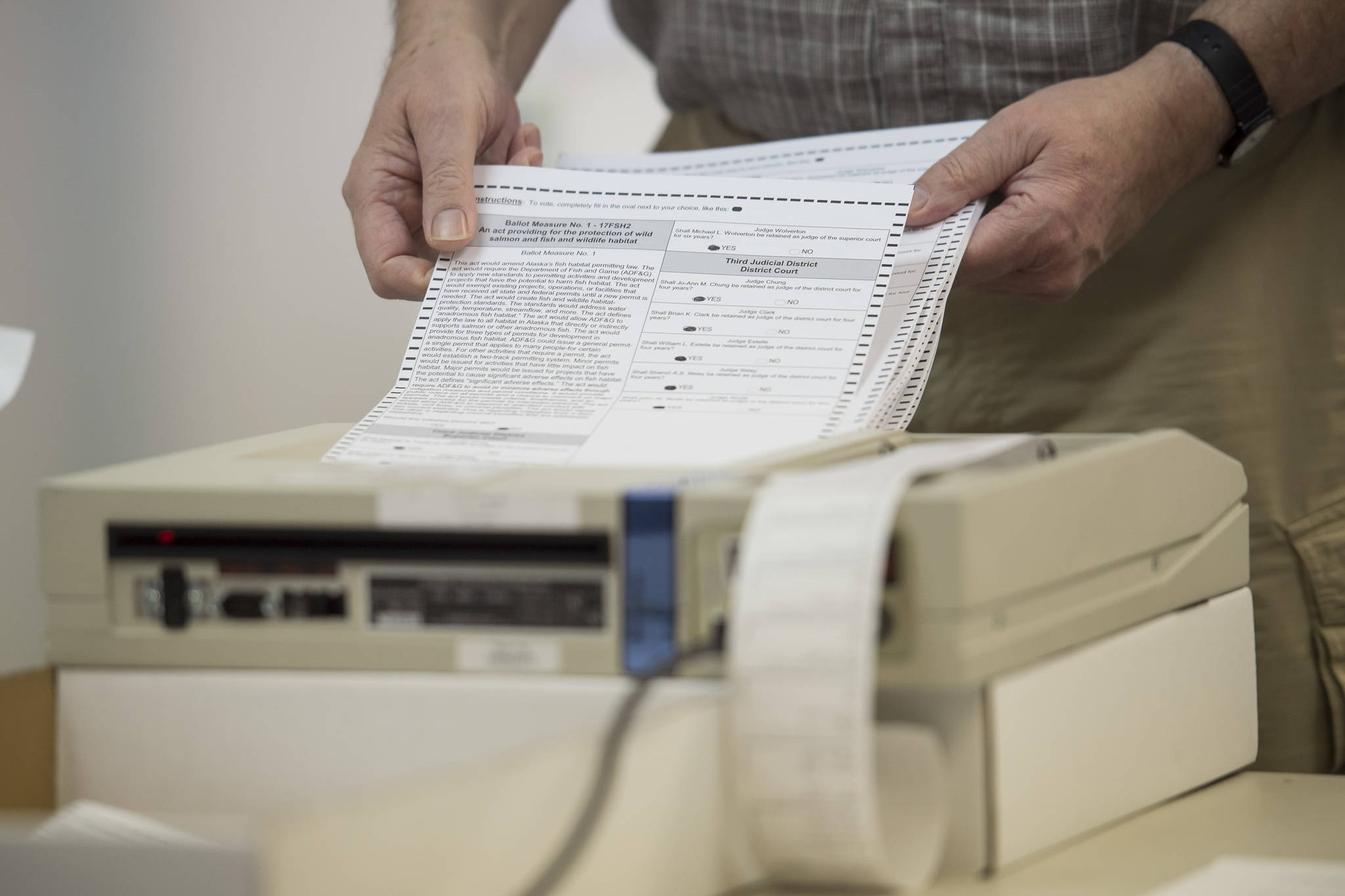
Regional Accu-Vote board member Mel Personett looks at a tally of questioned ballots from a Southeast district at the State of Alaska Election Office in the Mendenhall Mall Annex on Tuesday, Nov. 13, 2018. (Michael Penn | Juneau Empire)

Lauri Wilson, Region 1 Election Supervisor, and Regional Accu-Vote board member David Clover look over a questioned ballot from a Southeast district that failed to run through an Accu-Vote machine at the State of Alaska Election Office in the Mendenhall Mall Annex on Tuesday, Nov. 13, 2018. (Michael Penn | Juneau Empire)
