
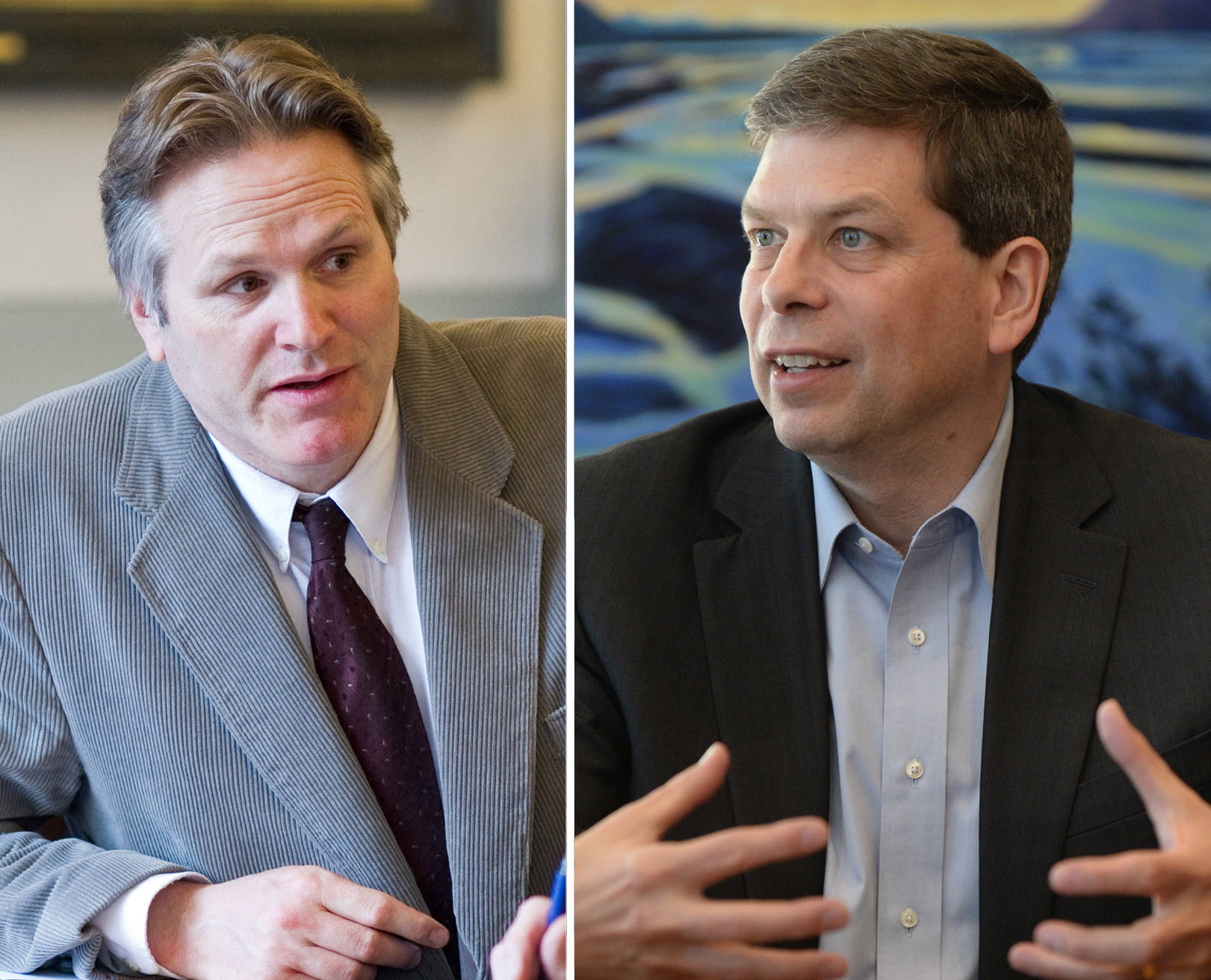
The Alaska Permanent Fund wasn’t physically present, but it shared the stage with Alaska’s two leading candidates for governor in their final debate for the general election.
Mark Begich and Mike Dunleavy used the hourlong event hosted by KTVA-TV to share their opinions on crime and on the fund. The candidates’ plans for the fund differ sharply and are some of the biggest differences between the two.
“Alaska is at a turning point, a crossroads,” Dunleavy said.
In the debate, he said he would seek to restore the traditional formula for distributing the Permanent Fund Dividend and would retroactively compensate Alaskans for prior cuts. Incumbent Gov. Bill Walker vetoed half the 2016 Permanent Fund Dividend, and the Alaska Legislature cut it in 2017 and 2018.
Dunleavy said Thursday night that he will pay Alaskans that money using approximately $6 billion from the Permanent Fund’s earnings reserve. While most of the $64 billion fund is constitutionally protected and cannot be spent without a vote of the people, $17 billion of its total is in the earnings reserve account, an unprotected portion that can be spent with a majority vote in the Legislature.
Dunleavy proposes taking $6 billion from that unprotected earnings reserve and giving it to Alaskans.
“I believe with $19 billion in the earnings reserve, we can pay out a full dividend,” Dunleavy said, slightly misstating the amount of the earnings reserve.
“What I hear here is a gimmick and a slogan,” Begich said.
“It’s not a gimmick,” Dunleavy responded.
The Dunleavy approach to the dividend has some side effects, Begich said.
“Under Mike’s plan, he has no inflation proofing which means long-term problems for the sustainability of the plan,” the Democratic candidate said.
The Permanent Fund’s board of trustees members have repeatedly emphasized the need for stability and a “rules-based approach” when it comes to spending from the Permanent Fund. The Alaska Legislature approved such an approach earlier this year, after Dunleavy’s resignation from the Alaska Senate.
Begich has emphasized his support for a constitutional amendment that would require the state to pay a dividend, but at a lower amount than proposed by Dunleavy. Begich’s plan envisions splitting the Permanent Fund’s investment earnings, with a portion going to dividends, a portion going to education spending, and a portion proofing the fund against inflation.
The plans of both men would require the support of the Alaska Legislature. Begich’s proposal would require voter approval as well, because any constitutional amendment must be approved by voters before becoming effective.
Dunleavy has said he supports a voter referendum on the use of the Permanent Fund for anything other than the dividend.
Crime discussion
The first third of the debate focused on what each candidate will do to arrest Alaska’s ongoing crime wave.
Dunleavy said he intends “to budget specifically for public safety,” by keeping courthouses open all day on Fridays (they currently close at noon to save money), fill vacant positions in the Alaska State Troopers and among prosecutors, and have “the right number” of correctional officers.
Begich offered a similar approach, then poked at Dunleavy, saying the former state senator voted in favor of cuts to public safety positions that he now proposes to reverse.
Dunleavy responded that he offered an amendment to shift $50 million from the trans-Alaska natural gas pipeline project to pay for public safety positions and education, but the idea was rejected by the House of Representatives.
Fisheries and Ballot Measure 1
Toward the end of the debate, Begich used an opportunity to question Dunleavy about his lack of support for Ballot Measure 1. If the Republican doesn’t support that measure to bolster Alaska’s fisheries, what does he intend to do to combat fisheries declining because of warming, acidifying ocean waters?
There’s little the state can do on its own, Dunleavy said.
“Alaska is not a smokestack industry state. We contribute very little to the pollution that some attribute to global warming,” he said.
He added that he would have the state work with the federal government and National Oceanic and Atmospheric Administration to investigate what can be done in the high seas, particularly with regard to stopping the interception of Alaska fish by foreign vessels.
Dunleavy asked Begich why he supports Ballot Measure 1, given that it likely will have some impacts on the ability of Alaska’s mining, drilling, logging and construction industries to do their work.
“The last thing we need is more regulations that’s going to kill jobs and investment,” Dunleavy said.
“I’m as pro-development as possible,” Begich said, adding that he supports the measure because it gives communities the ability to comment on projects that affect waters near them.
“This should have been dealt with in the Legislature. It wasn’t,” Begich said.
He said he also believes that if the measure passes, he is the best person to write the regulations to enforce it in a way that balances the requests of supporters and the needs of industry.
Upcoming events
Libertarian candidate Billy Toien did not participate in the debate.
Begich is scheduled to appear in Juneau on Friday, with a meet-and-greet appearance expected at the Sacred Grounds Café at noon. Dunleavy is scheduled to appear at a rally in Wasilla on Friday, followed by an event in Fairbanks on Saturday and another rally in Anchorage on Sunday.
• Contact reporter James Brooks at jbrooks@juneauempire.com or 523-2258.
