
Past an intensive construction zone, where the Chilkat River had begun to threaten the highway, up over the Three Guardsmen pass, there it begins — those splendid, wide, sweeping vistas of broad valleys, flanked by sharp-peaked mountains to the west. Trumpeter swans raise their cygnets in the ponds and marshes alongside the road. Long stretches of the highway are lined with bright purple flowers; without a specimen in my hand now, I cannot say which of two species it might be. (Confusingly, both are sometimes called sweet-vetch, but only the one that is also called bear root or Indian potato is nonpoisonous and edible).
It was late June, with a few friends, and I was bound for a few days of exploring some of the trails in the southern part of Kluane Park.
As we came down the north side of the pass, we saw a number of Arctic ground squirrels beside the road. They are familiarly — but inaccurately — often called “gophers,” but they are quite different from true gophers. Arctic ground squirrels here are near the southernmost part of their broad geographic range (all across Canada and eastern Siberia). They have a very long hibernation period, going to bed in late summer and early fall, not coming out again until spring. Females survive this time on stored body fat, but males make a cache of seeds in their winter burrows. They feed on this cache for a couple of weeks before they emerge in the spring, regaining the weight lost during the long winter fast. The food stash allows them to be ready and waiting for the females, which emerge from their winter burrows somewhat later than the males. Each male has a territory, defended vigorously against other males; a territory encompasses the burrows of several females, but a female is only receptive to mating for about four hours, so the males have to be ready. A territorial male usually sires about 90 percent of the ensuing pups born to the females on his territory, but a few are sired by extracurricular activity.
Descending farther, we entered the forested zone, where some of the conifer stands show signs of the spruce bark beetle infestation that has been in the news. Huge areas are covered with quaking aspen trees, famed (and named) for their trembling leaves that catch the sunlight. (Unlike the leaves of most trees, these have flat, not round, petioles, which let them flutter more). Many of these aspen stands had an understory of blue lupines and bluebells that contrasted beautifully with the pale tree trunks, emphasized by the sunlight that filtered through the canopy of dancing leaves.
As we walked through some of these aspen stands, we noted that some of the leaves looked, not green, but silvery. Looking more closely, we saw that leaf miners had been at work, leaving closely packed, sinuous trails where the tiny larval insect had eaten away the epidermis, leaving a swath of white on either side of its path and a black line of frass (excrement) down the middle. The aspen leaf miner is a moth; an adult female lays an egg in a rolled-up leaf edge and the larva chews its way around the surface of the leaf before pupating in its mine. An emerging adult moth overwinters under bark and other such crevices.
Sometimes huge populations of this leaf miner build up, turning whole aspen stands to silver. The middle layers of leaf cells, where photosynthesis (forming carbohydrates from carbon dioxide and water) takes place, is undisturbed, because the moth larvae eat only the epidermis of the leaves. A study in Alaska found that mines on the upper surface of the leaf do not greatly interfere with photosynthesis and so do little harm to the tree, but mines on the undersurface prevent the stomates (small openings) from regulating the passage of water vapor, and that in turn interferes with photosynthesis and so can affect the health of the tree. Trees with lots of mines, especially on the leaf undersurfaces, do not grow as well as others.
A little plant often known as bastard toadflax was extremely common in the forest understory. This is a hemiparasite: it has green leaves and can photosynthesize carbohydrates but it also gets some of its nutrition from other plants of many species, including spruce, aspen, rose, aster and so on. It occurs in Juneau too, but here it is far less common. I wonder why.
In the sandy soils along several trails, we saw a number of fairly large ant hills, two or three feet across, with several entrances — something we don’t see in Juneau. In some other North American forests, certain ants are important seed dispersers for particular species; these seeds typically have attractive attachments that draw in the ants, which collect the seeds and eat the attractive bit, dropping the seed somewhere away from the seed’s parent. Seeing those anthills made me wonder if this ecological interaction might occur here too.
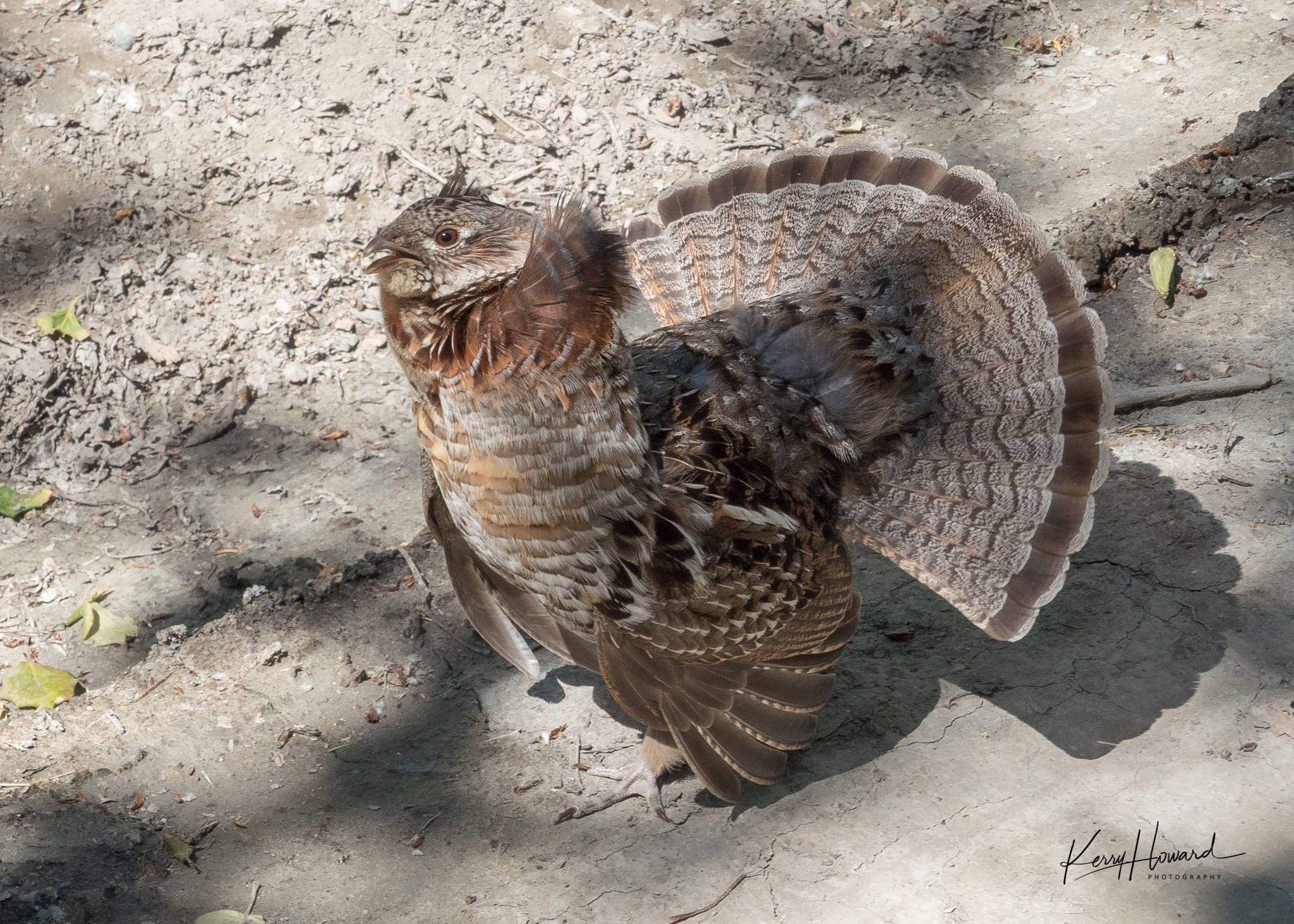
We came upon a ruffed grouse on the trail in one of the aspen stands. She had a brood of chicks in the nearby shrubbery, and I suspect she was thinking about crossing the trail with her family. However, our coming disturbed her and she put on a wonderful display of ruffled ruff and fanned tail feathers, accompanied by annoyed clucking. The chicks scuttled farther back into the brush, and she settled down after we slunk past.
This being June, we saw a riot of flowers almost everywhere we went: pink flowers of prickly rose and twinflower, bright yellows of stonecrop and buttercups, pale yellow of oxytropes, white of mountain avens, dwarf dogwood, and Labrador tea, purples and blues of louseworts, wild flax, columbines and penstemon (aka beardtongue) — a visual treat on every side. We found a showy sparrows-egg orchid and a yellow, parasitic orchid; something new for us was the white-flowered death camas (deadly poison, so it must be distinguished from the edible species of camas!).
This being June in the Interior, it was also mosquito season. On most of the trails, a cool breeze cut down their depredations, but in our cabin it was another story. We called our temporary home “Mosquito Ranch” for the number of mozzies that gathered there (no blame to the very genial owners of the place!). We made a game of demolishing them and slept under mosquito nets. And I bet that the barn swallows were very happy indeed.
• Mary F. Willson is a retired professor of ecology. “On The Trails” is a weekly column and appears every Friday. Her essays can be found online at www.onthetrailsjuneau.wordpress.com
