Sullivan discusses federal advocacy, legislation during Soldotna visit
Published 9:30 pm Monday, September 1, 2025
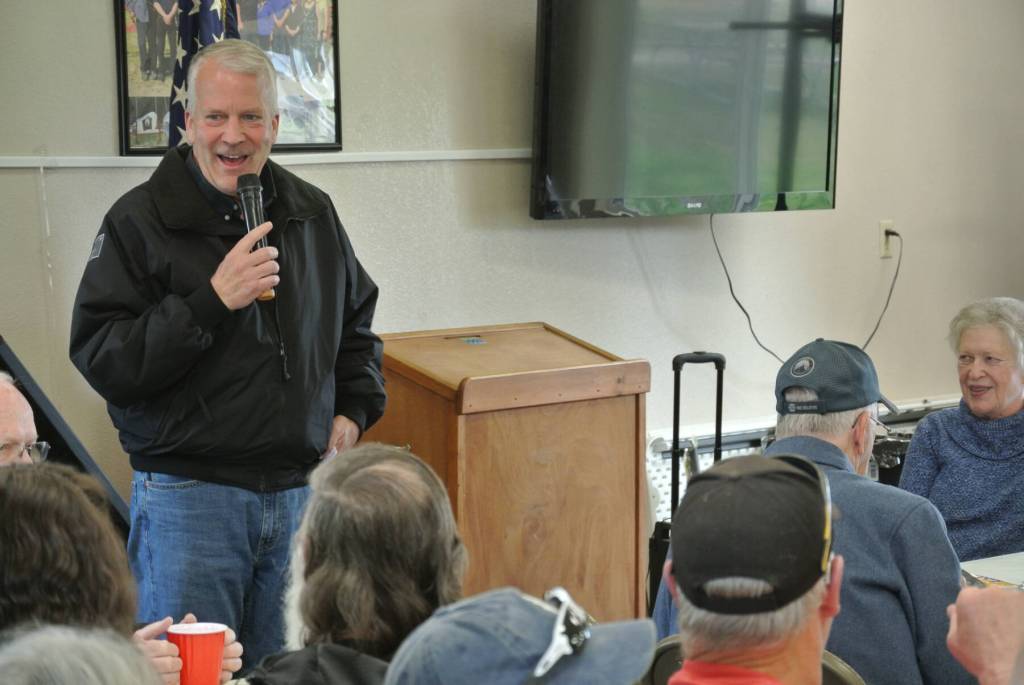


SOLDOTNA — During a visit to Soldotna last month, U.S. Sen. Dan Sullivan in a brief interview with the Clarion spotlighted visits to Alaska by cabinet officials, advocacy for increased military investment in the state and fisheries legislation.
Since June, Sullivan said, the secretaries of the interior, energy, homeland security, health and human services, housing and urban development, and transportation have all visited Alaska. Also visiting the state this summer have been “many generals and admirals” and the administrator of the U.S. Environmental Protection Agency.
Several of those officials had visited the Kenai Peninsula, Sullivan said, though Secretary Robert F. Kennedy Jr. of the Department of Health and Human Services was the only official who held a media availability.
It’s important, Sullivan said, for federal officials to travel to Alaska because it’s difficult to understand Alaska without seeing it.
“A huge part of the summer, for me, is bringing up people in the federal government who have power and influence and resources, and getting them to see our great state — meeting with Alaskans.”
The result is “a huge impact” on advocating for the state, Sullivan said. He pointed to a concerted effort to bring “key players of the Trump administration” to learn about the Alaska LNG Project. In a recent meeting with Dale Marks, assistant secretary of defense for energy, installations, and environment, Sullivan said he was working to convince the Pentagon to complete purchase agreements for the pipeline that would help lower potential development costs.
Having people visit Alaska “helps us,” Sullivan said.
Sullivan also focused on the federal budget reconciliation bill passed by Congress and signed into law in July. The bill contains hundreds of provisions that, among many other things, extend a 2017 set of tax cuts supported by U.S. President Donald Trump that target corporations and the most affluent Americans; direct $150 billion for defense spending, $150 billion for border enforcement and $10 billion for the U.S. Immigration and Customs Enforcement; increase a child tax credit, and create tax deductions for tips and overtime pay. The bill also eliminates some clean energy tax credits.
Sullivan provided to the Clarion promotional material on the bill, as well as a 25-page letter written by himself and his office about the bill. He said that he was traveling the state “walking people through the bill.” A couple of hours after meeting with the Clarion, Sullivan spoke on the bill at the Soldotna Public Library, to a collection of dignitaries from the Kenai Peninsula Borough, Kenai, Soldotna, Seward and Whittier, as well as the Kenai Peninsula Economic Development District.
“I’ve said if this bill were 10 different bills, each of these provisions … would in and of itself be ‘wow, that’s a pretty important bill for Alaska,’” Sullivan said. “When you combine all 10, it’s like ‘damn.’”
Sullivan said the bill will require lease sales for oil and gas development in the Arctic National Wildlife Refuge, the National Petroleum Reserve in Alaska, and in Cook Inlet. The bill also calls for increasing the state’s share of revenues to 70%, up from 27% in Cook Inlet. He pointed to reductions on regulations for resource extraction, increases in timber harvesting and mining and an “Energy Dominance Financing Program” that he said will help move the Alaska LNG Project forward.
Sullivan pointed to various tax changes, credits and deductions. He cited a “gigantic” investment in the U.S. Coast Guard, “a lot of this will be coming our way.” He said increases in spending for border enforcement help Alaska because they combat fentanyl, and that other military spending in the bill will be invested in bases in Anchorage, Fairbanks and Adak.
A focus, Sullivan said, in advocating for military spending, is increasing investment in the northern Pacific Ocean. He shared data indicating that much funding is either already spent or earmarked for the central “avenue of approach” from California across the ocean past Hawaii and to the Philippines. Far less, by comparison, is set for the northern avenue, from Washington up to Alaska and then on to Japan and South Korea.
“The northern route is where all the action is,” Sullivan said. “We need more.”
The bill also calls for investing in aviation safety, significant to Alaska, Sullivan said.
“Finally,” Sullivan said, Alaska is shielded from reforms to Medicaid that are expected to cut federal spending on health care and the bill includes an increase in spending on development of rural health care.
Sullivan said that accusations by Senate Democrats that the bill includes carve outs for Alaska, a “polar payoff,” is a compliment.
“We’re trying hard to help our constituents,” he said. “This is a really strong bill for our state.”
Fish are also a topic that Sullivan says he remains focused on. He said he’s working on legislation to approach the topic of bycatch of Alaska salmon by trawlers in federal waters and also to fund research about salmon in the oceans. That’s a “research gap,” he said, because state managers don’t have jurisdiction and federal managers don’t research salmon because they don’t manage them.
Reach reporter Jake Dye at jacob.dye@peninsulaclarion.com.