Silent in life, Tlingit code talkers finally getting recognition
Published 4:30 pm Monday, March 18, 2019


Harold Jacobs hardly ever heard his father talk about the war.
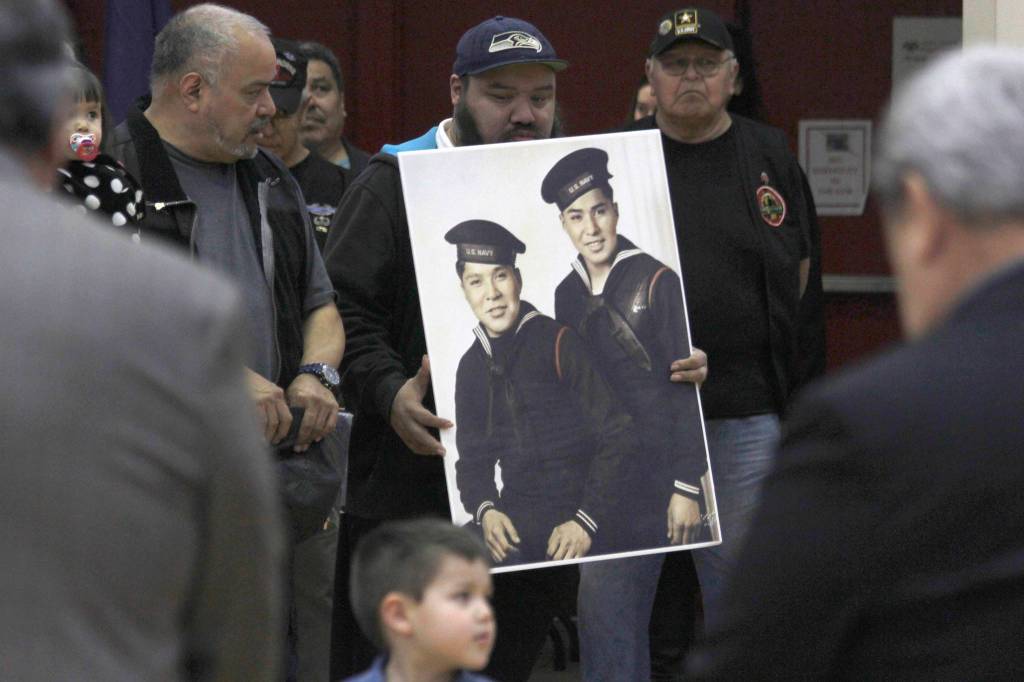
His father, Mark, and Mark’s brother Harvey had enlisted in the military on Dec. 9, 1941 — two days after the Japanese bombed Pearl Harbor. They were shipped out without even going to basic training.
All their family knew at the time was that the brothers were in the U.S. Navy. What they were really doing was much more secretive — the two were code talkers, developing ways for American soldiers to communicate clandestinely.
“The only thing I remember that he told me was he and his brother referred to radar as ‘eyes in the dark.’ That’s the only thing I remember him telling me,” Harold recalled.
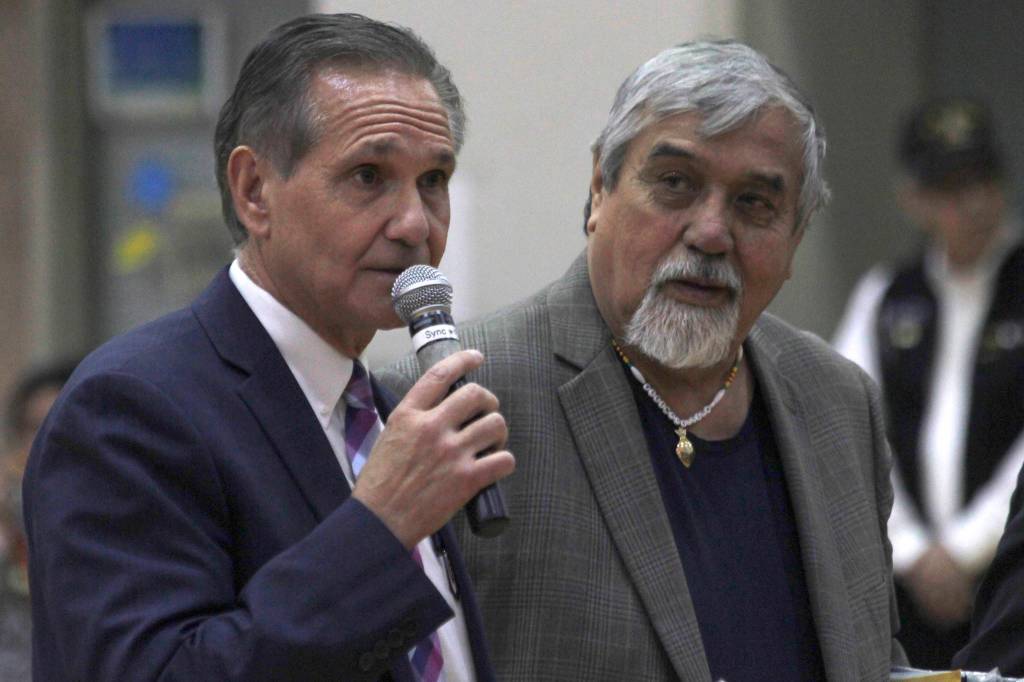
Mark and Harvey were two of five Tlingit code talkers who have been honored by the State of Alaska this month. They were honored by a citation March 6 and by speeches on the floors of the House and Senate. Then, prior to a game at the Gold Medal Basketball Tournament on Monday night, Lt. Gov. Kevin Meyer honored the five men and personally thanked family members of the quintet of code talkers.
Along with the Jacobs brothers, the state recognized Richard Bean Sr., Robert “Jeff” David Sr. and George Lewis Jr. Alongside Meyer were former legislators Bill Thomas and Albert Kookesh, both Tlingit.
[Talking in code: How the Tlingit, Navajo tribes helped end WWII]
Thomas was key in advocating for the state to recognize the Tlingit code talkers, as was Sealaska Heritage Institute (SHI), according to a release from SHI. Last week, Gov. Mike Dunleavy asked that all flags be lowered to half-mast each day of the week for each of the five code talkers.
All five code talkers are deceased, but a couple dozen family members were present Monday to receive folded American flags in honor of each code talker. Verna Adams, Lewis’ daughter, said it was a thrilling moment to be out on the court getting a flag in her father’s honor.
“I was shaking, I was excited, I was nervous,” Adams said. “But it’s huge. This was huge. I’m very proud of my father.”
While Navajo code talkers have long been recognized for their work in the war, the Tlingit code talkers remained silent. Bean’s granddaughter Krissy Bean said Bean’s wife went to her grave without ever knowing what her husband had done in the war.
Some of the family members said they found out in 2013, when Congress awarded posthumous silver medals to the Tlingit code talkers. Others said they found out even more recently than that. For Josh Jackson, grandson of Harvey Jacobs, finding out about Harvey’s accomplishments was quite the shock.
“Your mind’s kind of blown about it,” Jackson said. “You grow up knowing that he served but not knowing he was such a pivotal piece to something like that.”
During that 2013 ceremony, former House Speaker John Boehner reported at the ceremony that “during 48 hours on Iwo Jima, they say 800 Native language battle communications were received and translated. It took seconds, at a time when decoding by machines could take half an hour. The men undoubtedly saved lives.”
[Summit gathers many of the world’s fluent Alaska Native language speakers]
The irony of the use of the Tlingit language in such a vital time is not lost on the men’s descendents. When the code talkers were growing up, Alaska Native languages were being destroyed. In boarding schools around the territory, students were disciplined harshly if they were caught speaking their native language. Yet when the country needed an upper hand in the war, military leaders turned to the Tlingit language to help.
“They were punished and they were told not to speak their language,” Krissy said, “and (the language) just happened to save lots of lives.”
The Jacobs brothers and Lewis were all related and were all from the killer whale clan, Harold Jacobs said. Adams said Lewis knew all three distinct dialects of the Tlingit language, which surely helped him in his role.
[Follow our 2019 Gold Medal live blog]
Though Adams and Harold Jacobs knew their fathers, other family members on the court had only hazy memories of their relatives. Krissy Bean said her grandfather died when she was just 5 years old, and Jackson never met his grandfather.
Learning about their relatives’ accomplishments, and being on the court at Juneau-Douglas Yadaa.at Kalé High School on Monday, helped bring them a little closer to their relatives.
“It’s amazing. It’s really emotional,” Jackson said. “I never got to meet my grandfather, but he was a wonderful man from all I’ve heard.”
• Contact reporter Alex McCarthy at amccarthy@juneauempire.com. Follow him on Twitter at @akmccarthy.