Proposed Medicaid cuts in Alaska: A protest, a Senate resolution and where things currently stand
Published 9:30 pm Friday, May 9, 2025
This story has been updated with details of a proposal released by a House GOP panel on Sunday night.
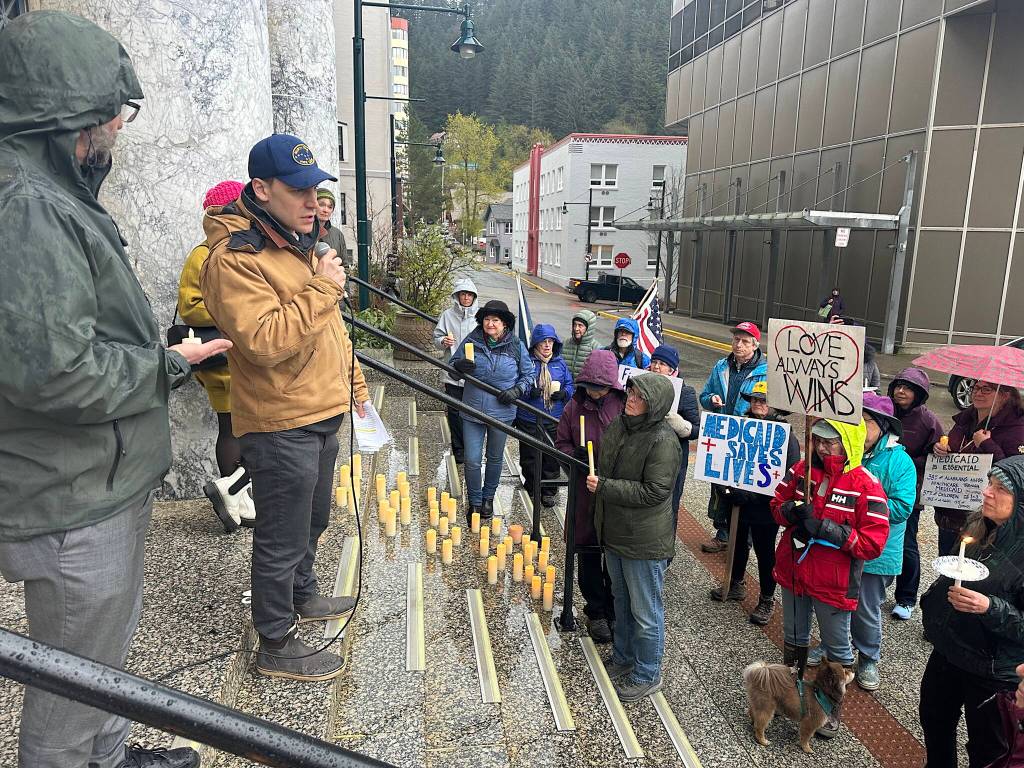
Sarah Dunlap says her adult daughter was born with a developmental disability that requires extensive home-based care and “her life is not possible without her Medicaid support.” And despite Congressional Republicans talking about protecting the most vulnerable from proposed cuts to the program, she’s not reassured.
“There’s really no other model of care that works for her life,” Dunlap said after a candlelight vigil in front of the Alaska State Capitol on Wednesday evening attended by about 30 residents, health providers and state lawmakers.
Medicaid allowed Dunlap and her husband to continued operating an adventure flying business in Juneau while caring for their daughter, she said. But they ceased operations a decade ago and her daughter’s current service provider “doesn’t have enough staff to fully provide her services, so her father and I have to fill in the other hours.”
“Her father is 81 with his own health problems and it’s a tenuous situation,” Dunlap said.
Cuts to needs-based Medicaid health insurance have been a foremost budget issue this year in Washington, D.C., as the Republican-led House — emboldened by President Donald Trump’s return to office and a Republican-led Senate — passed a spending plan calling for $880 billion in cuts over 10 years from the committee that oversees Medicaid. Budget analysts say there are few other programs under the committee’s purview that could be cut instead.
The committee on Sunday night released a proposal that avoids the worst-case scenario envisioned by critics, but would still cause millions of poor Americans to lose Medicaid health coverage and millions more to pay higher fees when they go to the doctor, The New York Times reported.
“Overall, the legislation would reduce federal spending by an estimated $912 billion over the decade and cause 8.6 million people to become uninsured, according to a partial analysis from the Congressional Budget Office that was circulated by Democrats on the committee,” the newspaper’s article states. “Most of those cuts —$715 billion — would come from changes to Medicaid and the Affordable Care Act.”
It includes a work requirement for mandating low-income adults without children prove they are working 80 hours every month to stay enrolled. It also increases paperwork requirements by allowing states to check the income and residency of beneficiaries more often, and to terminate coverage for people not responding promptly, which critics say is a way reduce the number of insured people without officially implementing cuts.
Some key policymakers involved in negotiations for the budget for the federal fiscal year that starts Oct. 1, including Trump, are balking about implementing the full-scale reduction that could affect coverage to tens of millions of people nationally, The New York Times reported Friday. He is supporting widely discussed aspects of the reductions such as adding work requirements for some Medicaid recipients.
But the newspaper also noted “Trump is well known for abruptly changing his mind on major issues” and the cuts are part of a $2 trillion overall budget reduction intended to cover some of the $4.5 trillion cost of extending tax cuts from Trump’s first term that critics say primarily benefit the wealthy. Also, Mehmet Oz, administrator of the Centers for Medicare and Medicaid Services, said Thursday “we’re not getting our money’s worth” on coverage for people with chronic illness.
“So for folks listening right now it’s your patriotic duty to be as healthy as you can,” he said during a Fox News appearance. ” “And it’s our job to help you get there, make it easy to do the right things.”
In Alaska the full cuts could mean more than 100,000 of the 279,000 people on Medicaid losing health coverage unless the state picks up the tab. State lawmakers have said that could cost well over $1 billion at a time when the state is already facing looming substantial multiyear deficits.
State Sen. Forrest Dunbar (D-Anchorage), who presided over Wednesday’s rally, said more than half of Alaska’s children are enrolled in Medicaid, and about 75% of nursing home residents receive food, housing and care through the program.
“About two-thirds of all behavioral health funds come from Medicaid,” he told those gathered. “And we know if you cut behavioral health programs we will feel that in our homes, we feel that in our emergency rooms, we will feel that on our streets and people will pass away.”
About 4% of Alaska’s total economy comes from the Medicaid program, Dunbar said.
“If those programs close a lot of those providers will leave Alaska,” he said. “Those professionals will leave Alaska, never to return. And then again people are going without services. They’re going without the things that they so desperately need.”
A resolution calling upon Alaska’s all-Republican congressional delegation to oppose cuts to Medicaid passed the Alaska Senate on Friday with the 14 members of the bipartisan majority in favor and six Republicans in the minority caucus opposed.
Sen. Shelley Hughes (R-Palmer), a member of the Senate Health and Social Services that authored the resolution, said her opposition is because Medicaid “is a good program that was meant to be a safety net.” But an expansion of people eligible since the Affordable Care Act passed in 2010 means “the costs have exploded.”
“I think what we should be supporting rather than the status quo is a restructuring because these working-age, able-bodied adults that are earning an income, but they can’t afford insurance, they do need coverage,” she said. In addition to restructuring eligibility to make Medicaid financially sustainable, “I would like see robust training so that some people that are working age and able-bodied could get some really fantastic jobs.”
All three members of Alaska’s congressional delegation have voted for the federal budget plan that contains the $880 billion cut. Sen. Lisa Murkowski has stated she will not support a final version “that would require significant cuts to Medicaid.” Sen. Dan Sullivan proposed an amendment to protect the “most vulnerable” and Rep. Nick Begich III has stated he supports work requirements — both of which essentially are forms of restructuring suggested by Hughes.
Opposition to imposing work requirements and otherwise scaling back eligibility was expressed by Dunbar during Friday’s state Senate floor debate. He said Medicaid expansion has resulted in more healthy people — and consequently more economic production, and fewer societal costs related to factors such as behavioral health and emergency room care for the uninsured.
“There just isn’t evidence that Medicaid expansion reduced the amount of skills people have, or the training they seek or the promotions they seek,” he said. “It is a broad bipartisan effort that went to many states — red states and blue states accepted the Medicaid expansion — and uniformly they have statistics that show that it saved lives and that it improved economic output.”
• Contact Mark Sabbatini at mark.sabbatini@juneauempire.com or (907) 957-2306.