On the Trails: Hither and yon in late May
Published 10:30 pm Monday, May 31, 2021

By Mary F. Willson
For the Juneau Empire
As readers of these essays know, I like to take a walk every day, just to see what I can see (or hear). I’m seldom disappointed. Here is a sampling of my recent observations.
A visit to the area around Moose Lake yielded not only singing waterthrushes, but also Wilson’s warblers and a yellow warbler. Robins were conducting a shouting match, so it was often hard to hear anyone else. Warbling vireos were singing their husky song from the willow/alder thickets along the old dike trail.
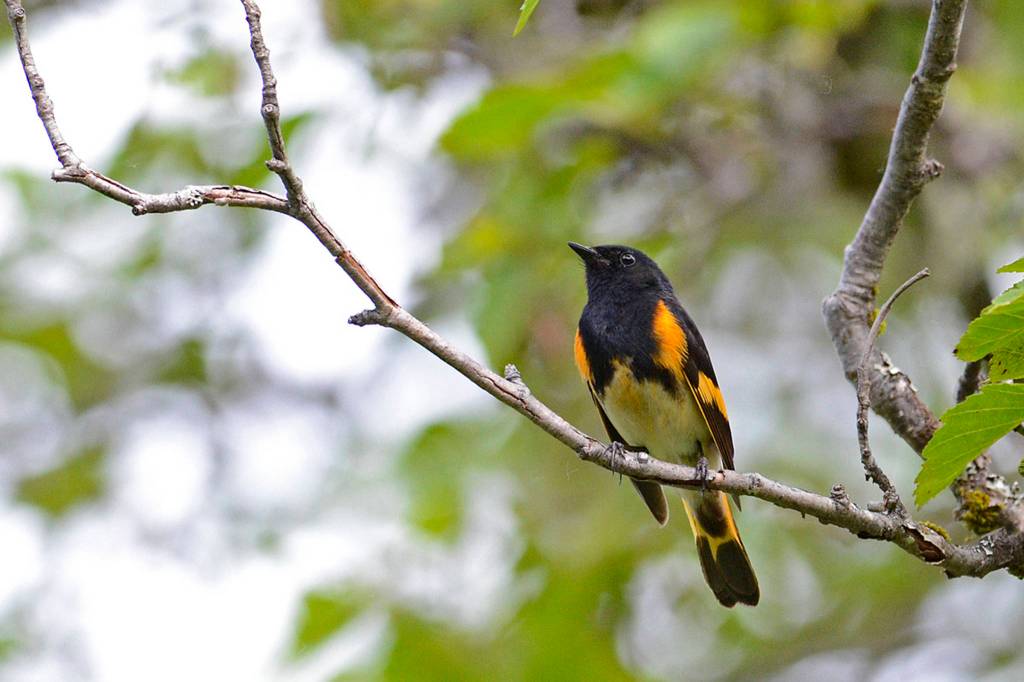
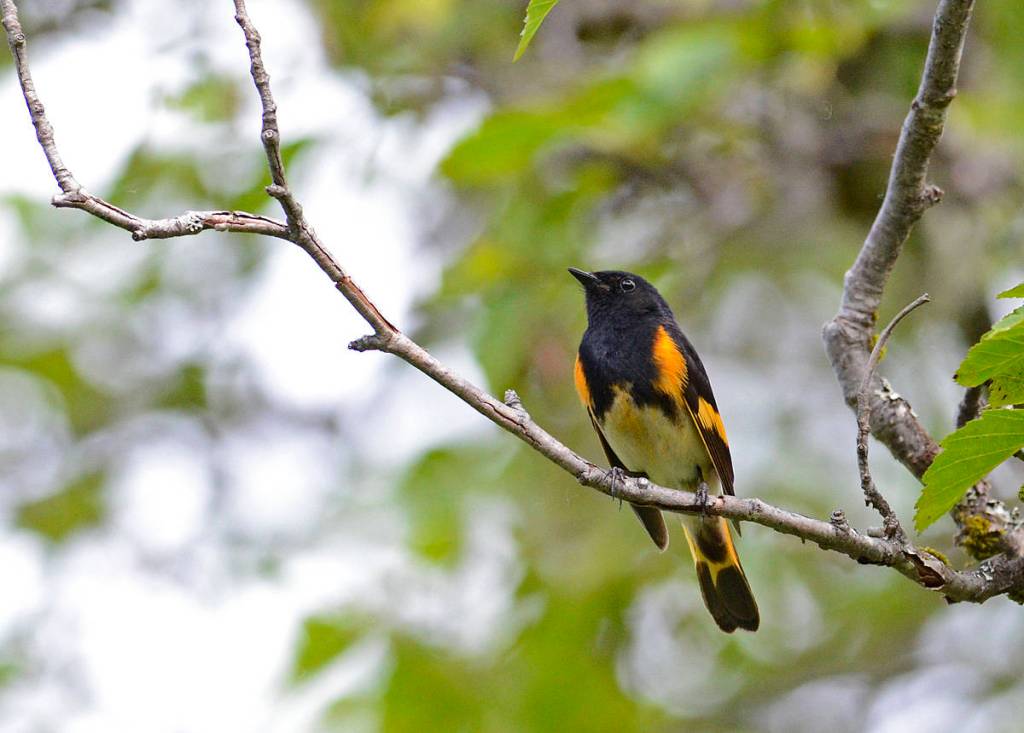
This little vireo is among the plainest of songbirds — no flashes of colorful feathers, no bright head-stripes, just shades of gray. Quite a contrast to the American redstarts that are often seen in this area in late spring—the unmistakable adult males dressed in black and red-orange on body, tail, and wings. Young males in their first and second summers look a lot like females; the big colorful tail patches are yellow instead of the red-orange of adult males. These young males are capable of breeding; for some reason, they just haven’t got the mature plumage yet, and they are generally not as successful in attracting a mate as the more colorful full-adult males are. Redstarts are often socially monogamous, but polygyny is not uncommon and philandering by both sexes is reported to be a regular occurrence.
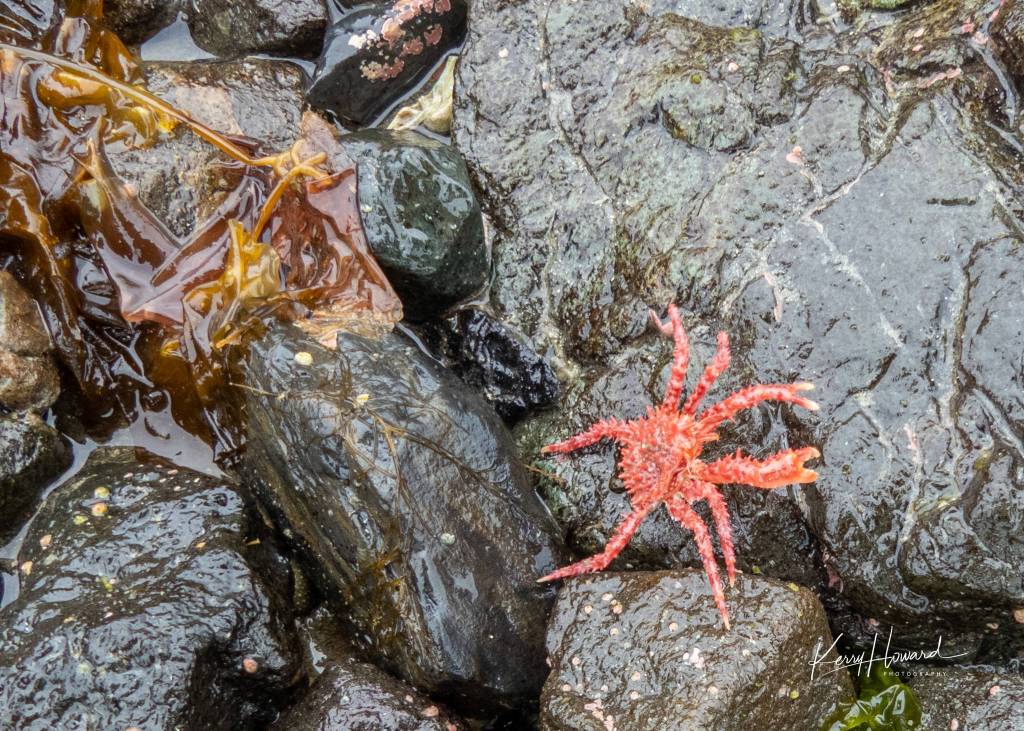
Some cobble-hobbling in intertidal areas on the very low tides found many of the same beasties that we saw in April, although the relative abundances were different and we found a few new things. Half-buried in mud between rocks were a couple of rock crabs, whose hefty front claws can deliver a mighty pinch. Lurking at the water’s edge, a few small, bright red, king crab juveniles were scrambling over the rocks; they take five or six years to reach maturity.
They prey on all sorts of critters, including snails, clams and cockles, urchins, sea stars, worms, barnacles, sponges, and so on; big crabs can take quite large prey, while very small ones often eat small prey such as copepods and single-celled diatoms and foraminifera. A brittle star, which feeds on detritus, sprawled in the mud covering the underside of a flat rock (we carefully replaced that rock). Some tiny snails clustered in a muddy pocket were distinguished by their smoothly tapered shell (the coils of the shell did not bulge out between the sutures)—maybe cucumber suckers that parasitize sea cucumbers?? A mass of tiny yellow eggs, thousands of them, were plastered on a rock wall—but whose were they??
One morning I visited Kingfisher Pond, having been reminded of it by a friend; somehow it had fallen off all the to-do lists and I hadn’t been there for several years. I was glad to get re-acquainted. Out on the open waters of the ponds, I found a trio of blue-wing teal (uncommon in Southeast), a redhead (a duck that’s rare in Southeast), and a green-wing teal. A female Wilson’s warbler foraged actively in the pond-side brush, and I got a brief glimpse of a small (unID) flycatcher.
A male red-winged blackbird complained continually about my presence, producing a litany of ‘chuck’ notes and a high, thin alarm call. He spent most of his time around one section of the pond and, presently, I saw a female pop up to perch in a tree. Redwings are often polygynous, but perhaps this pond is too small to attract more than one female(?).
The meadow at Eagle Beach was a flower-show: bright yellow buttercups and marsh marigolds, blue lupines and pink shooting stars beginning to bloom, with many more buds coming, violets in yellow or pale purple, white scurvy grass. I’m tempted to quote Gilbert and Sullivan (from “The Mikado”): “The flowers that bloom in the spring, Tra la!, breathe promise of merry sunshine…” That sounds very good to me as I write this while the rain pours down for yet another day!
• Mary F. Willson is a retired professor of ecology. “On the Trails” appears every Wednesday in the Juneau Empire.