Governor signs off on $1,600 PFD, calls for third special session
Published 7:20 am Monday, August 19, 2019
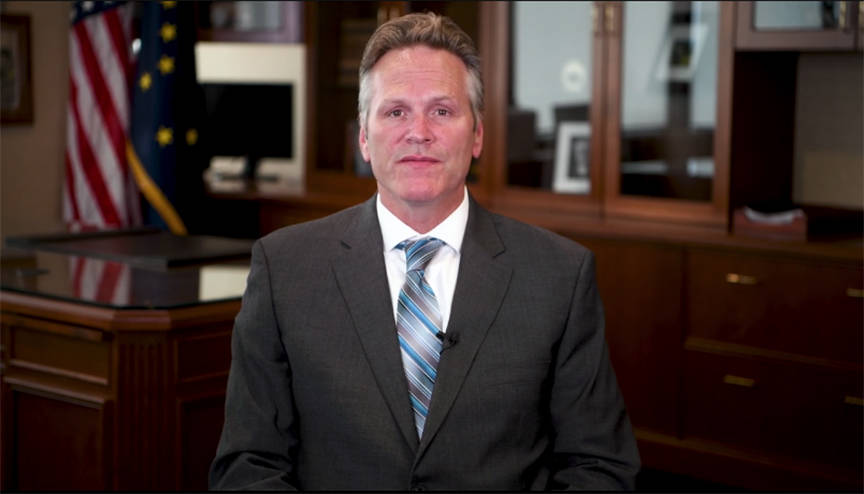
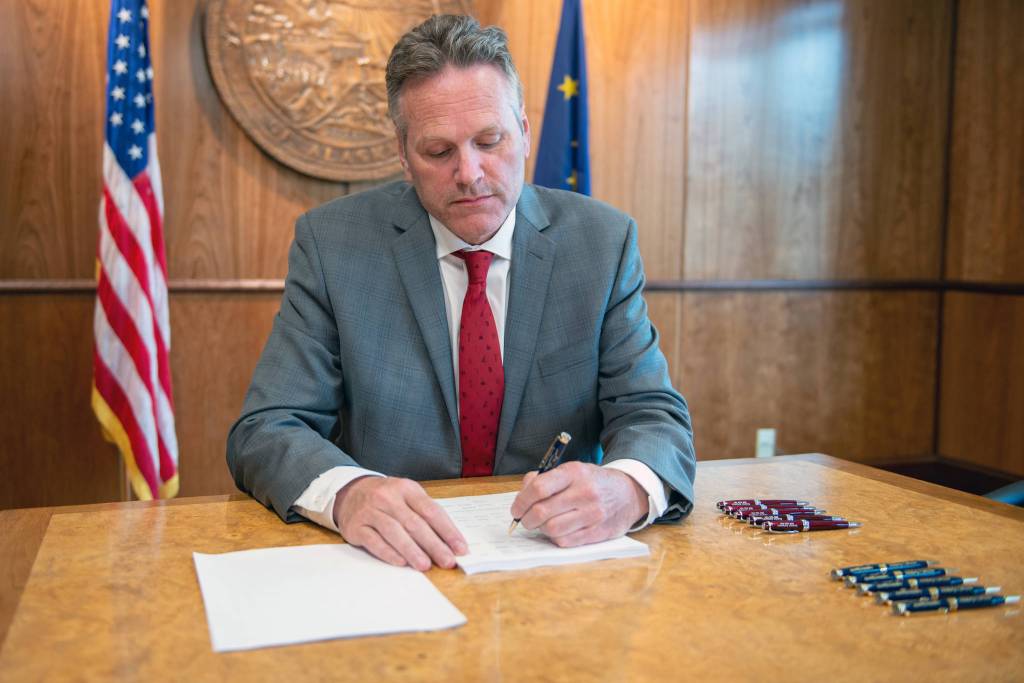


Gov. Mike Dunleavy signed House Bill 2001 Monday, finalizing the state’s budget and allocating a $1,600 Permanent Fund Dividend.
Dunleavy made significant cuts — $650 million, a roughly 8 percent spending decrease — to the state’s budget for the coming fiscal year. While he did not veto appropriations for a limited PFD, he did say he anticipates calling a third special session the sole purpose of which would be resolving the PFD issue.
“Effective today, through the enactment of HB 2001, we have eliminated over one-third of the state’s deficit through reduction of approximately $650 million in state spending,” Dunleavy said in the video. “Reforms have been initiated to make services and programs, such as Medicaid, University of Alaska, and the Alaska Marine Highway System more efficient and more sustainable.”
The governor’s budget included funding for various state programs in addition to programs like Head Start and senior benefits Dunleavy restored earlier this month.
The budget contained funding for Human Services Matching Grants and Community Initiative Grants which provide money to municipalities in order to qualify for matching funds for a number of social service programs like mental health, substance abuse and sexual assault treatment centers.
Additionally the budget allocated funds for the development of the state’s agriculture, including soil management programs as well as inspection and regulatory programs.
The governor’s budget also included full funding for the Alaska State Council on the Arts. Funding for ASCA had been entirely cut in July, prompting protests from across the state. In a statement following the governor budget announcement ASCA Chairman Benjamin Brown said that he applauded “Governor Dunleavy’s wise and prudent decision,” to fund arts in Alaska.
The governor’s office gives a breakdown of the budget here. The Office of Management and Budget’s exact summary can be found here.
While Dunleavy’s budget did restore funding for a number of programs, there were other programs that faced cuts, including $50 million from Medicaid. The Village Public Safety Officer Program received $3 million in cuts. Public broadcasting received a cut of roughly $2.7 million, while the Alaska Marine Highway System received $5 million in cuts.
In July the Legislature approved an additional $5 million specifically for the AMHS in an effort to provide more winter service to coastal communities that rely on the ferries for transportation and supplies. That money was vetoed by Dunleavy Monday.
Rep. Dan Ortiz, I-Ketchikan, said he was not surprised by the cut. That money was meant to provide increased service to Cordova and Prince William Sound.
“It won’t impact our already greatly reduced service,” he said. Ortiz said that the cuts to AMHS meant less service to Ketchikan’s nearest mainland port, Prince Rupert in British Columbia.
What Ortiz found more disappointing were the cuts to the Department of Fish and Game fisheries surveys which faced a cut of $2.5 million.Those surveys and projects are intended to create more fish catch opportunities.
“What you’re doing is your potentially reducing the opportunity for our commercial fisherman,” Ortiz said, adding that the fishing industry is the number one economic driver for coastal Alaska.
In a statement detailing all the cuts, the governor’s office said, “this reduction does not change the function or outcome of the program, it simply aligns the budget with prior year actual spending.” The statement said the reductions are based on unspent money from previous years based on “ongoing vacancies.”
A brief of the governor’s vetoes can be found here while a OMB’s veto summary can be found here.
The governor did not veto appropriations in the bill — which paid a $1,600 PFD — but expressed dismay at not having the full amount, and accused legislators of using the PFD for political purposes.
“Unfortunately, this process was thrown into chaos the past several years when oil prices fell. Too many in the Legislature now treat the PFD as a political football, arbitrarily setting its amount rather than following the statutory formula Alaskans know and trust,” Dunleavy said.
Dunleavy said that he “anticipates” a third special session in the fall where the sole focus will be allocating the remainder of the PFD. The governor has the authority to call the Legislature into special session, which Dunleavy did twice already this year.
“Now that the budget has been addressed, the full PFD will be the focus in this next special session, the sole focus,” the governor said. “I will not let up until the remaining funds are appropriated for the full statutory PFD. I know Alaskans understand this decision and I appreciate all of your input.”
Reaction from lawmakers
In a press release Monday afternoon, House Speaker Bryce Edgmon, I-Dillingham, said the governor’s budget, “in a way … represents good news for Alaska.” Edgmon said in the release that the governor was following the Legislature’s leadership in restoring programs and services, “essential to elders and children across our state.”
But Edgmon criticized the governor for making cuts “without analysis to determine impacts on people and our economy.”
Members of the Republican House Minority praised the governor in a press release Monday, saying that the governor’s reductions reflected a positive beginning for obtaining a statutory PFD.
House Minority Leader Lance Pruitt, R-Anchorage, said in the release that by working with the governor, “House Republicans were able to be that check and balance that is so vital to our system of government. Through our dialogue, we were able to preserve the Senior Benefits Program, Council for the Arts, and also transition the university’s reductions to a timeline that will not damage the integrity of the institution.”
Rep. Tammie Wilson, R-North Pole, said that this year’s legislative session was difficult because it forced the state government to, “take an objective look at our dangerous spending situation.”
Wilson, along with Colleen Sullivan-Leonard, R-Wasilla, also quoted in the release, said that they were determined to fight for the remainder of the PFD.
“I’m very saddened that our statutes and constitution are held in such low regard by so many in the legislature,” Wilson said. “Too many legislators made the decision that protecting government spending was more important than following the law and paying the full PFD.”
‘Right size’ government
Dunleavy maintained that his cuts were the only feasible solution to the state’s budget problems.
“Alaskans need to understand that we can no longer afford to spend at our current rates” Dunleavy said in the video. “We can no longer afford to deplete our savings and hope for higher revenues. We must begin making the long-term changes to put ourselves on a path to a more sustainable future, and we can no longer pretend the problem will fix itself.”
Dunleavy said that the Legislature’s reduced budget of roughly 2.9 percent or $270 million was, “a good start … but still leaving a gap of well over one billion dollars.”
The governor’s budget reduction of $650 million, or 8 percent, are “important steps … to address our deficit, right size our government and to put Alaska on a more sustainable path,” the governor said in his video.
Earlier this month, the governor reversed course by signing portions of the bill allocating funds for early education and senior benefits earlier this month, as well as signing an agreement with the University of Alaska Board of Regents for a multi-year budget reduction plan.
At the press conference where the governor approved appropriations for early education funding, Dunleavy said that his initial vetoes of roughly $444 million were not meant to harm Alaskans, but to begin a difficult but much needed conversation about which state programs were valued most.
“You don’t get to this point unless you veto,” the governor said at that press conference. “You don’t have this conversation unless you veto, most people think it’s not going to happen, that we’re going to be saved by oil prices.”
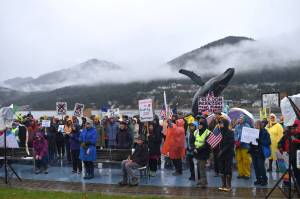
The announcement of the governor’s vetoes set off a number of large protests around the state and galvanized a recall campaign that has collected almost 30,000 signatures in two weeks.
The governor has said that the state’s current fiscal realities don’t allow for continued spending at current levels and that drastic cuts to the state’s budget need to be made in order to preserve savings.
Dunleavy has said that cuts to the budget were his attempt to close the state’s $1.8 million deficit “without taking the PFD and without using taxes.”
However many legislators and citizens have pointed to revenue, rather than cuts, as a solution the the state’s budget problems. Lowering oil tax credits for energy companies which operate in the state, as well as implementing a state income tax have both been suggested as ways to reduce the deficit without drastically cutting state spending.
Dunleavy has said in the past that he generally favors less taxes and that “more money in the private sector means more investment in the state, long term.”
• Contact reporter Peter Segall at 523-2228 or psegall@juneauempire.com.