Gov sues to seize Mendenhall lake, river from feds
Published 10:30 pm Tuesday, November 1, 2022


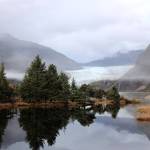
Gov. Mike Dunleavy, facing a reelection battle in one week, filed a lawsuit Tuesday seeking to seize state control of Mendenhall Lake and Mendenhall River from the federal government which, among other things, would remove restrictions on motorized vessels on the lake.
The federal lawsuit comes as the U.S. Forest Service is planning a large-scale overhaul of the Mendenhall Glacier Recreation Area, which is Juneau’s most-visited tourist attraction. Proposals in the plan include new infrastructure, trails and allowing limited motorized vessel access by licensed operators, but Dunleavy’s administration has sent cease-and-desist letters to federal agencies involved with the planned projects.
“Instead of responsibly working with Alaska as the sovereign owner of lands adjacent to its own, the federal government has chosen to ignore state ownership, management and authority,” Akis Gialopsos, commissioner of the state Department of Natural Resources, said in a prepared statement Tuesday. “(They’ve) chosen to make decisions and take actions on state land without state involvement or consent, (and) chosen to gaslight the public into believing that Alaska is not the rightful owner.”
Dunleavy announced his intention to file the lawsuit in late April, with a 180-day advance notice requirement to federal authorities setting up the timing just before the election. The governor has also filed or announced intentions to file similar claims for submerged lands throughout the state since March of last year as part of his “Unlocking Alaska” initiative, some aspects of which are questioned by legal experts and which environmental advocates say is politically motivated.
The lawsuit claims the state owns the submerged lands beneath the lake and river, and thus the navigable waters above, which the federal government does not recognize. Federal case law also has generally established the federal government has concurrent jurisdiction over navigable waters that even where the state owns the submerged land.
The U.S. Forest Service office in Anchorage declined to comment on the lawsuit Wednesday beyond stating an attorney from the U.S. Department of Justice has not yet been assigned to the case.
“The United States will be responding to the allegations in the state’s newly filed complaint in the course of the litigation,” Erica Keene, a spokesperson for the Forest Service’s Alaska region, said in an email.
A wilderness of precedent
The issue stems from the Sturgeon v. Frost ruling by the U.S. Supreme Court, involving two cases decided in 2016 and 2019 where justices unanimously declared Alaska’s lands submerged beneath navigable waterways were controlled by the state. But the ruling is based on a complex web of factors including whether land is public or non-public, case law dating back to the 1800s, federal ownership of land at the time of statehood in 1959 and how regulatory authority of the National Park Service is affected by the 1980 Alaska National Interest Lands Conservation Act.
A defining issue is that the federal government defines “navigable” waters as being capable of transporting commerce — and doesn’t include typical guided tours or vessels such as inflatable boats as qualifying commerce, according to a state Department of Natural Resources Navigability Project website explaining Dunleavy’s initiative. The federal definition of navigable is based on an 1870 Supreme Court case, while the state asserts if a waterway is capable of vessel transport it is navigable even if there is no history of commerce.
“The federal government has admitted that professionally guided transportation on Alaska’s rivers, lakes and streams constitutes commerce, but nevertheless has argued that the waters are not being used as a navigable ’highway’ when recreation is involved, but rather more as an amusement park,” the website states.
The lawsuit claims the lake and river, during its centuries-long history, has been used “in its fluid capacity as a highway —floating of logs, use by wooden and skin boats, log and inflatable rafts, power and jet boats, and canoes providing transportation for individuals and supplies, for subsistence and recreational guided and non-guided hunting and fishing activities, for trapping, mining and prospecting, freighting and similar purposes, related to commerce and travel.”
Another key aspect is state jurisdiction applies only to waterways on federal lands that were “unreserved” at the time of Alaska statehood in 1959. Federal jurisdiction of the lake and river areas in the lawsuit were subject to a series of back-and-forth actions by several presidential administrations between 1909 and 1947, with executive orders and other actions ultimately resulting in federal claims of jurisdiction. Dunleavy’s lawsuit, in its own series of claims on those actions, asserts as a whole they did not withdraw the submerged lands from the Statehood Act and related law.
Alaska received title to “non-public” (AKA not subject to National Park Service regulations) navigable water bottoms at statehood, which subsequently included many “national interest lands” designated by ANILCA — although federal land withdrawals pre-dating statehood are excluded.
Interpreting meanings and motives
Thomas Meacham, an Anchorage attorney who has expressed doubts about some previous actions by Dunleavy to claim submerged lands, said the key issue in the Mendenhall lawsuit is the interpretation of the federal executive branch orders prior to statehood.
“The legal question is do those administrative land orders have the legal effect of preventing the state from getting the land under the Submerged Land Act,” he said.
In a subsequent email, Meacham noted “the location of the front edge of Mendenhall Glacier on Jan. 3, 1959 (the date of statehood), would seem to determine how much of the present lakebed the state could claim, even if its entitlement to some of the lakebed were upheld. This is a novel legal question that has not been specifically litigated to my knowledge, and it becomes relevant with the recession of glaciers throughout Alaska.”
Less nuance is being expressed by entities opposed to Dunleavy’s politics and claims such as all Alaskans are allowed to use motorized vessels on Mendenhall Lake. In an analysis of the “Unlock Alaska” initiative by Lauren Sherman and Katie Strong for Trustees for Alaska, which described itself as a nonprofit public interest environmental law firm.
“Cries of federal overreach and standing up to the ’jack-booted government thugs’ plays well in Alaska politics,” they wrote. “Another way to look at it is as part of a long-standing effort by the state to expand its authority by bringing lawsuits aimed at broadening the definition of navigability — in this case, by asking its citizens to violate federal law so they end up in court to promote a political agenda.”
• Contact Mark Sabbatini at mark.sabbatini@juneauempire.com