Feds OK most of state’s revised transportation plan, but ferry and other projects again rejected
Published 9:30 pm Tuesday, March 26, 2024

This is a developing story.
The federal government approved most of Alaska’s $5.6 billion statewide transportation plan for the next four years on Wednesday, after rejecting it earlier this year due to a multitude of flaws. But several items were again excluded, including a first-ever use of ferry revenues as matching funds — rather than conventional state funds — for more than $100 million in federal grants for Alaska Marine Highway System vessel and infrastructure projects.
Among the other major statewide rejections were about $69 million for repairs to a major port in Anchorage, and $23.2 million for bridge and tunnel inspections. Dozens of additional projects, including a ferry terminal at Cascade Point, will need further revising before they are eligible for funding.
However, lawmakers and other officials statewide expressed relief about the approval of the Statewide Transportation Improvement Plan (STIP) for 2024-2027 after the federal rejection of it in mid-February, with Alaska the only state in such a situation. The state was given until March 1 to submit a revised plan for the federal government’s possible approval by March 31, when funding for the 2020-23 STIP expires — meaning a rejection would have delayed or canceled a huge range of projects from highways to bike paths during the upcoming warm-weather season.
“We appreciate the federal agencies considerable engagement on the March 1 submittal, and (state transportation) staff for putting together this new STIP in record time,” said Ryan Anderson, commissioner of the state Department of Transportation and Public Facilities, in a prepared statement. “Alaska’s project development will continue seamlessly, and our upcoming construction season will be robust.”
A state DOT spokesperson characterized the rejection involving the ferry matching funds as a technical issue related to how funds for specific projects are categorized. She acknowledged the federal government has also declared it is still reviewing whether it will allow the use of so-called “toll credits” from ferry revenues as matching funds.
“The next step that has to happen is the Federal Highway Administration has to approve our toll credit plan,” said Shannon McCarthy, DOT’s communications director, in an interview Wednesday evening.
When asked what happens to the ferry projects if the federal government rejects the toll credits, McCarthy said that scenario appears unlikely.
“They seem open to the concept,” she said. “It’s really a matter of how much credit do we get in terms from what people have paid in terms of tickets, essentially. So it’s a matter of figuring out what that mathematical formulation is, from what I understand.”
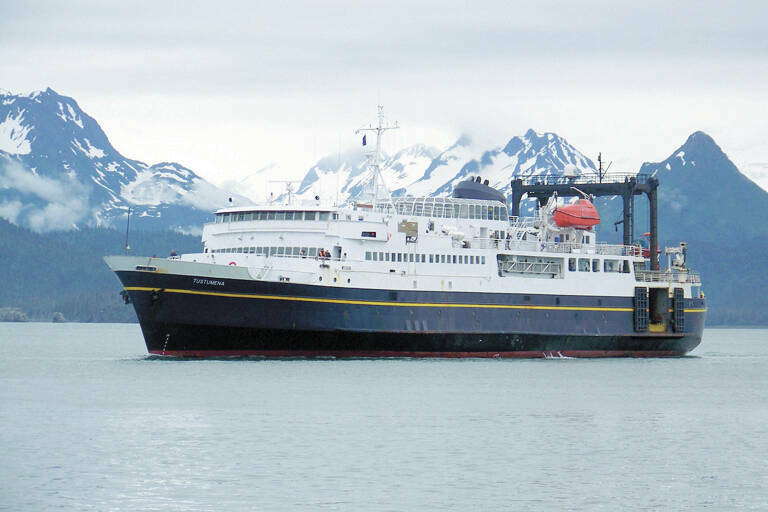
The state proposed providing roughly $20 million in such funds in the revised STIP. The biggest project is replacing the aging Tustumena ferry that serves Southwest and Southcentral Alaska with AMHS’ first diesel-electric hybrid ferry. There are also numerous ferry terminal upgrades in Southeast and other communities, as well as repairs and improvements to other vessels.
Gov. Mike Dunleavy proposed the first-ever use of AMHS revenues as toll credits last spring and administration officials have said several times since federal transportation officials were agreeable to the concept. But a 30-page report sent Wednesday by U.S. Department of Transportation to Anderson states “toll credits have been requested and are being reviewed for approval by FHWA.”
Besides the general review of the concept, McCarthy said the rejection of toll credits for projects in the STIP is because “we were trying to capture them in a single STIP ID” rather than as specifically funded individual projects.
According to the FHWA, states can earn toll credits “when a public, quasi-public, or private agency uses toll revenues to build, improve, or maintain highways, bridges, or tunnels (or, consistent with requirements in 23 U.S.C. 129(c), a ferry that serves as a link on a highway) that serve the public purpose of interstate commerce.” While other ferry systems have qualified for toll credits, such as one in Washington that is a mainstay of the Seattle-area transportation hub, some officials have questioned if Alaska is eligible due to mainline routes being used largely for tourism.
A different funding issue exists for the controversial proposed ferry terminal at Cascade Point, about 30 miles north of the current Auke Bay Ferry Terminal, with the revised STIP projecting completion of an operational facility by the end of 2025 at a total cost of $76.6 million (up from previous estimates of about $35 million).
However, members of the Alaska Marine Highway Operations Board are stating a sufficient case hasn’t yet been made for a terminal at that site. Also, the federal DOT report on Wednesday declares it needs to officially be part of the state’s ferry system before it can be part of the STIP.
“An eligible AMHS ferry transportation facility will have to exist prior to authorization of federal funding,” the report states.
• Contact Mark Sabbatini at mark.sabbatini@juneauempire.com or (907) 957-2306.