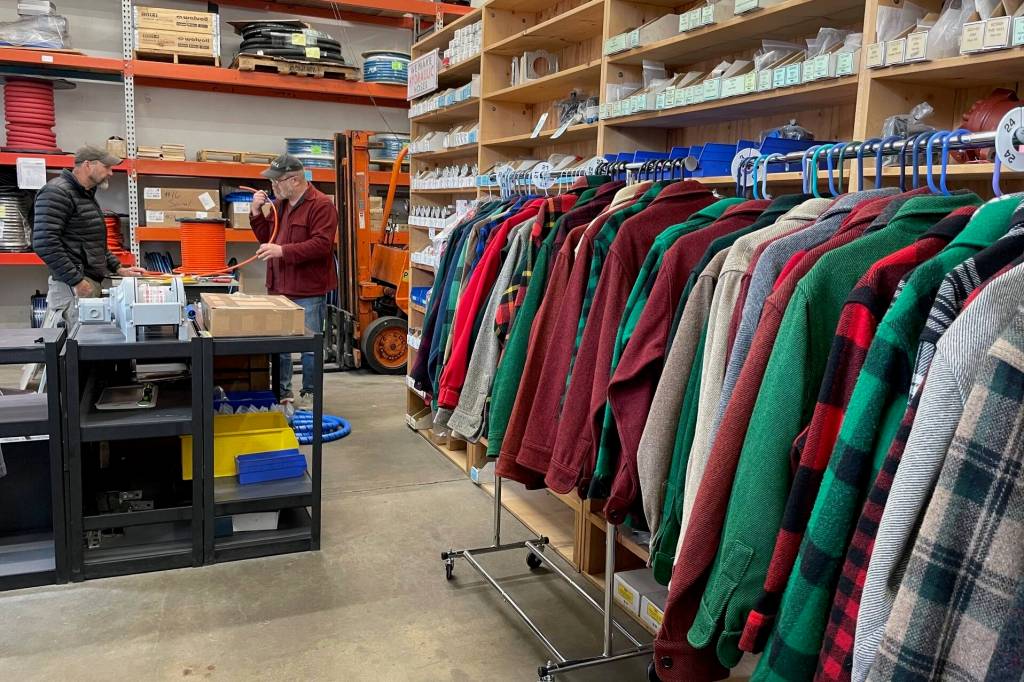
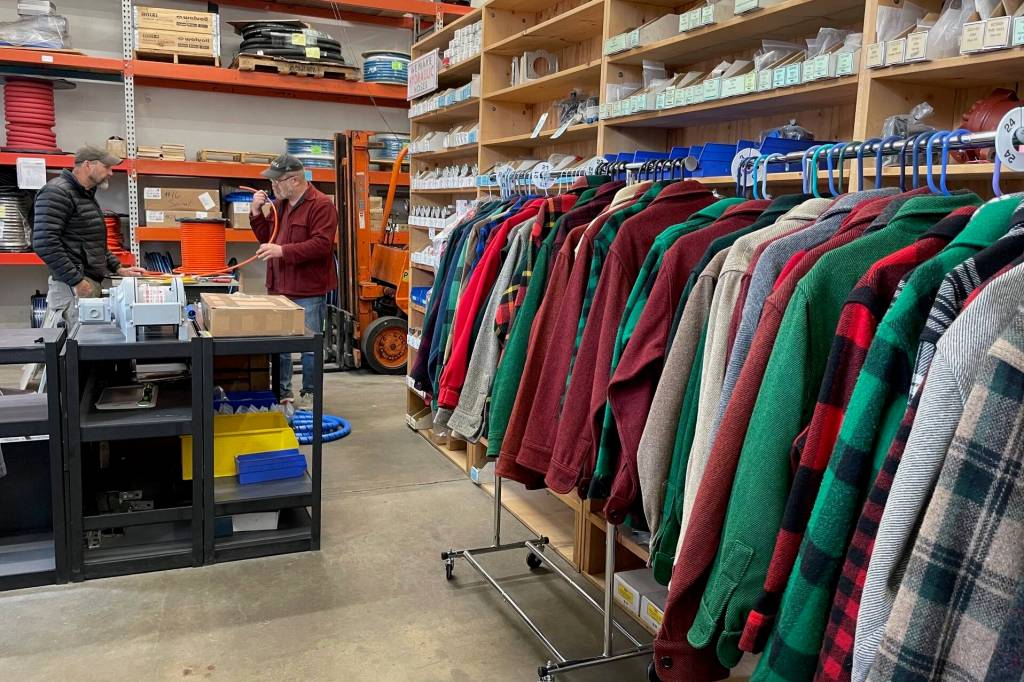
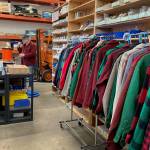
Tom Abbas discusses the hose his boat needs as shop owner and vintage halibut jacket provider Jim Geraghty shows his customer the options. Racks of dry-cleaned woolen jackets hang among the marine supply aisles in Gerahgty’s Lemon Creek business. (Laurie Craig / Juneau Empire)

Tom Abbas discusses the hose his boat needs as shop owner and vintage halibut jacket provider Jim Geraghty shows his customer the options. Racks of dry-cleaned woolen jackets hang among the marine supply aisles in Gerahgty’s Lemon Creek business. (Laurie Craig / Juneau Empire)

Coats of many colors: Halibut jackets make a big splash again

“Pre-owned” wool garments from many decades ago being tracked down for resale by Juneau marine shop.

Amid tidy rows of carefully labeled trays holding marine fittings and big spools of various diameter hoses stand three racks of colorful wool jackets. They might seem out of place in a maritime supply shop, but they are keenly sought by Southeasterners who spend their lives on the water.

The iconic jackets are hard to find. They are becoming antiques in Alaska closets. The wool resists rain and the extra panel across the front and back shoulders, known as the “cape,” adds warmth. Initially used as a warm layer under oilskins that fishermen wore on their boats, the short wool coats were respectable enough to wear into town once the waterproof gear was shed, says Jim Gerahgty, owner of a Lemon Creek marine shop.

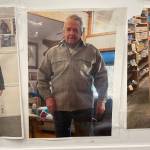
Jim Gerahgty’s uncle Norm Israelson proudly models his new, “pre-owned” halibut jacket in a photo on his nephew’s wall posted with more than 50 other jacket buyers. (Laurie Craig / Juneau Empire)

Jim Gerahgty’s uncle Norm Israelson proudly models his new, “pre-owned” halibut jacket in a photo on his nephew’s wall posted with more than 50 other jacket buyers. (Laurie Craig / Juneau Empire)

The jackets were made by John L. Rich and Sons in Pennsylvania, a company founded in 1830. The Rich family combined their name with a nearby woolen mill to create the name Woolrich. Other makers include Filson in Seattle, Johnson Woolen Mills in Vermont and Pendleton in Oregon.

The origin of the name “halibut” jacket is a little fuzzy, but the local term seems to come from longline halibut fishermen.

Marine parts manufacturer Jim Gerahgty stumbled onto his new line of old merchandise about a year ago when his uncle Norm Israelson misplaced his prized, decades-old halibut jacket. He really wanted one, Jim said. So Jim went searching online and found a classic Woolrich replacement. He ordered it. The package was lost in the mail, so he found two more online and bought them. Then both the original order and the backup package arrived simultaneously. One jacket went to his uncle and the others hung casually in Jim’s shop.

“People went crazy,” Geraghty said when his customers saw the halibut jackets hanging near the boat parts. Soon those extras were sold and friends came looking for more.

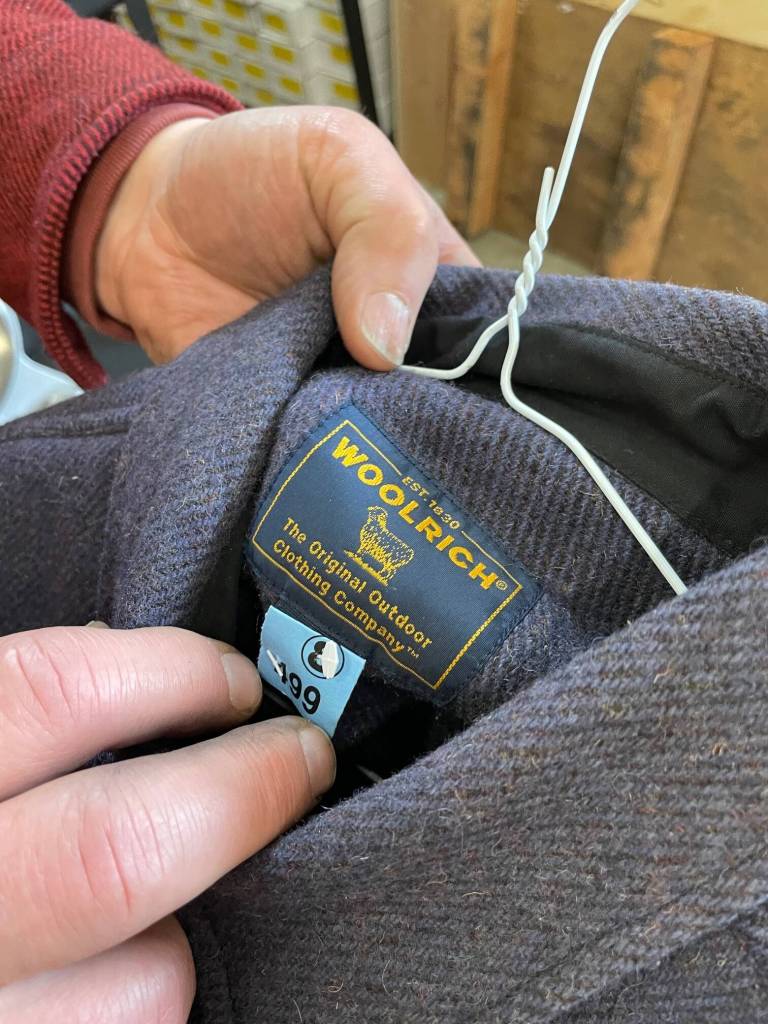
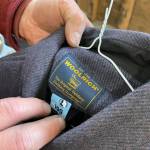
A dry cleaning tag hangs from the Woolrich jacket logo tag. Geraghty gives all jackets a professional dry cleaning before selling them. He washes his own wool in lukewarm water with Woolite. Don’t put them in the dryer, he suggests, or they will shrink. (Laurie Craig / Juneau Empire)

A dry cleaning tag hangs from the Woolrich jacket logo tag. Geraghty gives all jackets a professional dry cleaning before selling them. He washes his own wool in lukewarm water with Woolite. Don’t put them in the dryer, he suggests, or they will shrink. (Laurie Craig / Juneau Empire)

Jim scouted online resources the same way he has searched doggedly for historical photos of Juneau. Gerahgty is known as a dedicated historian who has purchased online estate sale photo collections and donated them to public sources such as libraries and museums.

Now a selection of hard-to-find “pre-owned” wool jackets hang on racks. Each still bears the dry cleaning tag from Alaska Laundry where Jim sent them before display. The jackets reveal the bright colors that became hot ticket items in the 1970s when Woolrich expanded beyond gray and dark red, the color Jim wears.

“Royal blue is the most sought-after color,” Jim said between waiting on a half-dozen boat-owning customers on a cloudy Friday afternoon in May. While his staff manufactured hoses to order with the exact couplings, the customers waited and chatted with the shop owner. Green, bright red, blue and wheat were the newer jacket colors in the 1970s. The original woolen mill design was a red and black checkered flannel made for lumberjacks, hunters and trappers.

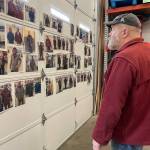
Jim Geraghty looks at the many photos posted on his shop wall of smiling owners of new/used jackets. (Laurie Craig / Juneau Empire)

Jim Geraghty looks at the many photos posted on his shop wall of smiling owners of new/used jackets. (Laurie Craig / Juneau Empire)

Proof of new jacket owners’ pleasure is revealed in more than 50 color photos posted on the wall in Gerahgty’s shop. Each person — both men and women — grins at the camera as they pose proudly in their new attire. It’s a fashion runway of happy outdoors people. Jim riffles through another 25 photo prints he hasn’t had time to display yet.

Over the years sizes have changed and so have human bodies. “People were much smaller years ago,” Jim remarks. The advantage of his racks of jackets is that customers can try them on and view in a full-length mirror tilted against the wall. He tells of one man who tried on several models then finally exclaimed, “This is my jacket!” after finding the perfect fit.

Ron Flint, owner of Nugget Alaskan Outfitter in the valley, once sold the popular wool jackets. “They were originally called ‘stag’ jackets,” he said. But they became difficult to obtain and the undependable delivery became “hit or miss,” said Flint. His parents Bill and Donna Flint started the family business 50 years ago downtown as a department store that sold a wide variety of clothing for the entire family. Flint sells wool outdoor clothing made in Canada now.

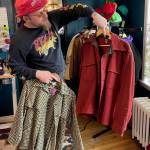
Cosmik Debriz owner Axel Gillam holds two vintage jackets in his shop on Monday, May 20. (Laurie Craig / Juneau Empire)

Cosmik Debriz owner Axel Gillam holds two vintage jackets in his shop on Monday, May 20. (Laurie Craig / Juneau Empire)

Downtown a small local shop specializes in vintage clothing and finds popular appeal for the wool jackets. Axel Gillam, who at 28 years old is younger than some of the iconic wool coats he sells, finds nostalgic connections with his likewise youthful customers at Cosmik Debriz. His shoppers are seeking durability in their clothing and appreciate links with their elders. Gillam was born in Utqiagvik and raised in remote Southcentral Alaska areas and Homer where the Woolrich coats were not known as halibut jackets. Nonetheless, they were ubiquitous and are definitely experiencing a comeback, he says.

As a sound engineer for performers, Gillam visits other locations for music gigs and spends time “thrifting” for his shop on North Franklin Street.

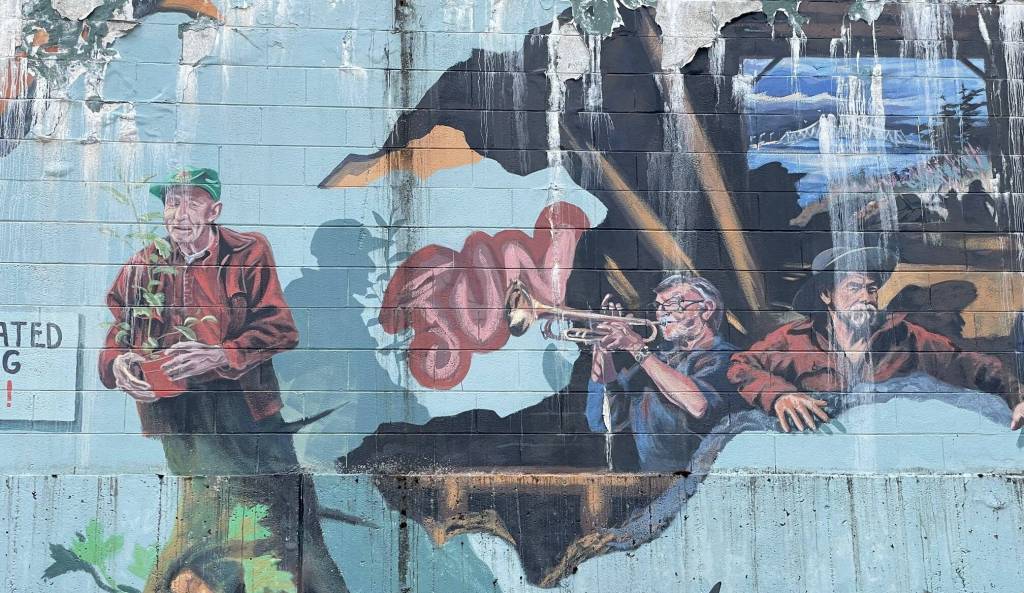
Across the street a large mural by Juneau artist Arnie Weimer features portraits of familiar local people. Two of them are depicted wearing the original dark red halibut jackets.

Artist Arnie Weimer includes two locals’ portraits wearing the original dark red halibut jackets in the mural he painted on a concrete exterior wall near Second and Franklin Streets. (Laurie Craig / Juneau Empire)

Artist Arnie Weimer includes two locals’ portraits wearing the original dark red halibut jackets in the mural he painted on a concrete exterior wall near Second and Franklin Streets. (Laurie Craig / Juneau Empire)

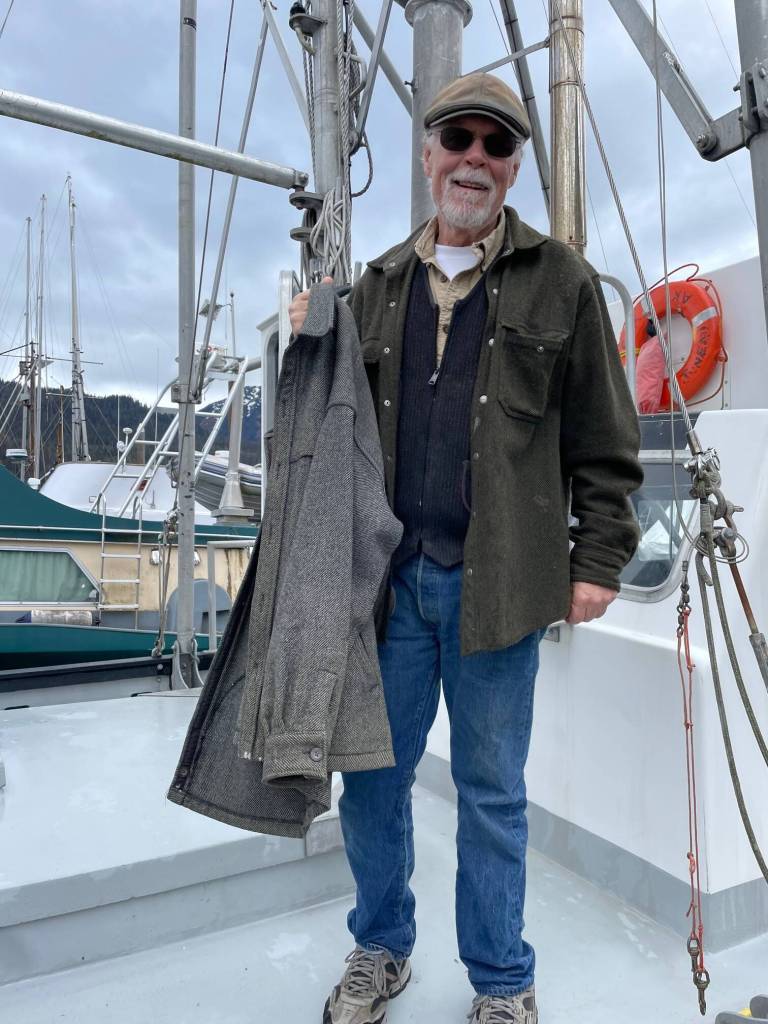
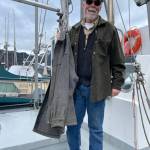
A stroll of Juneau’s harbors reveals more stories. In Harris Harbor, commercial fisherman Mike Walsh wore a wool vest under a halibut “shirt,” woven lighter than the jackets and lacking the shoulder layer. But he had the iconic gray coat in the wheelhouse of his troller “Silver Fox” and pulled it out to show a few remnants of working life with bottom paint spots on the back and hull paint on the front.

The third mate on a luxury cruise ship docked downtown spoke affectionately of his 30-year-old Filson woolen hunting jacket and wool pants that serve to protect him in the woods or while operating Zodiac boats in icy Alaska waters.

Commercial fisherman Mike Walsh wore his lightweight wool halibut “shirt” over a wool vest on Saturday, May 18, as he hosed the deck of his salmon troller. He stepped into the wheelhouse of his boat Silver Fox to pull out his gray Woolrich coat. The well-used and well-loved jacket — with some spots of bottom and hull paint — stays on the boat. (Laurie Craig / Juneau Empire)

Commercial fisherman Mike Walsh wore his lightweight wool halibut “shirt” over a wool vest on Saturday, May 18, as he hosed the deck of his salmon troller. He stepped into the wheelhouse of his boat Silver Fox to pull out his gray Woolrich coat. The well-used and well-loved jacket — with some spots of bottom and hull paint — stays on the boat. (Laurie Craig / Juneau Empire)

In Auke Bay a charter boat skipper sanding a door on his vessel said his late father gave him one of his own prized woolen Woolrich coats a few years ago. It is a wearable family heirloom now. He also has scouts on the lookout for recycled halibut jackets at thrift stores.

New fabrics and technology have replaced the durable wool jacket for many contemporary adventurers. Fleece and other lightweight waterproof clothing is more readily available. However, Ron Flint’s daughter recently purchased a used halibut jacket online, he said, so the tradition continues.

• Contact Laurie Craig at laurie.craig@juneauempire.com.

More in News

The Juneau road system ends at Cascade Point in Berners Bay, as shown in a May 2006 photo. (Michael Penn / Juneau Empire file)
State starts engineering for power at proposed Cascade Point ferry terminal

DOT says the contract for electrical planning is not a commitment to construct the terminal.

Members of the Alaska Air and Army National Guard, Alaska Naval Militia, and Alaska State Defense Force work together to load plywood onto a CH-47 Chinook helicopter, in Bethel, Alaska, Nov. 2, 2025, bound for the villages of Napaskiak, Tuntutuliak, and Napakiak. The materials will help residents rebuild homes and restore community spaces damaged by past storms. (U.S. Army National Guard photo by Spc. Ericka Gillespie)
Gov. Dunleavy approves Alaska National Guard assisting ICE in Anchorage

The National Guard said five service members will assist with administrative support; lawmakers and civil rights advocates worry that the move signals a ramping up of immigration enforcement operations in Alaska

A cruise ship, with several orange lifeboats visible, is docked in downtown Juneau. (Laurie Craig / Juneau Empire file photo)
CBJ seeks input on uses for marine passenger fees

Public comment period is open for the month of December.

Browsers crowd into Annie Kaill’s gallery and gift shop during the 2024 Gallery Walk. (Juneau Empire file photo)
Gallery Walk guide for Friday, Dec. 5

The Juneau Arts & Humanities Council announced community events taking place during… Continue reading

The Alaska State Capitol is seen on Tuesday, Nov. 25, 2025. (Photo by James Brooks/Alaska Beacon)
Alaska Senate Republicans confirm Rauscher, Tilton and open two vacancies in state House

The Alaska Republican Party is moving quickly after Republicans in the Alaska… Continue reading

Downtown Skagway, with snow dusting its streets, is seen in this undated photo. (Photo by C. Anderson/National Park Service)
Skagway’s lone paramedic is suing the city, alleging retaliation by fire department officials

This article was reported and published in collaboration between the Chilkat Valley… Continue reading

A spruce tree grows along Rainforest Trail on Douglas Island. (Mari Kanagy / Juneau Empire)
Where to cut your Christmas tree in Juneau

CBJ and Tongass National Forest outline where and how residents can harvest.

Winter dining has always carried more weight than the menu might suggest. In the off-season, eating out isn’t just about comfort food or convenience; it’s a way of supporting local businesses as they hold steady through the slower months. Photo credit: Canva.
Savoring local in Juneau: How a simple meal helps the whole community

Independent cafés and neighborhood restaurants keep Juneau strong through the slow season

Kaskanak Creek in the Bristol Bay’s Kvichak watershed is seen from the air on Sept. 27, 2011. The Kvichak watershed would be damaged by the Pebble mine project, the Environmental Protection Agency has determined. (Photo provided by Environmental Protection Agency)
Pebble Mine, halted by EPA order, gets support from national development groups

In 2023, the EPA invoked a rarely used “veto” clause of the Clean Water Act to say that there was no way that the proposed Pebble Mine could be developed without significant harm to the environment.

Most Read