Ballot Propositions 2: Ship-Free Saturday
Published 9:30 pm Monday, September 9, 2024
This story has been moved in front of the Empire’s paywall.
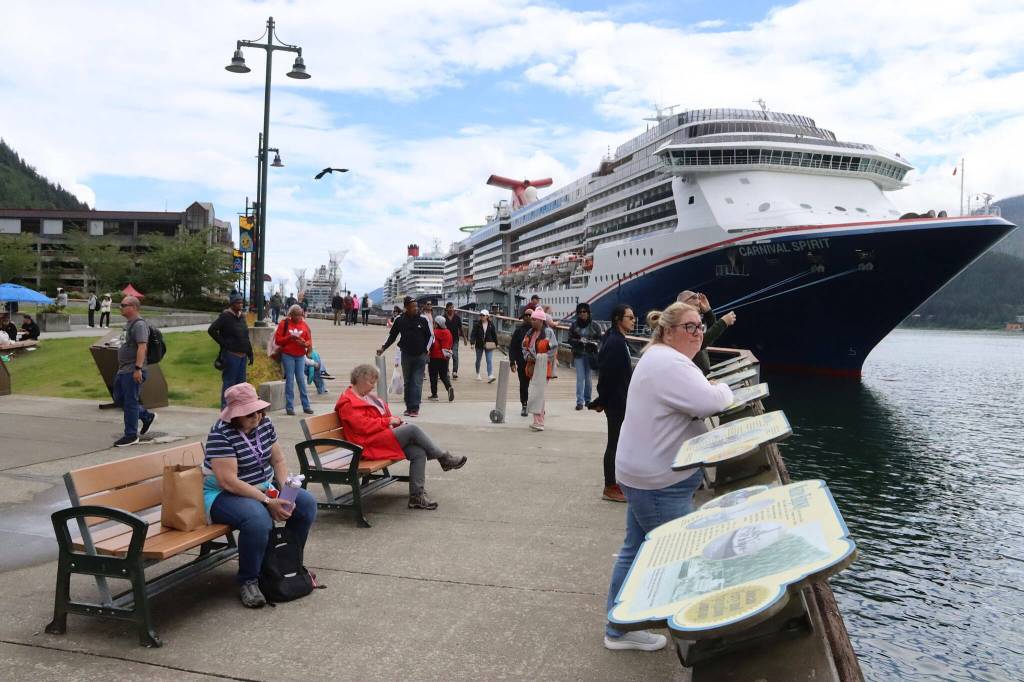
The most high-profile and controversial vote of the 2024 Juneau municipal election is the Ship-Free Saturday proposal, officially known as Ballot Proposition 2, which will ban cruise ships with capacity for 250 or more passengers from docking in Juneau on Saturdays and the Fourth of July.
The measure was certified for the ballot on July 1 when its supporters met the requirement of 2,359 signatures on petitions, one-fourth of the number of votes cast during the most recent municipal election.
Supporters launched their effort at the beginning of this year’s cruise ship season, which is expected to attract about the same number of passengers as last year’s record 1.67 million passengers. That total was up 40% higher than 2022 and 30% higher than the previous record high set in 2019.
Debate about the proposition has received global media coverage — with varying degrees of accuracy about the specifics and motivations of the measure — due to the broader debate about economic, social, environmental and other aspects of mass tourism.
The backers of the measure are Juneau Cruise Control: Juneau CAN Rethink Tourism, with its lead organizer listed as Karla Hart, a longtime Juneau activist on cruise ship tourism issues. The primary group opposing the measure is Protect Juneau’s Future, whose co-chairs are McHugh Pierre, president and CEO of Goldbelt Inc., and Craig Jennison, vice president of tours and marketing for Temsco Helicopters.
The ballot question contains a preface of the supporters’ arguments which, among other statements, assert “a majority of Juneau residents think that our local government is not doing enough to manage cruise tourism,” and “city leaders and industry have had decades to act and have failed to balance the economic benefits to some against the economic and other harms of the many imposed by the cruise tourism industry.”
“Ship-Free Saturdays puts residents first for one day per week,” Hart wrote in the official CBJ voter information guide. “It gives us a chance to enjoy our homes, the glacier, downtown, and to reclaim a sense of community. It gives whales a break. Seasonal employees might count on one consistent day off per week. It is about restoring balance.”
Opponents of the measure — besides cruise-affiliated businesses — include the Greater Juneau Chamber of Commerce, and eight of the nine mayoral and Juneau Assembly candidates.
A primary argument of opponents is the cruise industry accounted for $375 million in direct spending in Juneau in 2023, mostly by passengers, according to a report prepared for CBJ by McKinley Research Group LLC. Furthermore, banning cruise ships on Saturday would result in scheduling challenges throughout the region that could reduce some sailings and thus have a wider economic impact than just the loss of revenue in Juneau on Saturdays.
Another key argument of opponents is voluntary agreements between CBJ and the industry, including a five-ship-a-day limit in effect as of this year, and a daily limit of 16,000 passengers (12,000 on Saturdays) scheduled to go into effect in 2026 — although the latter agreement contains a provision allowing exemptions on certain days.
“Cruise tourism supports thousands of jobs in Juneau,” Eric Forst, general manager of the Red Dog Saloon, wrote in the official response opposing the proposition in the CBJ voter information guide. “Eliminating cruise ship visits on Saturdays will result in job losses, affecting families who rely on tourism for their livelihood. This measure endangers the economic stability of our community, potentially forcing families to move out in search of employment.”
In addition to the arguments presented by the two groups, the City and Borough of Juneau has published what it calls a “neutral” FAQ about the proposition and its possible impacts. However, the top half of the three-page document lists steps CBJ has taken or is taking to mitigate effects of cruise ship tourism, including the voluntary agreements reached with the cruise industry.
Hard numbers in the FAQ include a reported $30 million in direct spending and a resulting $3.7 million in tax revenues for CBJ on Saturdays in 2023.
The document also refers to the results of the most recent annual tourism survey, based on the 2023 season. It found more local residents think cruise ships have a negative impact overall on Juneau and fewer say there is a positive impact, although the positive responses still outnumber the negative ones by 48% to 22%. A total of 64% of the 517 local respondents said they favor keeping the number of cruise passengers about the same or slightly lower.
When asked about CBJ’s management of tourism, 56% of this year’s respondents said not enough is being done, 33% said just the right amount, 4% said more than enough and 7% said they didn’t know. The “not enough” responses were 11% higher than 2021 and 2022, while “just the right amount” was 8% lower than last year.
The Saturday ban could face legal challenges if it passes, similar to a U.S. District Court case involving a 2022 referendum passed in Bar Harbor, Maine, that prevents more than 1,000 cruise ship passengers a day from disembarking. A federal judge ruled in February the ordinance is valid, but business owners in the area are appealing on the grounds the ban is unconstitutional.
The most recent action is that lawsuit occurred about two weeks ago when two additional groups, including the Cruise Lines International Association (CLIA), were allowed to submit briefs to the court for consideration. CLIA is among the groups opposing Ship-Free Saturdays, although a representative for the group has told the Empire no decisions about a legal challenge to the proposition — and/or whether the industry might abandon the voluntary agreements reached with CBJ — are expected unless the measure passes.