A Day in the Life of: Chas’ Koowu Tla’a Teri Rofkar
Published 8:02 am Wednesday, October 7, 2015
For renowned Sitka Ravenstail and spruce root basket weaver Teri Rofkar, the past, present and future are interwoven.
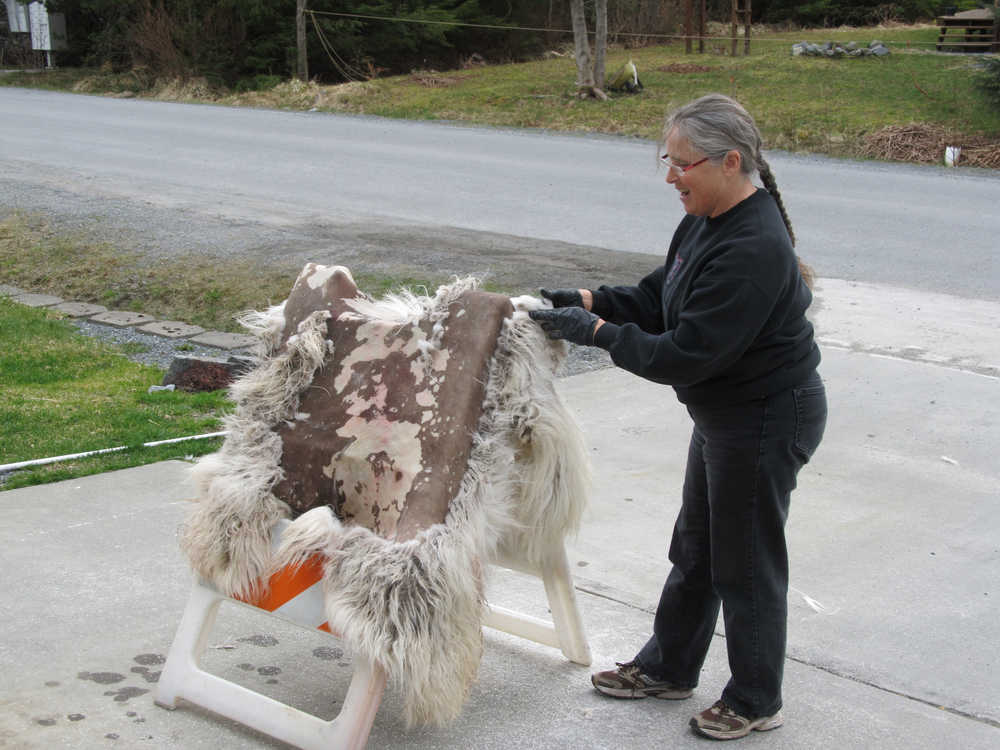
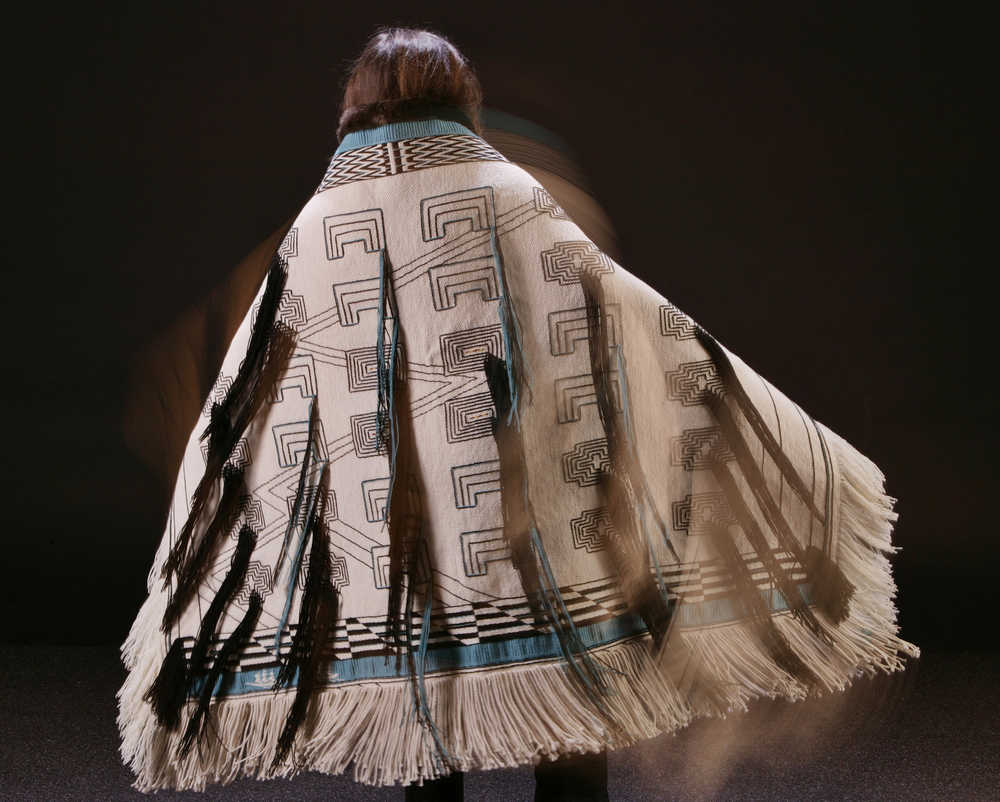
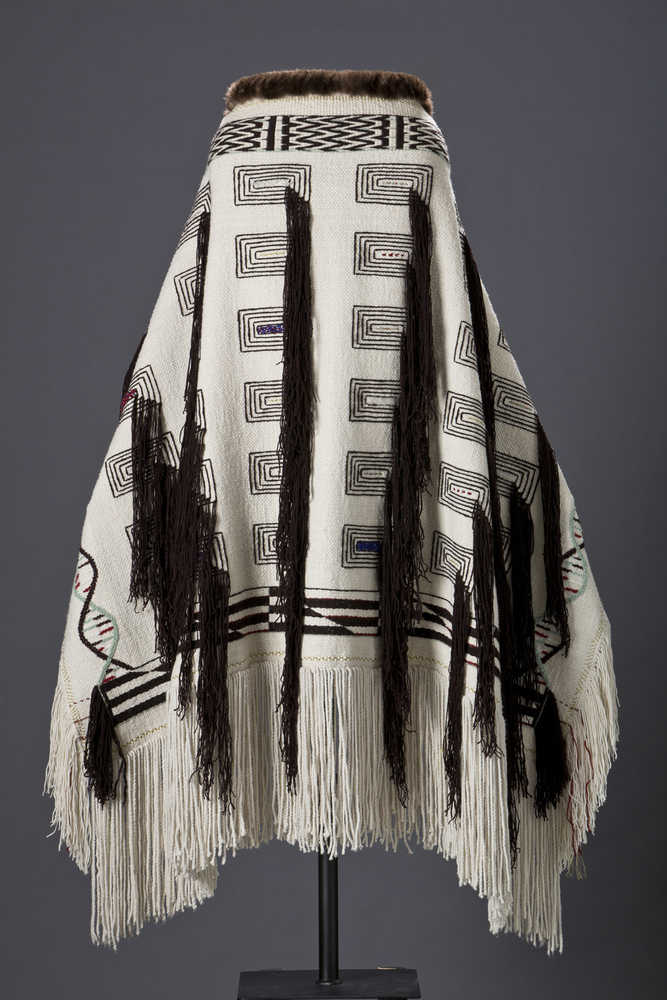
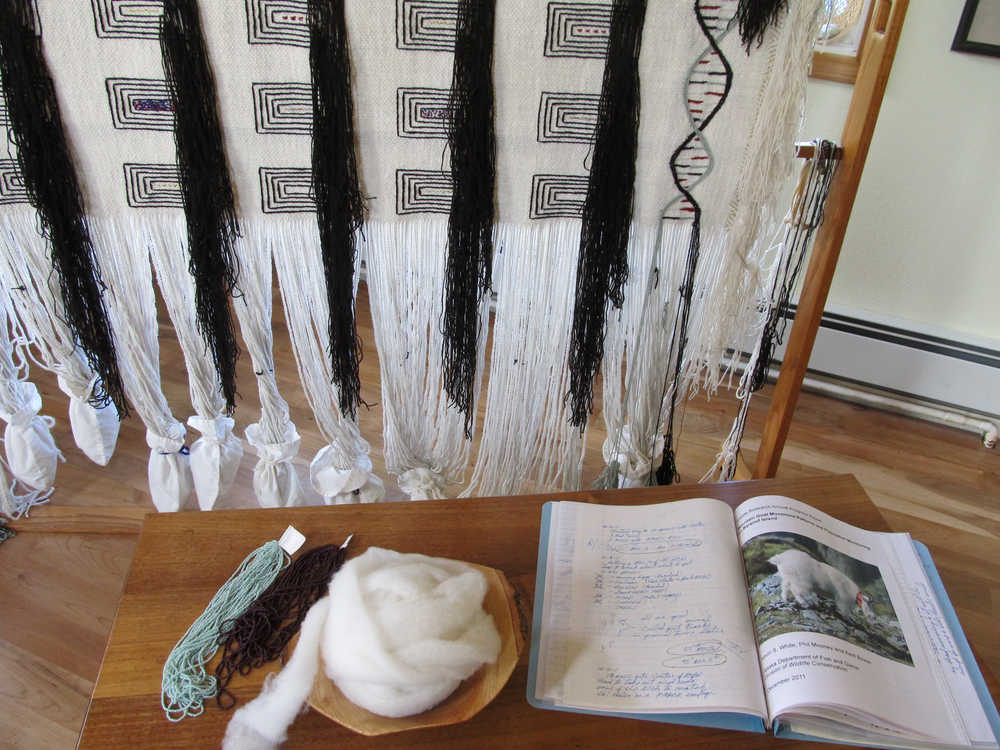
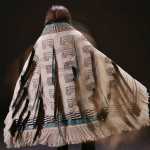
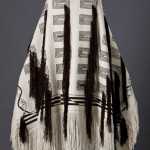
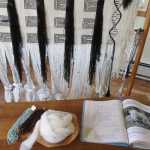
A current project, her “Tlingit Superman” series, is a prime example of that. She’s woven what she believes to be the first all mountain goat wool robe — and definitely the first all mountain goat Ravenstail robe — in more than 200 years, complete with double helix designs for DNA, to indicate Baranof Island’s unique mountain goat population. She’s also making a robe that lights up like the aurora. And she’s making a bulletproof robe, out of Kevlar.
“There are events … in our lives today that are of legendary proportions,” Rofkar said. “I’m trying to create pieces as quality as those (in museums), only telling our story today.”
Rofkar’s all mountain goat wool robe is the first in her “Tlingit Superman” series, funded by a grant from Creative Capital.
“I wanted to ground it in absolutely traditional materials,” she said.
Next up, she’s looking for a contractor to help her with a robe into which she’ll be incorporating LEDs and fiber optics.
“Spruce roots and mountain goat were cutting edge 6,000 years ago,” she said. “But if I want Tlingit weaving to be relevant 6,000 years from now, I’m going to need modern materials.”
The new elements will look like an aurora when the wearer dances, she said. Images of pink and green will cycle through the body of the robe, complete with constellations.
“I’m using the traditional methodology for creating it even though I’m using modern materials, because I’m the one that’s passing through for a brief period of time,” she said. “I’m carrying this traditional art for a while; it’s going to go on beyond me.”
The third robe will be bulletproof. She’s using ballistic grade fibers and Kevlar to make it.
“I’m really sad that we have such a militarization of our homeland,” she said. “We still think of it as our homeland, the Native peoples of this country.”
Rofkar has been weaving professionally since 1986, and one of the aspects of traditional weaving that most impresses her is the math and science embedded in it. Ravenstail weaving is essentially binary code, she said. (Binary code is a data-encoding system used by computers.)
Nevertheless, both spruce root basket weaving and Ravenstail weaving, traditionally women’s arts, are endangered.
“I don’t see the women’s arts held up in any of the institutes that are purchasing and highlighting Native art anymore,” she said.
Rofkar said historically, she knows of only 11 purely Ravenstail robes in the world.
Rofkar’s sister Shelly Laws, who weaves in the Chilkat style, says weaving in that style is “like painting with wool,” Rofkar said. It allows the weaver to create eagles, ravens, killer whales. Ravenstail, in contrast, is “very geometric — very mathematical. Much like the basketry. Once I decide on a design, it’s dictated by mathematical formulas and the rhythm in the design itself,” she said. “It’s absolutely binary code. Basketry is, as well.”
These works of art are also “the original data storage devices,” paired with oral histories of the people that made them, she said.
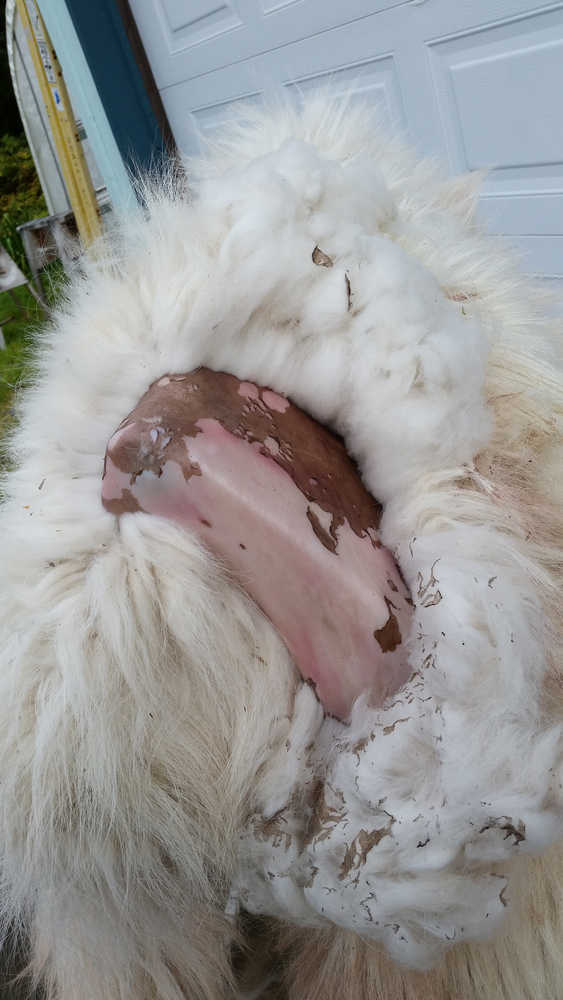
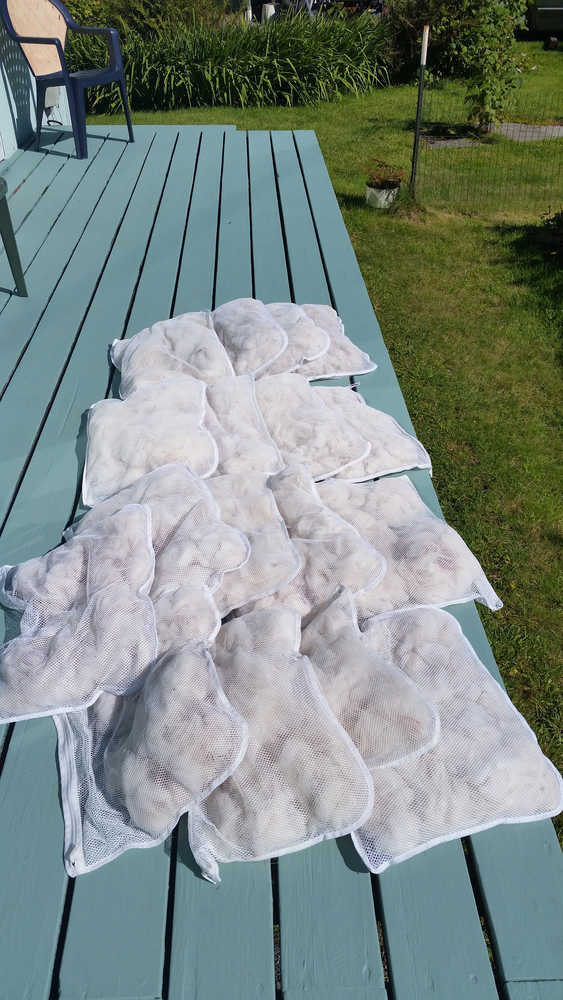
Rofkar and Native weavers traditionally use mountain goat wool to weave their robes. They face a modern-day problem, though: traditionally, Tlingits harvested a few billy goats in the spring, when their wool is beginning to detach.
“It’s a really great example of our intimate relationship with place,” she said. “They would just take a few goats, which would feed a village pretty well. All this wool, you could use. You could just comb it right out of the hide. The guard hairs stay attached.”
Mountain goat season now tends to be late summer, fall, and early winter. At the beginning of the season, the goats don’t even have any wool. Even if a hunter harvests a goat in December, near the end of the season, the goats are “very attached to their wool” that time of year, Rofkar said, making for a lot of work.
Many weavers incorporate merino wool, as the closest approximation. It’s for that reason — and because by the early 1800s, Tlingits were trading for cloth and wool yarn — that Rofkar thinks her all mountain goat robe is the first in so long.
“If we’re going to rejuvenate these arts and really renew a relationship with the place we live, we need to start working with mountain goat wool again,” she said.
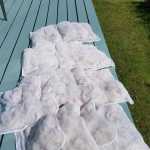
She does manage to find some wool – people will send her wool they find while hiking, or at kill sites. ADF&G Wildlife Research Biologist Kevin White helps weavers across Southeast access this traditional resource when he inspects mortality sites. Frequently, goats die during the winter, when they have wool.
“It’s a great opportunity for us to collect wool, and give it to Teri or other weavers here in Juneau,” he said.
He recommends those that come across wool while hiking collect it to give to a weaver who can use it.
Rofkar frequently ends up giving hers to her students at the University of Alaska Southeast-Sitka, where she teaches a weaving class.
When it comes to animals, Rofkar prefers the term “relationship” to “resource.”
“’Resource’ is such an economic term,” she said. “It becomes an equation rather than a living, valued being.”
She’s also working on creating a 3D-printed puffin beak. The birds shed the colorful outer part of their beaks after the breeding season. Those beaks were a common part of regalia, but Native peoples aren’t allowed to collect them now.
She may have difficulty acquiring the same materials used traditionally, but no matter the medium, Rofkar’s robes tell a story. Another prime example of Rofkar’s modern-day story-telling is her Lituya Bay robe, which now belongs to her daughter.
Lituya Bay, located 99 miles southeast of Yakutat, is the farthest back Rofkar, who is Tak’dein taan — a Raven from the Snail house — can trace her family history. Her uncle was also in Lituya Bay during the 1958 earthquake that created a tsunami in the bay.
The robe documents that earthquake, with a fault line running throughout it. And on the sides, to scale, is a pattern that turns to white space where the mountains that shape the bay lost their trees.
In 2010, Rofkar went to St. Petersburg, Russia to see some Ravenstail robes. The curator pulled her aside to tell her the robes were collected in 1788 in Lituya Bay.
She’d woven her own Lituya Bay robe years before that.
“It was just such a moving experience,” she said. “I called (my mom) up from Russia and said ‘Mom, they are our grandmother’s robes.’”
Now, she appreciates each robe or basket she creates even more. Shortly after receiving her grant for “Tlingit Superman,” Rofkar was diagnosed with aggressive breast cancer. She fought it for two years and marks one year cancer-free in November.
“I’m glad to be here,” she said. “There is a joy, that I get to be here every day… it has allowed me that focus of what’s important.”
•••
Rofkar’s weavings have been exhibited at the Alaska Native Heritage Center in Anchorage, the Denver Art Museum, the Museum of the North in Fairbanks, the Peabody Essex Museum in Massachusetts, the Field Museum in Chicago, and the Smithsonian’s National Museum of the American Indian in Washington, D.C., among others.
Her honors include recognition as a National Heritage Fellow “Living Treasure” by the National Endowment of the Arts in 2009, Rasmuson’s Distinguished Artist of the Year award in 2013, a Governor’s Award for Alaska Native Art in 2004, and the Native Arts and Cultures Foundation Traditional Arts Fellowship in 2013.
• Contact Capital City Weekly staff writer Mary Catharine Martin at maryc.martin@capweek.com.